
Fusion Fuel Green PLC: Expansion Ambitions Confront Tight Liquidity and Execution Risks in the Green Hydrogen Buildout
The company’s ability to translate project wins and geographic diversification into sustainable financial performance will determine its resilience in a capital-intensive, rapidly evolving sector.
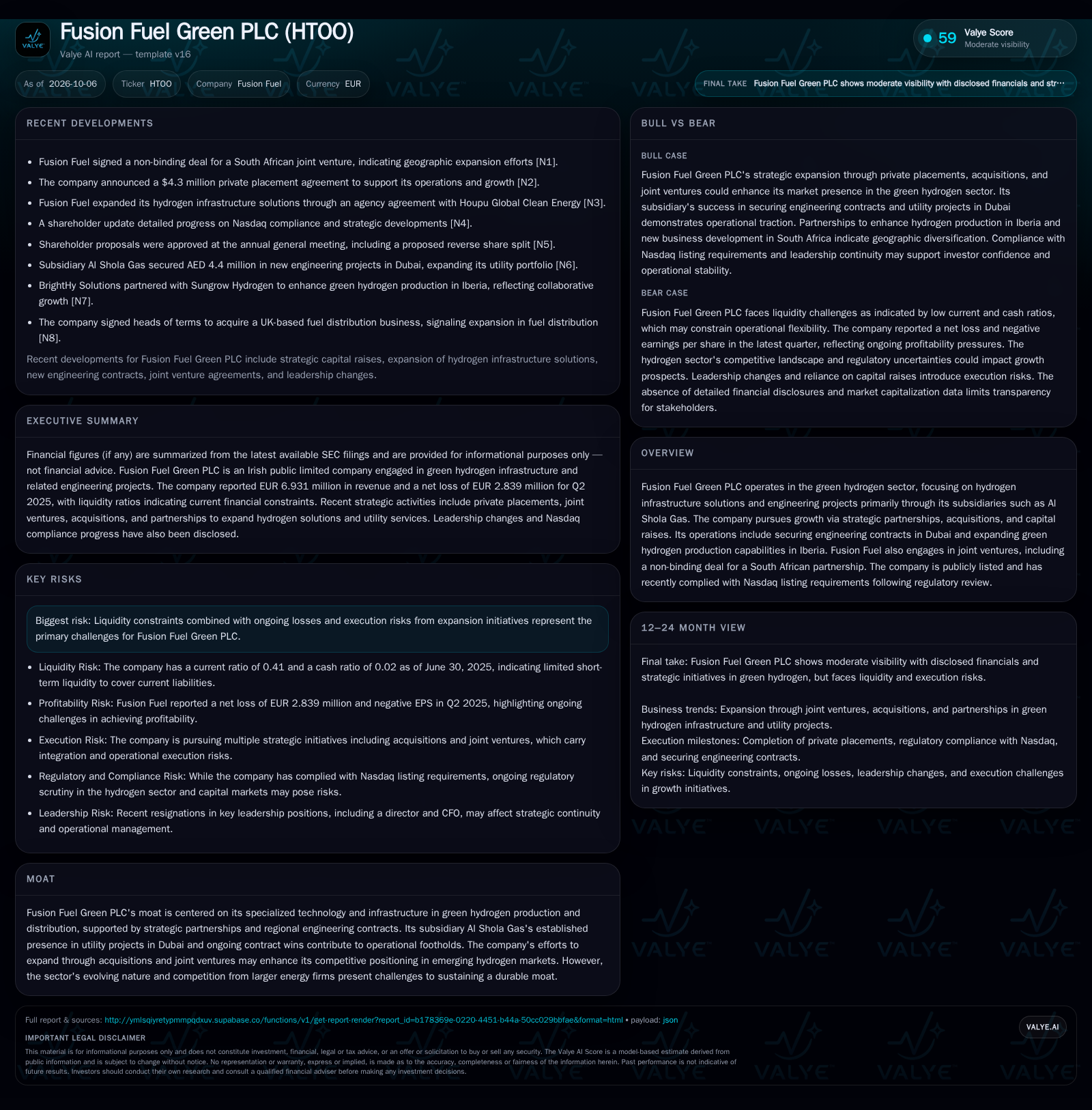
The company is advancing expansion through a $4.3 million private placement, new engineering contracts in Dubai, a non-binding South African joint venture, and plans to acquire a UK fuel distributor. Execution risk remains high as the company juggles growth initiatives and regulatory compliance amid leadership turnover. Its long-term viability hinges on converting its project pipeline and geographic reach into real, recurring cash flows while managing financial pressures. [S1] [N1] [N2] [N6] [N8]
Fusion Fuel Green PLC is at a strategic inflection point as it seeks to scale its green hydrogen footprint across new regions and business lines. The company’s ambitious push—evidenced by fresh engineering wins, geographic expansion, and M&A activity—contrasts sharply with acute near-term liquidity pressures and ongoing operating losses. The coming quarters will test whether its deal pipeline and asset-light partnerships can offset the sector’s capital demands and mounting competitive pressures. [S1] [N1] [N2] [N6] [N8]
Liquidity Strain and Expansion Moves Define the Current Picture
Fusion Fuel Green PLC reported revenue of EUR 6.931 million and a net loss of EUR 2.839 million for the quarter ended June 30, 2025, indicating that the company remains in a loss-making phase. The company reported cash and liquidity metrics for the period; these figures do not by themselves establish operating runway, investment capacity, financial flexibility, or financing capacity. [S1]
Despite these pressures, the company is pursuing multiple growth initiatives: a $4.3 million private placement to bolster funding, a non-binding agreement for a South African joint venture, and the signing of heads of terms to acquire a UK-based fuel distribution business. The Dubai-based subsidiary, Al Shola Gas, has secured AED 4.4 million in new engineering projects, expanding its utility services portfolio. These moves indicate a strategy focused on both geographic and vertical expansion, but execution and funding risks remain acute. [N1] [N2] [N6] [N8]
The interplay between liquidity constraints and aggressive expansion efforts creates a complex dynamic that Fusion Fuel must navigate carefully. While the private placement and joint ventures provide capital and market access, the timing and scale of these initiatives relative to cash burn rates are critical. If capital inflows lag behind operational expenditures, the company may face intensified pressure to prioritize short-term survival over strategic growth. Conversely, well-timed capital injections aligned with project milestones could enable Fusion Fuel to leverage its expanded footprint and engineering capabilities more effectively, enhancing its negotiating position with suppliers and customers alike.
How Fusion Fuel’s Business Model Could Scale—And Where It May Stumble
Fusion Fuel’s revenue streams are currently anchored in engineering contracts and hydrogen infrastructure solutions, primarily via its Al Shola Gas subsidiary and direct project development. Contract wins in Dubai and planned expansion into South Africa and the UK suggest a mix of project-based and recurring service revenue. However, the company’s ability to achieve operating leverage is hampered by the capital-intensive nature of green hydrogen infrastructure, which typically involves high upfront investment and long payback periods.
This dependency increases vulnerability to market and execution shocks. If the company can convert its growing project pipeline into recurring, higher-margin service or infrastructure revenue, it may gradually improve gross margins and cash flow. However, if contract wins remain predominantly one-off engineering projects, the path to profitability and self-sustaining cash generation will remain elusive.
Achieving operating leverage in a capital-intensive sector like green hydrogen often depends on the ability to standardize technology deployment and reduce per-unit costs through scale. Fusion Fuel’s asset-light model, relying on partnerships and project-based contracts, may limit its capacity to capture these economies fully unless it can develop proprietary, scalable solutions that differentiate its offerings. Additionally, the company’s risk profile is influenced by the regulatory environments in its target markets; favorable policies supporting green hydrogen adoption could accelerate project approvals and revenue recognition, whereas regulatory uncertainty or delays could extend payback periods and strain liquidity further.
Specialized Technology and Partnerships Versus Scale and Capital of Larger Players
Fusion Fuel positions itself as a specialist in green hydrogen production solutions, leveraging proprietary technology and regional partnerships. Its ability to secure contracts in Dubai and form alliances in Iberia and South Africa suggests some technical credibility and local relationship-building capacity. However, the global green hydrogen market is attracting much larger energy and industrial players with deeper balance sheets, established customer relationships, and integrated supply chains.
Fusion Fuel’s competitive edge may rest on agility, project localization, and the ability to deliver bespoke solutions in emerging markets. Yet, the absence of clear recurring revenue streams, customer lock-in, or network effects limits its defensibility. The sector’s rapid technological evolution and potential for price competition from larger players or alternative hydrogen production pathways (such as blue hydrogen or electrolysis at scale) could further compress margins and threaten long-term differentiation.
If Project Pipeline Converts to Recurring Revenue, a Path to Financial Stability Emerges
A favorable scenario unfolds if Fusion Fuel successfully executes and monetizes its announced engineering contracts, JV expansions, and acquisition targets. If the company can shift from project-based revenue to more stable, recurring revenue—such as long-term hydrogen supply agreements or utility-like service contracts—it could achieve greater margin stability and gradually reduce reliance on external capital.
Evidence confirming this scenario would include multi-year service or hydrogen offtake agreements, a growing backlog of contracted revenue, and a shift toward positive operating cash flow. Additional signs would be successful integration of the UK fuel distributor, expansion of the Dubai utility portfolio, and new joint ventures translating into concrete financial contributions. Reduced quarterly losses and improving liquidity metrics would further validate this trajectory.
If Fusion Fuel can secure long-term contracts that embed hydrogen supply into customer operations, it may create a more predictable revenue stream that supports reinvestment and debt servicing. Such contracts often involve performance guarantees or volume commitments that reduce revenue volatility and enhance creditworthiness. Moreover, successful integration of acquisitions and joint ventures could unlock cross-selling opportunities and operational synergies, driving margin expansion. However, this scenario depends on the company’s ability to manage integration complexity and maintain service quality, as failure to do so could erode customer trust and diminish competitive positioning.
Expansion Continues, but Profitability and Liquidity Remain Under Pressure
The most plausible near-term outcome is that Fusion Fuel continues to secure new contracts and partnerships, gradually expanding its geographic and operational reach. However, the capital intensity of the hydrogen sector, combined with the company’s limited financial resources, likely means that losses persist and additional capital raises are required.
This scenario is confirmed if Fusion Fuel announces more engineering or infrastructure contracts without a commensurate improvement in operating margins or cash flow. Continued leadership turnover or delays in project execution would also reinforce the base case.
In a scenario where expansion proceeds without corresponding margin improvement, Fusion Fuel may face a protracted period of negative cash flow, necessitating repeated capital raises that dilute existing shareholders. The company’s ability to optimize working capital and control overhead costs will be pivotal in managing this risk. Furthermore, ongoing leadership changes could disrupt strategic continuity and operational execution, impeding the company’s responsiveness to market shifts. The persistence of these challenges might constrain Fusion Fuel’s capacity to capitalize on emerging market opportunities or respond effectively to competitive pressures.
Funding Shortfall or Execution Missteps Could Force Strategic Retrenchment
If Fusion Fuel fails to close additional funding or cannot convert its project pipeline into cash-generating operations quickly, the company could face a liquidity crisis. Acute cash constraints may lead to project delays, inability to meet contractual obligations, or forced asset sales. Execution missteps—such as failed integrations, regulatory setbacks, or customer defaults—would further erode confidence.
Confirmation of this scenario would include missed payments, project cancellations, covenant breaches, or urgent dilutive financings. Leadership instability or regulatory non-compliance could accelerate downside risks. Conversely, a successful, non-dilutive capital infusion or unexpected margin improvement would challenge this negative case.
What Will Determine Whether Fusion Fuel’s Expansion Pays Off?
Conversion rate of announced project wins (Dubai, South Africa, UK) into recognized revenue and positive cash flow. A useful metric would be project backlog or contractually secured future revenue, if disclosed.
Evidence of recurring or multi-year service agreements rather than one-off engineering contracts. Disclosure of offtake contracts or long-term utility deals would help test the path to margin stability.
Gross margin trends across engineering and infrastructure segments—do margins improve as the business mix evolves?
Pace and cost of capital raising—does Fusion Fuel secure funding on favorable terms, or are new financings increasingly dilutive or expensive?
Leadership continuity and depth—does the company stabilize its executive ranks following recent resignations, or does turnover persist?
Regulatory compliance status—does Fusion Fuel maintain Nasdaq compliance and meet local regulatory requirements in new markets?
Integration and performance of acquired businesses, such as the planned UK fuel distributor—does the acquisition contribute to revenue growth and operational leverage, or introduce new risks?
Disclaimer: This is research-only, informational analysis and not investment advice. It may include AI-generated interpretation and general industry context. Always verify important details using primary sources.

Comments