
Mag Magna Corp: From Poultry Consulting to Rare Earth Aspirations—A High-Risk Pivot at the Pre-Exploration Stage
After a sweeping business model shift and a pair of mineral rights acquisitions, Mag Magna Corp stands at a crossroads: facing immediate capital shortfalls, unproven mining assets, and the operational complexity of pursuing both rare earth minerals and poultry technology. The company’s future now hinges on its ability to fund and execute exploration, secure permits, and integrate disparate ventures—amid a lack of revenue and substantial net losses.
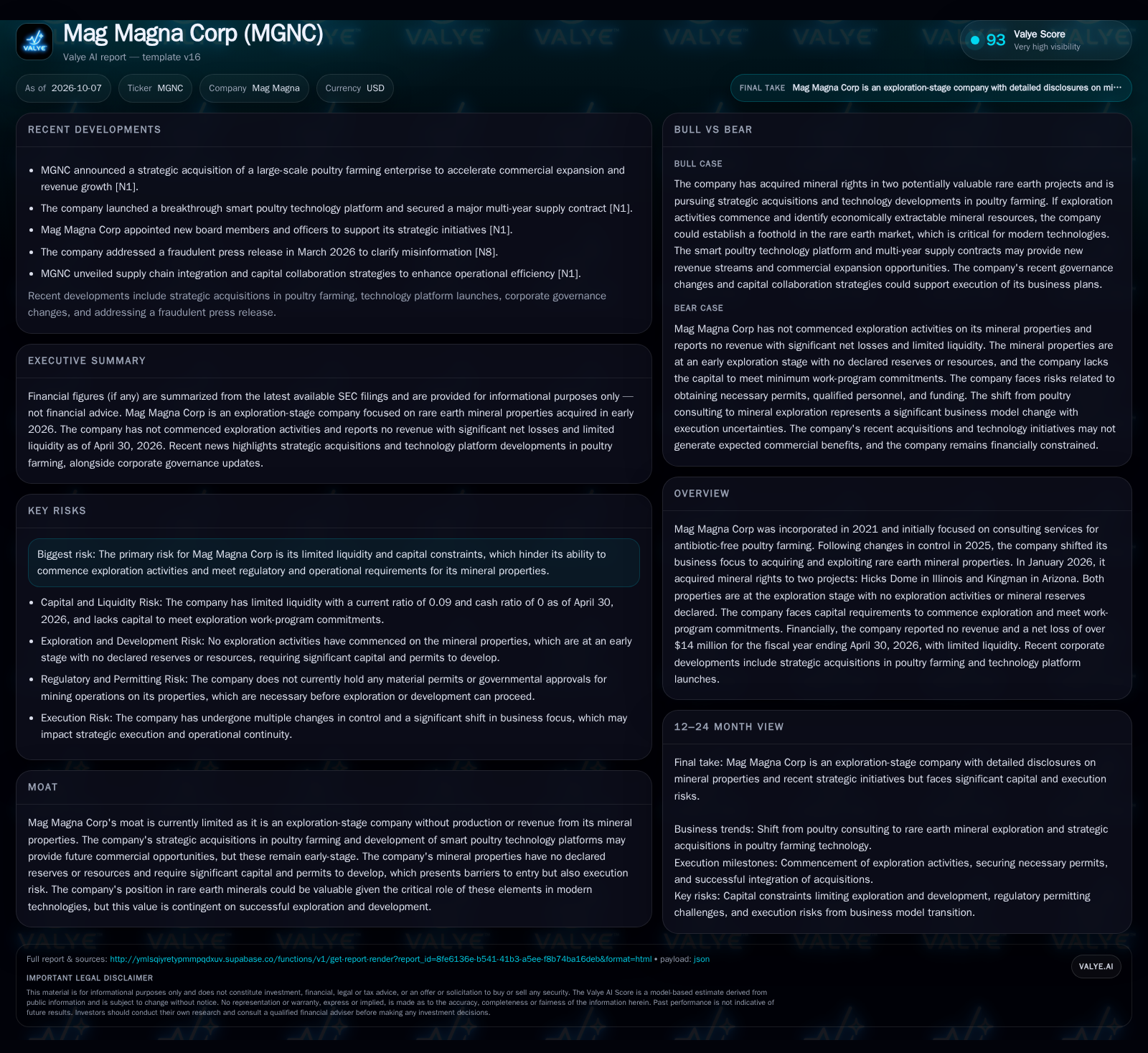
Mag Magna Corp has pivoted from poultry consulting to rare earth exploration, acquiring mineral rights in Illinois and Arizona, but has yet to start any exploration or declare resources. Its future depends on securing financing, commencing exploration, and realizing value from both mining and poultry technology initiatives. [S1]
Despite acquiring mineral rights to projects in Illinois and Arizona, the company remains at a pre-exploration stage—without technical validation, production, or revenue. Meanwhile, its diversification into poultry technology and a recent farming acquisition add layers of operational complexity. [S1]
A Company in Flux: Capital Scarcity, New Mineral Assets, and Unproven Ventures
Mag Magna Corp’s most material current facts center on a radical business transformation and a precarious financial position. In December 2025, the company changed control and shifted from poultry consulting to rare earth mineral acquisition and exploitation. By January 2026, it had acquired mineral rights to 21 parcels in Illinois (Hicks Dome Project) and 3 mining claims in Arizona (Kingman Project), recognizing $1.9 million in mining assets. Despite these moves, both projects are still at the exploration stage—no exploration has begun, no reserves or resources are declared, and no technical reports have been prepared. [S1]
Financially, Mag Magna reported a net loss of $14.7 million and no revenue for the fiscal year ending April 30, 2026. Its liquidity is extremely limited, with a current ratio of 0.09 and cash ratio of zero. The company faces minimum work-program commitments of $100,000 in 2026 and $200,000 in 2027, but does not currently have the capital to meet these obligations. [S1]
Recent news introduces further complexity: Mag Magna announced a large-scale poultry farming acquisition, a smart poultry technology platform tied to a multi-year supply contract, and governance changes. These developments suggest a hybrid strategy that spans both mineral exploration and agri-tech, but with no current revenue, the commercial viability of either line remains unproven. [S1]
How Value Could Be Created—And the Economics of Early-Stage Exploration
At present, Mag Magna’s economic engine is aspirational: there is no revenue from mining or poultry operations, and costs are dominated by overhead, acquisition, and administrative expenses. The core mining assets (Hicks Dome and Kingman) are at the pre-exploration stage, with no proven resources. This means the company’s value proposition depends entirely on future exploration success, which is inherently high risk and capital intensive.
For rare earth exploration, initial capital outlays are required for geological surveys, permitting, and drilling. These are largely fixed costs, with only modest variable costs until (and unless) a resource is delineated. If exploration is successful, the economics shift dramatically: rare earth deposits, if proven and permitted, can command premium pricing due to their strategic importance (e.g., neodymium-praseodymium magnets for electronics and EVs). However, the upfront investment is substantial, and the timeline from exploration to commercial production is typically measured in years.
The company’s poultry technology and farming acquisition suggest a parallel effort to generate nearer-term commercial returns. If the technology platform and supply contract deliver, this segment could provide incremental cash flow and diversify risk. However, the economics of integrating agri-tech with mining are untested, and commercial mechanics—such as contract structure, pricing, and margin—are undisclosed. The question is whether either segment can reach scale before liquidity needs force dilutive financing or asset sales.
Assessing Barriers and Counterforces in Rare Earths and Agri-Tech
In rare earths, Mag Magna enters a sector dominated by established players with capital, technical expertise, and multi-year project pipelines. Barriers to entry are high: exploration and permitting are costly, regulatory scrutiny is intense, and supply chains are often vertically integrated. The company’s lack of declared resources, technical reports, or exploration activity makes it a speculative entrant rather than a true competitor at present.
If Mag Magna can prove up a resource and secure permits, the underlying market offers structural tailwinds: rare earths are critical for defense, electronics, and renewable energy, and supply security is a national priority for many governments. However, major mining companies, specialist juniors, and foreign state-backed entities all compete for quality deposits, and buyers may prefer suppliers with reliable production history.
In poultry technology, the company faces established agri-tech platforms, equipment manufacturers, and consulting firms. The recent supply contract could signal early traction, but without details on contract terms, recurring revenue, or customer retention, it is impossible to assess the durability of any competitive advantage. There is no evidence yet of scale, proprietary technology, or switching costs that would confer defensibility in either segment.
What a Breakout Would Look Like: From Exploration Success to Commercial Traction
A favorable scenario for Mag Magna hinges on two parallel breakthroughs. First, the company raises sufficient capital—through equity, debt, or strategic partnerships—to fund its minimum work commitments and commence exploration. Early drilling at Hicks Dome or Kingman identifies promising mineralization, leading to a technical report and a maiden resource declaration. This, in turn, attracts further investment, strategic partners, or off-take agreements, validating the potential of the rare earth assets.
Meanwhile, the smart poultry technology platform gains commercial traction: the multi-year supply contract is executed successfully, generating initial revenue and providing a cash bridge while mining projects mature. Positive customer outcomes and additional contracts expand this segment, giving Mag Magna a diversified revenue base.
Evidence confirming this scenario would include: announcements of completed exploration work, technical reports by qualified persons, resource declarations, new funding rounds, revenue recognition from supply contracts, and follow-on commercial agreements in poultry technology. A falsification would be failure to secure funding, lack of exploration progress, or delayed execution on the supply contract.
Stalled Progress Amid Capital Constraints and Execution Uncertainty
The most plausible middle path is that Mag Magna struggles to secure the necessary capital to execute its multi-pronged strategy. Exploration on the mineral properties is delayed or limited in scope, with no meaningful technical progress or resource declaration in the near term.
On the poultry technology front, the company may achieve limited commercial milestones—perhaps initial revenue from the supply contract—but lacks the scale, operational resources, or market positioning to drive rapid expansion. Overhead costs and integration challenges from the recent farming acquisition dilute any near-term profitability.
Confirmation of this scenario would include: repeated financing disclosures, slow or incremental exploration updates, minimal or one-off revenue recognition, and continued net losses. Falsifying evidence would require a step-change in exploration activity, significant new capital raised, or rapid revenue growth in the poultry or mining segments.
Liquidity Exhaustion and Strategic Drift: How the Thesis Could Collapse
The adverse case sees Mag Magna unable to raise sufficient funds to meet its minimum work commitments or operational needs. Without exploration progress or revenue from poultry technology, the company is forced to delay projects, default on commitments, or sell assets at distressed valuations. The lack of technical validation for the mining assets means they cannot be monetized at attractive terms, and the company’s credibility is further undermined by its rapid business-model shifts.
In this scenario, overhead and administrative costs consume remaining resources, and the company faces regulatory or legal challenges from unfulfilled work programs or contractual obligations. Shareholder value is eroded through dilutive financings, asset impairment, or even delisting if financial distress persists.
This scenario would be confirmed by: repeated going-concern warnings, missed work-program deadlines, no progress on exploration or revenue, and evidence of forced asset sales or emergency financings. A reversal would require an unexpected capital infusion, discovery, or commercial breakthrough.
Milestones That Will Decide If Mag Magna’s Pivot Can Succeed
Completion and public disclosure of technical reports or resource estimates for either Hicks Dome or Kingman Project—if disclosed—would be a decisive signal of exploration progress and asset validation.
Announcements of successful capital raises (equity, debt, or strategic investment) sufficient to fund minimum work commitments and operational needs are essential for continued viability.
Evidence of actual exploration activity commencement—such as drilling permits secured, contractors hired, or fieldwork underway—would help test the company’s ability to execute on its mining ambitions.
Revenue recognition from the smart poultry technology platform’s multi-year supply contract, with details on contract structure and margin, would clarify the potential of this business line.
Integration milestones and operational updates from the recently acquired poultry farming enterprise, including any realized synergies or cost savings, would help assess execution capability.
Disclosure of additional commercial contracts, partnerships, or customer wins in either mining or poultry segments would indicate traction beyond initial announcements.
Any regulatory developments, permitting progress, or government engagement related to mining activities would materially affect the timeline and feasibility of asset development.
If disclosed, updates on working capital and liquidity management strategies (such as bridge financing or asset sales) would be crucial for understanding near-term solvency risk.
Disclaimer: This is research-only, informational analysis and not investment advice. It may include AI-generated interpretation and general industry context. Always verify important details using primary sources.

Comments