
Costco’s Value Moat Deepens: Membership, Private Label, and Digital Scale in a Shifting Retail Landscape
With over 84 million paid members, a surging e-commerce platform, and strategic price cuts on Kirkland Signature products, Costco is doubling down on its core value proposition. The challenge: sustaining growth and defending share as retail competition intensifies and macro headwinds loom.
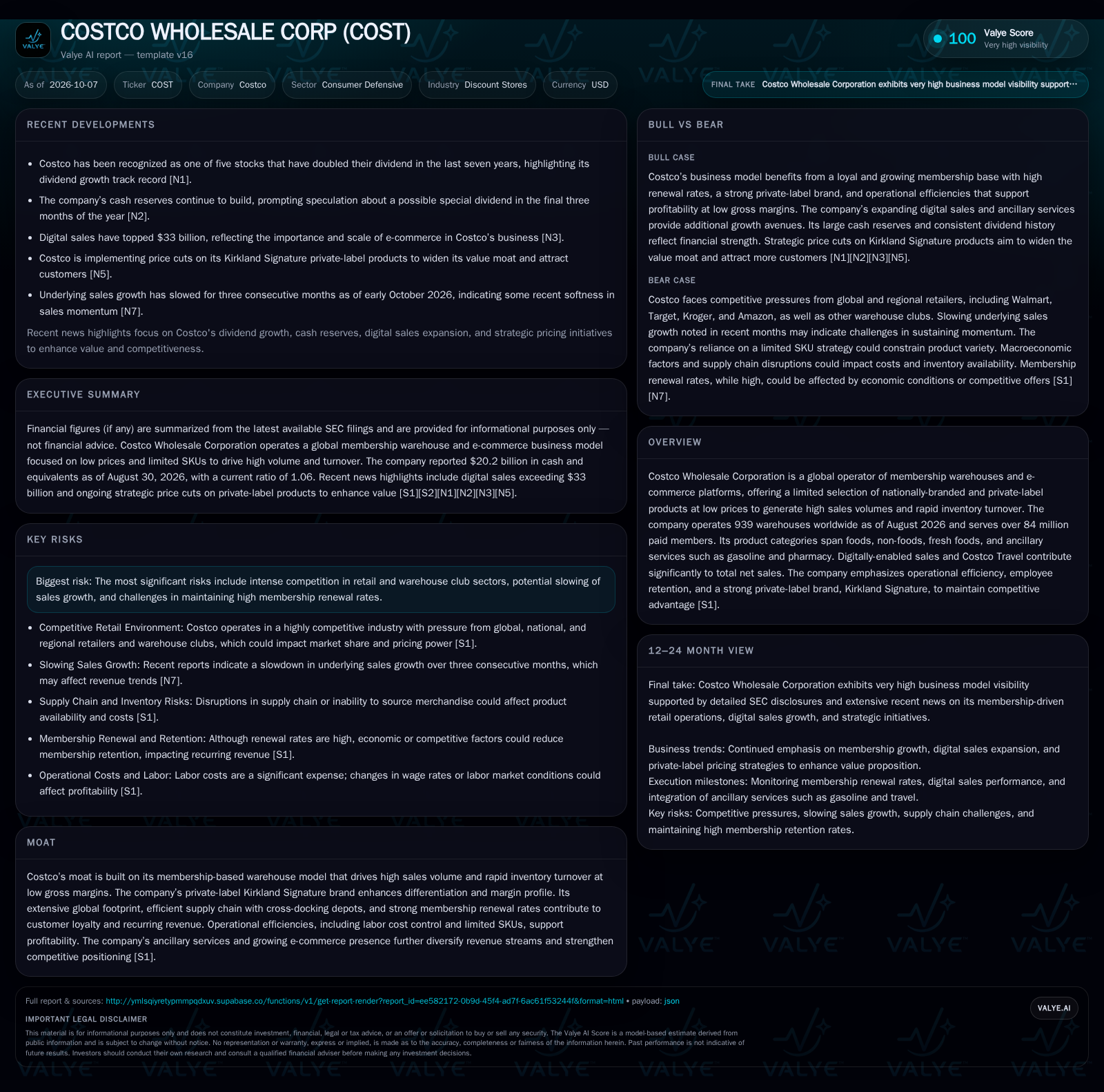
Costco continues to leverage its membership-driven business model, with renewal rates near record highs, while digital sales surpass $33 billion. Strategic price reductions on Kirkland Signature products aim to reinforce Costco’s differentiation as competition from both traditional and digital-first retailers intensifies. The company’s sizable cash reserves are fueling speculation about shareholder returns, but the key test remains sustaining high renewal rates and digital momentum in a maturing global footprint. [S1] [N2] [N3] [N5]
Costco’s distinctive membership warehouse model—anchored by high renewal rates, a curated SKU selection, and the Kirkland Signature private label—continues to set it apart in a crowded global retail market. As digital channels account for a growing share of sales and the company doubles down on value via product price cuts, the key question is whether Costco can maintain this momentum as competition intensifies, consumer preferences shift, and its global expansion matures. The evolving interplay between membership economics, digital scale, and operational discipline will shape Costco’s next phase.
Membership Scale, Digital Growth, and Strategic Pricing: The 2026 Snapshot
As of August 2026, Costco operated 939 warehouses worldwide, serving 84.1 million paid members and 150.4 million total cardholders—a testament to the scale and global reach of its membership model [S1]. Membership renewal rates stood at 92.3% in the U.S. and Canada and 89.8% globally, underscoring the stickiness of its value proposition [S1]. Digital channels, including e-commerce and Costco Travel, now represent 11% of total net sales, with digital sales surpassing $33 billion [S1] [N3]. In a bid to widen its value moat, Costco is cutting prices on Kirkland Signature products, solidifying its reputation for value and differentiation [N5]. The company reported cash and liquidity metrics for the period; these figures do not by themselves establish operating runway, investment capacity, financial flexibility, or financing capacity. [S1] [N2]
How Costco’s Economics Work: Membership, Margin Discipline, and Volume Leverage
Costco’s business model is fundamentally anchored in recurring membership fees, which provide a stable and predictable revenue stream insulated from short-term fluctuations in retail sales. These fees contribute disproportionately to operating income relative to their share of total revenue, enabling Costco to operate with gross margins significantly below industry norms. The company’s limited SKU strategy—less than 4,000 active items per warehouse—drives high inventory turnover and purchasing power, supporting further price reductions and reinforcing its value proposition [S1].
Operating leverage is achieved through high fixed-cost absorption at scale: large-format warehouses, centralized logistics, and a lean labor model (with 95% of employees in warehouses/distribution) allow Costco to maintain efficiency as volume grows [S1]. Ancillary services—gasoline, pharmacy, optical, food court, and travel—diversify revenue and draw traffic, but most are margin-thin and serve as value enhancers rather than profit centers. E-commerce introduces incremental variable costs (shipping, fulfillment), but digital scale may offset these via higher average transaction sizes and cross-selling.
Capital needs are relatively modest for an operator of Costco’s scale, as the company finances expansion and operations primarily through cash flow, with a current ratio of 1.06 and cash and equivalents of $20.2 billion [S1]. The cited source reports dividend-related activity; that disclosure alone does not establish dividend-policy continuity, management confidence, or a material constraint on capital flexibility.
Defending the Value Moat: Private Label, Digital Expansion, and Retail Counterforces
Costco’s competitive positioning revolves around its membership-driven model, private-label strength, and relentless focus on value. The Kirkland Signature brand is a key differentiator, enabling Costco to offer quality at lower prices and maintain some margin insulation from branded suppliers [S1]. High renewal rates and a loyal member base create switching frictions, but these are not absolute—price-sensitive shoppers can be tempted by aggressive promotions or convenience from competitors.
Major competitive threats stem from a diverse set of players: warehouse clubs (Sam’s Club, BJ’s), mass merchants (Walmart, Target), supermarkets, and pure-play e-commerce (Amazon). Each category can attack different Costco strengths: mass merchants on breadth/convenience, digital players on speed and selection, and warehouse clubs on price and local presence.
Digital expansion is both an opportunity and a risk. While e-commerce and digitally-enabled sales now account for 11% of revenue [S1], pure-play online retailers may offer broader selection, faster delivery, or deeper personalization. Costco’s challenge is to translate its in-warehouse value proposition to digital channels without eroding margin discipline or diluting the membership value. The company’s operational efficiency, global footprint, and supply-chain scale provide defenses, but the competitive landscape is dynamic and increasingly digital.
If Membership and Digital Synergies Accelerate: Pathways to Outperformance
The most favorable scenario for Costco is one in which high membership renewal rates persist or even improve, supported by ongoing investments in value (such as Kirkland Signature price cuts) and compelling digital offerings. If digital sales continue to scale (e.g., exceeding the current 11% of net sales) while retaining or improving margins, Costco could capture incremental share from both traditional and digital-first competitors [S1] [N3] [N5]. Ancillary services and international expansion could further diversify revenue streams.
Confirmation for this scenario would come from continued growth in paid Executive memberships (which drive a disproportionate share of sales), rising digital penetration without margin compression, and positive net new warehouse openings in high-growth international markets. Additional evidence would include stable or rising renewal rates and robust same-store sales growth, especially in digital and ancillary channels.
Falsification would be signaled by declining renewal rates, digital sales stalling or compressing margins, or evidence that price cuts on private label products materially erode profitability without driving corresponding volume gains.
Sustaining High Renewal Rates and Incremental Digital Gains: The Most Likely Course
The most plausible forward scenario is that Costco maintains its core strengths—high renewal rates, operational efficiency, and a compelling value proposition—while digital sales continue to grow incrementally, albeit at a slower pace as the channel matures. Membership growth may slow in more saturated markets, but international expansion and ancillary services provide ongoing opportunities.
This scenario would be confirmed by renewal rates remaining near current levels, digital sales as a percentage of net sales edging upward, and steady (if modest) warehouse expansion in select markets. Gross margins would remain stable, and the contribution of membership fees to operating income would continue to buffer overall profitability.
Falsification would involve a material drop in renewal rates, stagnation of digital sales, or margin compression that signals competitive or executional pressures are mounting.
Margin Compression and Membership Fatigue: Risks to Costco’s Economic Engine
The greatest risk to Costco is a combination of margin erosion and declining membership engagement. Intensifying competition—through aggressive discounting, digital convenience, or enhanced loyalty programs from rivals—could undermine the perceived value of membership, leading to reduced renewal rates and slower new member acquisition. If price cuts on private-label products fail to drive volume or are matched by competitors, Costco’s operating model could face pressure.
Confirmation of the downside would be visible in falling renewal rates (especially among Executive members), declining same-store sales, and negative trends in digital sales or ancillary service utilization. Margin compression, particularly if gross margins fall below historical norms without offsetting volume gains, would further signal that Costco’s value moat is under siege.
A useful falsification of a severe downside would be resilience in renewal rates and margins even as competitors step up their attacks, indicating that Costco’s core value proposition remains intact.
Milestones That Will Test Costco’s Membership and Digital Resilience
Membership renewal rates, both overall and specifically for Executive members, as a leading indicator of value proposition stickiness and recurring revenue health.
Digital sales growth rate and digital share of total net sales, to gauge whether e-commerce and digitally-enabled channels are sustaining momentum or approaching saturation.
Gross margin trends, especially in the wake of Kirkland Signature price cuts, to assess whether value investments are driving volume or eroding profitability.
Net new warehouse openings by region, particularly in international markets, as a signal of continued expansion opportunity and market penetration.
Same-store sales growth, both in-warehouse and digital (if disclosed), to monitor underlying demand and competitive positioning.
Ancillary service utilization rates (e.g., gasoline, pharmacy, optical, travel), as a barometer of traffic drivers and wallet share diversification.
Cash deployment decisions, especially any announcement of a special dividend or large-scale capital return, as a test of management’s capital allocation discipline.
Labor cost and retention metrics, given the importance of employee satisfaction and cost control to the operating model (if disclosed).
Disclaimer: This is research-only, informational analysis and not investment advice. It may include AI-generated interpretation and general industry context. Always verify important details using primary sources.

Comments