
Concentrix: AI Ambitions, Profitability Pressures, and the Stakes of Global CX Consolidation
Concentrix’s push into AI-powered CX solutions and global scale faces a critical profitability test as the industry consolidates, client expectations rise, and automation reshapes both value proposition and cost structure.
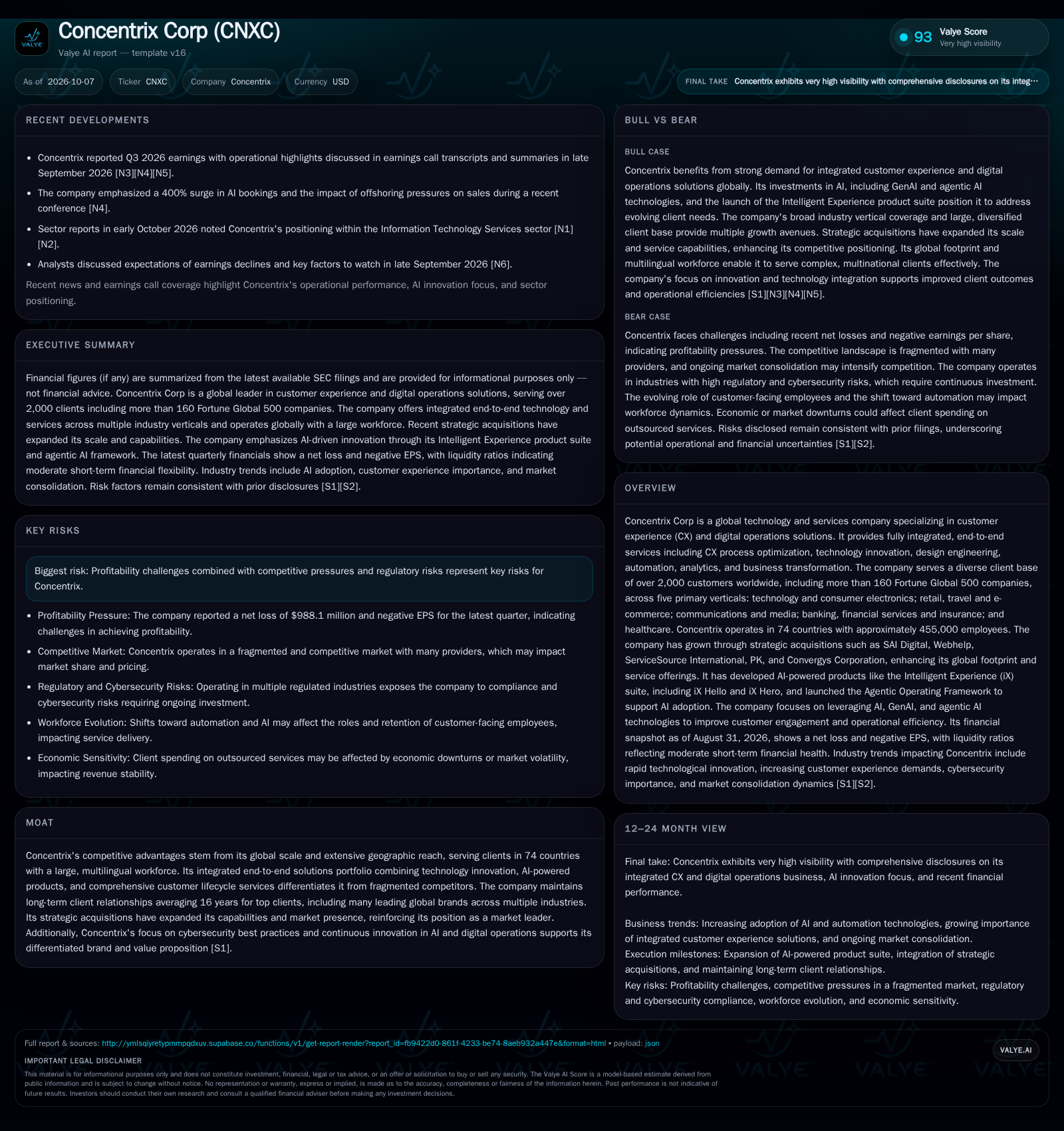
Concentrix is a leading global provider of customer experience (CX) and digital operations solutions, serving over 2,000 clients—including more than 160 Fortune Global 500 firms—across five major verticals. The company has invested heavily in AI, launching its Intelligent Experience (iX) suite and Agentic Operating Framework to drive operational efficiency and client outcomes. Despite these strategic moves and a history of acquisition-fueled growth, Concentrix reported a significant net loss of $988.1 million for the quarter ended August 31, 2026. The core thesis now hinges on whether Concentrix can translate technology and scale into sustainable margins amid intensifying competition, rapid automation, and evolving client demands. [S1] [S2]
Concentrix stands at a crossroads: it is a global leader in customer experience and digital operations, with deep enterprise relationships, a broad international footprint, and a clear strategy centered on AI-driven transformation. Yet, despite these assets and a history of growth-by-acquisition, the company has entered a period of acute profitability pressure, reporting a sizable net loss in its most recent quarter. The stakes are high: Concentrix must prove that its investments in AI, automation, and integrated CX platforms can deliver margin expansion and durable competitive advantage in a consolidating, fast-evolving industry. The next phase will hinge on execution—translating technology and scale into sustainable economics while navigating intensifying competition and shifting client priorities. [S1] [S2]
Recent Losses and AI Acceleration: What’s Shaping the Concentrix Narrative
Concentrix reported a net loss of $988.1 million and negative EPS of -$16.24 for the quarter ended August 31, 2026, marking a clear break from sustained profitability and putting near-term financial performance under scrutiny. [S2]
On the strategic front, Concentrix has doubled down on AI innovation, launching its Intelligent Experience (iX) suite—including GenAI-powered and agentic AI products—and unveiling the Agentic Operating Framework to help clients overcome barriers to AI adoption. [S1] These moves are designed to address both client demand for automation and the company’s own cost and efficiency goals.
Operationally, the company continues to serve over 2,000 clients, including more than 160 Fortune Global 500 companies, leveraging a workforce of 455,000 across 74 countries. [S1] This scale positions Concentrix as a key global player but also amplifies the complexity and cost base the company must manage.
How Concentrix’s Model Converts Scale and Technology Into Value—Or Risk
Concentrix’s business model is anchored by long-term relationships with large enterprise clients, with an average tenure of 16 years for its top 30 customers. [S1] Its integrated offering combines high-volume, people-intensive CX operations with increasingly technology-driven solutions such as automation, analytics, and AI-powered platforms.
Historically, the company’s growth-through-acquisition strategy has delivered scale and expanded service breadth, but it also introduces integration costs, amortization, and complexity that can compress margins—especially during periods of rapid industry change or economic headwinds.
AI and automation are structurally deflationary for traditional labor-intensive BPO services: as clients demand more automation and self-service, unit economics shift from labor to software. If Concentrix can successfully commercialize its iX suite and Agentic Operating Framework—by delivering AI-enabled services that clients value and by reducing its own delivery costs—margins could expand. However, the transition may require upfront investment and could risk cannibalizing legacy labor-based revenue streams.
The company’s financials reveal a tension: achieving operational leverage from technology investments is plausible, but the recent net loss suggests either cost overruns, acquisition integration drag, or slower-than-expected client adoption of higher-margin digital services.
Industry Fragmentation, Consolidation, and the Battle for CX Leadership
Concentrix operates in a fragmented and highly competitive global market for CX and digital operations services. Its primary competitors span traditional BPOs, IT services firms, and emerging digital/AI-native providers.
The company’s global scale, breadth of service offerings, and 74-country footprint create switching frictions for multinational clients—particularly those with complex, multilingual needs. Long-term relationships with major brands and a track record of integrating acquisitions (Webhelp, SAI Digital, ServiceSource, PK, Convergys) are sources of potential lock-in and cross-selling.
However, industry consolidation is accelerating. As clients pursue vendor rationalization and seek partners with both technology and operational depth, the competitive bar rises: scale alone is not enough if rivals can deliver more advanced or cost-effective AI-powered solutions. Technology substitution risk is real, as pure-play AI or automation-first competitors may undercut legacy models or leapfrog on innovation.
Concentrix’s ability to integrate AI as a core differentiator—not just a feature—will determine whether it can sustain pricing power and defend share against both established and insurgent rivals. The company’s focus on cybersecurity and compliance is also mission-critical, as breaches or regulatory failures could rapidly erode client trust and contract value.
AI Monetization and Margin Recovery: The Case for a Turnaround
The most constructive scenario is one where Concentrix successfully leverages its AI investments to drive both top-line growth and margin expansion. If enterprise clients increasingly adopt the iX suite and Agentic Operating Framework—not just for pilots but at scale—Concentrix could see higher-value client engagements, improved renewal rates, and reduced delivery costs.
A surge in AI-related bookings, as recently reported, could be an early indicator of this shift if it translates into recognized revenue and improved gross margins. [N4] Successful integration of recent acquisitions (notably SAI Digital and Webhelp) would further strengthen the company’s technology stack and consulting capabilities, supporting cross-sell and upsell opportunities.
Confirmation would come from sustained improvement in operating margins, positive EPS trends, and evidence of client wins tied specifically to AI-enabled offerings. A reduction in cost-to-serve—reflected in both SG&A and delivery expense lines—would further validate the thesis. Conversely, persistent losses, client churn, or lack of revenue uplift from AI products would falsify the upside scenario.
Integrated CX at Scale: Navigating Transformation With Measured Progress
The most plausible path is a measured recovery: Concentrix continues to grow its client base and expand digital/AI offerings, but the pace of margin improvement is gradual due to industry-wide pricing pressure, integration costs, and the complexity of shifting legacy clients to new solutions.
Financial performance stabilizes as cost synergies from acquisitions are realized and AI investments start to yield moderate productivity gains. However, competitive intensity and client bargaining power cap pricing, limiting rapid margin expansion. Revenue mix may gradually shift toward higher-value, technology-enabled services, but the legacy labor-based business could remain a drag on overall profitability.
Evidence supporting this scenario would include incremental improvement in net income, stable or slightly improving operating margins, and regular announcements of new AI-driven client contracts. If disclosed, a steady increase in the share of revenue from digital or automation-enabled services would further support the base case. Falsification would come from renewed losses, stalled client adoption of new solutions, or unexpected integration setbacks.
Margin Compression and Disruption: When Scale Becomes a Liability
In the adverse scenario, Concentrix’s large-scale, people-heavy delivery model becomes a source of vulnerability rather than strength. If AI and automation adoption outpaces the company’s ability to transform its own operations, clients may shift spend to nimbler, more cost-effective digital-native competitors.
Integration challenges from recent acquisitions could exacerbate cost overruns or dilute focus, while legacy contracts may be repriced or lost. Persistent net losses and lack of margin recovery could force Concentrix to curtail investment in innovation or trigger restructuring, damaging its brand and client relationships.
Confirmation of this scenario would come from ongoing negative EPS, declining renewal rates among major clients, visible layoffs or restructuring charges, and public indications of client defections to competitors. A useful warning sign would be stagnation or decline in AI-related revenue or bookings, especially if industry peers report outperformance.
Milestones That Will Determine If Concentrix’s AI Bet Pays Off
Quarterly operating margin and net income trends—especially any inflection from loss to profit or sustained margin expansion.
AI-related revenue and bookings growth, if disclosed, and the extent to which these translate into recognized revenue versus pilot or trial projects.
Client retention and renewal rates among the top 30 customers, which would indicate the stickiness of the integrated CX platform and switching frictions.
Integration progress and realized cost synergies from recent acquisitions (SAI Digital, Webhelp, ServiceSource), as reflected in SG&A and delivery expense trends.
Revenue mix evolution—specifically, the share of revenue from technology-enabled or automation-driven services (digital, analytics, AI-powered platforms) versus traditional BPO.
Public disclosures or third-party reports on major contract wins or losses, especially involving AI-enabled offerings.
Any material cybersecurity incidents, regulatory compliance failures, or associated cost impacts.
Trends in employee headcount and productivity metrics, which would help gauge the impact of automation and workforce transformation.
Disclaimer: This is research-only, informational analysis and not investment advice. It may include AI-generated interpretation and general industry context. Always verify important details using primary sources.

Comments