
Constellation Brands: Portfolio Depth, Innovation Pressures, and the Realities of a Mature Beverage Giant
Constellation Brands remains a formidable player in beverage alcohol, leveraging its diverse brand lineup and established distribution.
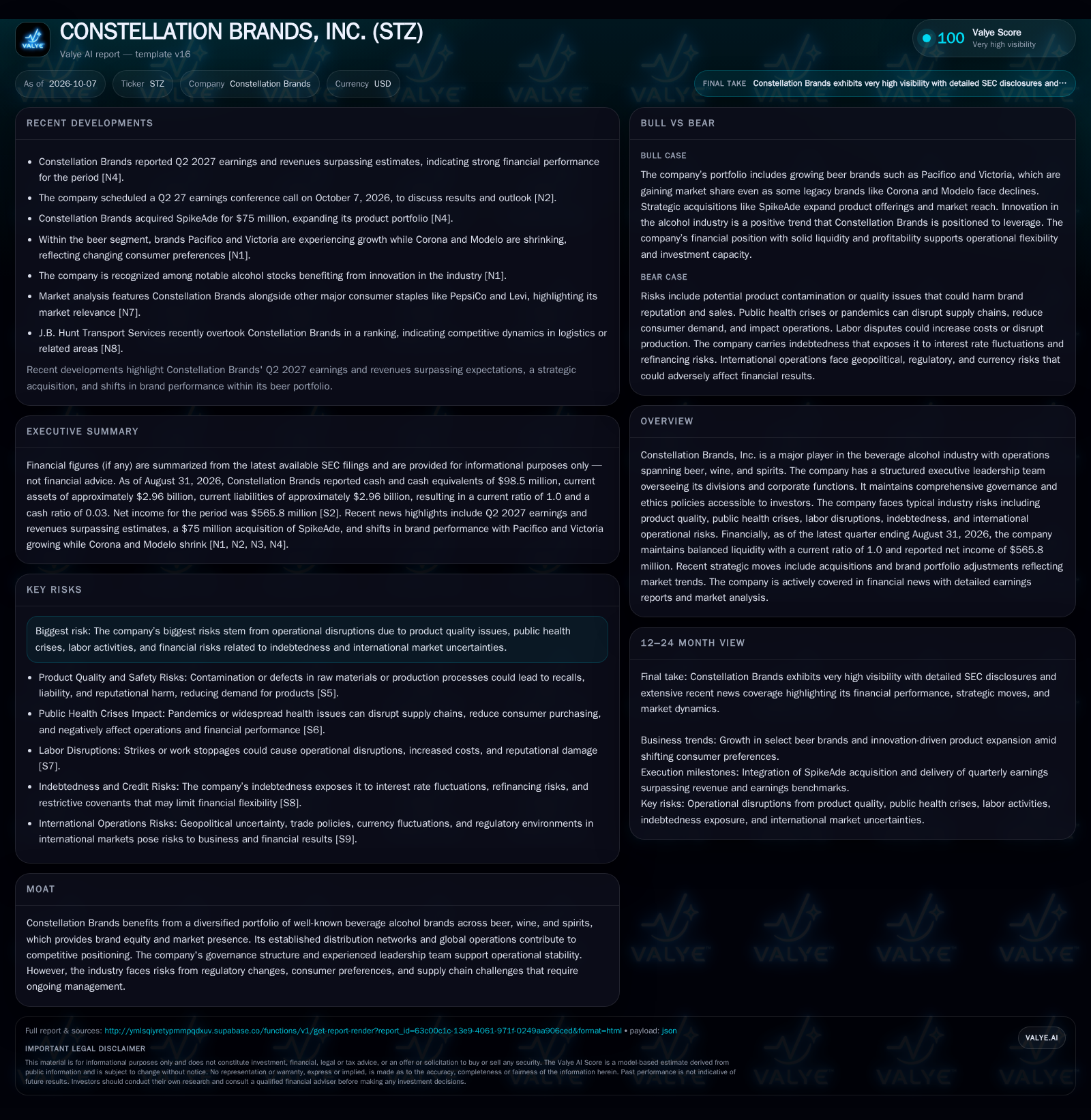
Constellation Brands reported $565.8 million in net income for the period ending August 31, 2026, with a current ratio of 1.0 and cash of $98.5 million. The company's core strength lies in its broad beverage portfolio and entrenched market presence, yet it faces operational, financial, and strategic risks. Performance will hinge on the ability to drive growth from emerging brands and manage supply chain and indebtedness risks effectively. [S2]
Constellation Brands, Inc. stands out in the beverage alcohol sector thanks to its extensive brand portfolio and entrenched distribution infrastructure. Recent financials show robust profitability, but a tight cash position and balanced current assets and liabilities underscore delicate liquidity management. As the company navigates shifting consumer preferences, potential operational disruptions, and the challenges of a mature industry, its future will depend on the success of new brand introductions, margin management, and the ability to stave off competitive and macroeconomic pressures. The next phase will test whether its scale and portfolio depth remain sufficient moats in a rapidly evolving market landscape.
Recent Financial Performance and Strategic Standing
Constellation Brands reported net income of $565.8 million for the period ending August 31, 2026, reflecting continued profitability in a challenging consumer environment [S2]. The company’s liquidity profile shows cash and cash equivalents of $98.5 million, with current assets and liabilities closely matched at $2.96 billion each, resulting in a current ratio of 1.0 and a notably reported cash ratio of 0.03 [S2]. The company reported cash and liquidity metrics for the period; these figures do not by themselves establish operating runway, investment capacity, financial flexibility, or financing capacity. The company is positioned among market-relevant consumer staples such as PepsiCo and Levi, indicating its ongoing relevance in the sector [N7]. However, it was recently surpassed by J.B. Hunt Transport Services in a ranking, highlighting the competitive pressures and the need to sustain operational and strategic momentum [N8].
How Constellation Brands Generates Profits in a Mature Beverage Market
Constellation Brands’ business model is anchored by its diversified portfolio spanning beer, wine, and spirits. The company typically benefits from premium pricing on established brands, while volume growth is often driven by innovation and the introduction of new products. Profitability in the beverage alcohol industry tends to hinge on brand strength, channel mix (on-premise vs. off-premise), and the ability to manage input costs—particularly commodities and packaging.
Operating leverage is a factor, as fixed costs associated with production, distribution, and marketing can be spread over high sales volumes. However, as a mature player, incremental growth is increasingly reliant on portfolio optimization and targeted innovation (e.g., new flavors, health-oriented offerings, or alternative packaging). Capital needs remain substantial due to ongoing marketing, production upgrades, and distribution investments. [S2] This structure can amplify both gains from efficient execution and risks from supply chain or demand shocks.
Given the mature nature of the beverage alcohol market, the company’s reliance on premium pricing necessitates continuous brand investment to maintain consumer perception and avoid commoditization. This dynamic creates a tension between sustaining marketing expenditures and protecting margins, especially as input costs fluctuate. Additionally, the shift in channel mix towards off-premise and e-commerce sales introduces margin variability due to differing distribution costs and promotional pressures. The capital intensity of production and distribution infrastructure means that any downturn in volume can disproportionately impact profitability due to fixed cost absorption challenges. Therefore, the company’s profit generation is highly sensitive to both top-line growth and operational efficiency improvements.
Brand Equity and Distribution: Moat or Mirage?
Constellation Brands’ primary competitive strength lies in its portfolio of well-known brands and broad distribution reach. Brand equity enables premium pricing and shelf presence, while established relationships with distributors create barriers for new entrants. However, the beverage alcohol market is highly competitive, with global peers, craft upstarts, and private-label offerings all vying for consumer attention.
The company’s historical moat has been reinforced by consumer loyalty and regulatory complexities in alcohol distribution, particularly in the U.S. Yet, these advantages are increasingly challenged by changing consumer tastes (e.g., shifts toward low- and no-alcohol options or ready-to-drink formats) and the rise of direct-to-consumer and e-commerce channels. Regulatory risk, supply chain pressures, and the need to continually refresh the brand portfolio further test the durability of Constellation’s competitive position.
While brand equity and distribution networks have historically provided a robust competitive moat, the accelerating consumer shift towards experiential and health-conscious consumption patterns challenges this advantage. For instance, the rise of low-alcohol and functional beverages compels the company to innovate rapidly or risk losing relevance. Moreover, the expansion of direct-to-consumer models and digital platforms reduces the dependency on traditional distributor relationships, potentially eroding established barriers to entry. The regulatory environment, while complex, can be a double-edged sword; changes in legislation or enforcement can either entrench incumbents or open avenues for agile competitors. Hence, the durability of Constellation Brands’ moat will depend on its adaptability to these evolving market and regulatory dynamics.
Innovation and Brand Expansion Drive Renewed Growth
A favorable scenario for Constellation Brands is one where its recent investments in emerging beer brands and innovation-led product launches (such as SpikeAde) gain traction, offsetting declines in legacy brands and capitalizing on evolving consumer preferences. If the company can accelerate growth in brands like Pacifico and Victoria, and successfully commercialize new offerings that tap into health, flavor, or convenience trends, it could achieve above-industry growth and margin expansion.
Confirmation of this scenario would come from sustained top-line growth in the beer segment, expanding gross margins, and evidence of successful product launches gaining share in key markets. Additional signals would include favorable channel mix shifts (e.g., higher-margin direct-to-consumer sales) and successful international expansion. Conversely, failure to generate significant revenue from new brands or a lack of margin improvement would cast doubt on this upside case.
Portfolio Optimization Offsets Headwinds, but Growth Remains Modest
The most plausible outcome is that Constellation Brands continues to deliver stable, if unspectacular, growth by optimizing its existing portfolio and gradually shifting resources toward brands with better momentum. Incremental improvements in supply chain efficiency and disciplined marketing could help preserve margins, while the breadth of the product lineup mitigates shocks from underperforming categories.
Supporting evidence would include stable or slightly rising revenues and operating margins, manageable working capital levels, and continued profitability despite external pressures. Signs that would challenge this scenario include persistent declines in flagship brands without offsetting gains elsewhere, or operational disruptions that erode margins and cash flow.
Operational Shocks and Indebtedness Amplify Vulnerabilities
Should these events coincide with rising interest rates or refinancing challenges on existing debt, Constellation Brands could face liquidity stress or be forced into asset sales or defensive cost-cutting.
Downside confirmation would come from declining current ratios, negative cash flow from operations, or increased reliance on short-term borrowing. Additional warning signs would include adverse regulatory actions, major product quality incidents, or sustained underperformance in key brands leading to write-downs or restructuring.
Milestones and Metrics That Will Shape Constellation Brands’ Next Chapter
Reported growth rates and profitability in emerging brands such as Pacifico, Victoria, and innovation-led products—if disclosed—will indicate whether new launches can offset declines in legacy brands.
Gross margin trends and segment-level profitability, especially in the beer division, will be critical for assessing pricing power and cost management.
Updates on debt structure, interest expense, and refinancing activities will clarify the company’s ability to manage its indebtedness and avoid liquidity stress.
Evidence of operational disruptions, such as product recalls, labor disputes, or supply chain interruptions, would provide early signals of downside risk.
Market share trends in core categories (beer, wine, spirits) and any commentary on competitive dynamics will show whether the portfolio remains resilient.
Progress or setbacks in international markets, particularly exposure to currency fluctuations and regulatory changes, will impact overall performance.
Management commentary or filings regarding capital allocation priorities—such as acquisitions, brand divestitures, or increased marketing investment—will reveal strategic direction and risk appetite.
Disclaimer: This is research-only, informational analysis and not investment advice. It may include AI-generated interpretation and general industry context. Always verify important details using primary sources.

Comments