
STARGUIDE GROUP, INC.: Facing Existential Financial Constraints Amid Absence of Commercial Activity
With a complete lack of revenue, a substantial stockholders’ deficit, and zero liquidity, STARGUIDE GROUP, INC. stands at a critical juncture. Without demonstrable operating activity or capital access, the company’s ability to persist as a going concern is in question, while related party liabilities further complicate its options.
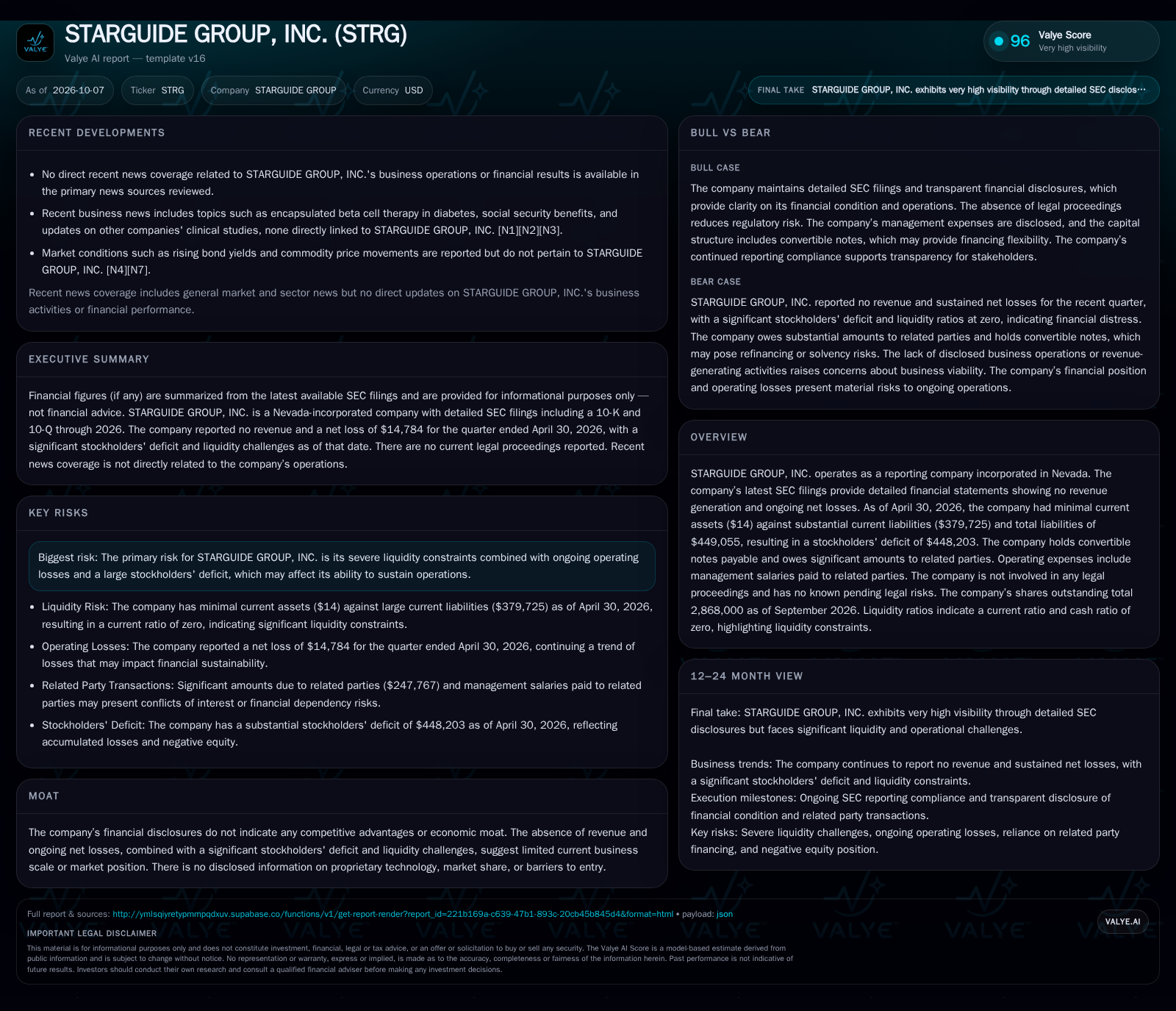
STARGUIDE GROUP, INC. reported no revenue and a net loss for the latest quarter, with just $14 in current assets against $449,055 in liabilities as of April 30, 2026. The company’s zero liquidity and heavy reliance on related party loans create acute financial distress. Without a clear operating model or new capital, near-term viability is uncertain. [S2]
STARGUIDE GROUP, INC. is a Nevada-incorporated entity that, as of the latest filings, reports no revenue, minimal assets, and a mounting stockholders’ deficit. The company’s balance sheet is dominated by liabilities—much of it owed to related parties and convertible note holders—while its current ratio and cash position are effectively zero. With no clear operating or commercial activity disclosed, the company’s survival hinges on external capital or a fundamental business pivot. The central question for investors is not about growth, but about the very sustainability of the corporate entity in its present form. [S2]
STARGUIDE’s Financial Position: Extreme Distress and Absence of Operations
As of April 30, 2026, STARGUIDE GROUP, INC. reported total current assets of just $14 against total liabilities of $449,055, yielding a stockholders’ deficit of $448,203. The company posted zero revenue and a net loss of $14,784 for the quarter, continuing a trend of consistent operating losses. Convertible notes payable stand at $138,137, while amounts due to related parties total $247,767, reflecting a capital structure heavily reliant on short-term and insider financing. The company reported cash and liquidity metrics for the period; these figures do not by themselves establish operating runway, investment capacity, financial flexibility, or financing capacity. There are no disclosed ongoing legal or regulatory proceedings. Together, these facts present a company with neither operational traction nor potential financial flexibility—raising fundamental doubts about its ability to continue as a going concern. [S2]
The extreme imbalance between current assets and liabilities not only reflects immediate liquidity challenges but also signals a deteriorating capital structure that undermines stakeholder confidence. In such a scenario, the company's access to external financing markets is typically constrained, as lenders and investors require evidence of operational viability and collateral value, both of which are absent here. Moreover, the reliance on related party liabilities introduces potential conflicts of interest and may limit the company's negotiating leverage with third-party creditors, further complicating any restructuring efforts. The absence of disclosed legal or regulatory proceedings provides a neutral backdrop but does not alleviate the existential financial pressures facing the company.
Assessing the Economics: No Revenue, Negative Equity, and Capital Dependency
STARGUIDE GROUP, INC. currently generates no revenue and continues to incur operating expenses, primarily for management salaries and related party transactions. With no disclosed products, services, or commercial activities, the company lacks a business engine to generate cash flow, leaving it entirely dependent on external or insider funding to cover even basic administrative expenses. The fixed costs, though modest in absolute terms (~$11,500 in quarterly operating expenses), are unsustainable without incoming cash. The presence of convertible notes and related party payables suggests prior attempts to fund operations through debt and insider support rather than from business activities or equity raises. This structure creates compounding risk: new capital is needed simply to service legacy obligations, while negative equity impedes traditional financing routes. Without a revenue model or cost discipline tied to actual operations, there is no path to operating leverage or self-sustaining economics in the current state.
The company’s dependence on convertible notes and related party funding creates a precarious financial dynamic, where servicing debt obligations consumes scarce resources, leaving no margin for investment or growth initiatives. This debt structure may also lead to dilution risks for existing shareholders if conversion terms are triggered without corresponding increases in enterprise value. Furthermore, the lack of revenue-generating activities means that traditional metrics used to assess operational efficiency or profitability are inapplicable, making it difficult for stakeholders to evaluate the company's prospects. The absence of a clear path to positive cash flow or break-even operations suggests that any turnaround would require a fundamental redefinition of the business model rather than incremental improvements.
Market Position: No Evident Moat or Commercial Presence
The company’s filings reveal no proprietary technology, product portfolio, customer base, or commercial relationships. In this context, STARGUIDE GROUP, INC. cannot be said to compete in any industry in a meaningful sense. The absence of revenue and operating activity means there is no competitive moat—no switching costs, network effects, or brand equity to defend. If the company were to pursue a new business line or asset acquisition, it would face steep barriers to entry, including lack of capital, negative equity, and no track record. Its only advantage is transparency, as regular SEC filings provide clarity to stakeholders, but this does not substitute for actual commercial differentiation. In effect, the company is not currently positioned within any value chain or market structure.
Without a defined market presence or competitive differentiators, the company faces significant barriers to establishing a sustainable business. Entry into new markets or sectors would require substantial capital outlays for product development, marketing, and customer acquisition, which are unlikely given the current financial constraints. Additionally, the lack of intellectual property or proprietary assets limits the company’s ability to create defensible market positions or command pricing power. In industries where network effects or scale economies are critical, starting from a position of zero operating history further diminishes prospects. Consequently, any attempt to build a competitive position would necessitate not only capital but also strategic partnerships or acquisitions to bridge capability gaps.
Turnaround Potential: Capital Infusion and Strategic Pivot as the Only Lifelines
The only plausible upside for STARGUIDE GROUP, INC. would stem from a successful capital raise—either through equity, debt, or a strategic partnership—that enables the company to pursue a new line of business or acquire revenue-generating assets. Such a scenario might be catalyzed by a reverse merger, asset acquisition, or a change in control attracting new management and capital. Confirmation of an upside turn would require public disclosure of a meaningful financing event, the announcement of a new operating plan, or the acquisition of a business with demonstrable revenue. Early evidence would include SEC filings detailing capital inflows, changes in the board or management, and new business development activity. Conversely, failure to secure new funding or to articulate a credible business plan would falsify the turnaround thesis.
Stasis and Deterioration: Ongoing Losses and Erosion of Stakeholder Value
The most probable near-term outcome is continued financial stasis, with the company incurring modest operating expenses, accruing losses, and deepening its stockholders’ deficit. Without new capital or a change in business direction, STARGUIDE GROUP, INC. may persist as a shell, relying on related party loans to cover minimal administrative costs while falling further behind on its obligations. This scenario is confirmed by continued zero revenue, recurring net losses, and the absence of any disclosed business development or financing initiatives in future filings. Any sign of creditor action, legal proceedings, or a halt in SEC compliance would signal further deterioration or a possible wind-down.
Failure Cascade: Insolvency, Legal Exposure, and Potential Delisting
If related party support wanes or creditors move to recover debts, STARGUIDE GROUP, INC. could quickly become insolvent. The lack of liquidity leaves the company highly exposed to any demand for payment, regulatory fees, or unforeseen expenses. In this scenario, the company could face lawsuits, forced asset sales (if any exist), or regulatory delisting for failure to meet minimum reporting or capitalization standards. Confirmation would come via disclosures of legal actions, bankruptcy filings, or formal SEC notifications of non-compliance. The absence of any operating assets or revenue-generating activity heightens the risk of a disorderly wind-down rather than an orderly restructuring.
Milestones That Will Determine STARGUIDE GROUP’s Fate
Any SEC filing disclosing a capital raise, reverse merger, or acquisition of a revenue-generating asset would be a critical inflection point.
A public announcement or filing describing a new business plan, product launch, or market entry would help test for an operational pivot.
Quarterly filings showing a material increase in current assets or a reduction in liabilities (especially related party or convertible notes) would signal improved financial health.
Evidence of new management, board changes, or the involvement of external investors would suggest a possible strategic shift.
If disclosed, tracking the level and terms of related party financing would clarify the sustainability of ongoing operations.
Any SEC notification or press release indicating regulatory or listing compliance issues would heighten downside risk.
A useful metric would be disclosure of cash inflows (from financing or operations) in subsequent filings.
Disclosures of legal proceedings, creditor actions, or bankruptcy would confirm a move toward insolvency.
Disclaimer: This is research-only, informational analysis and not investment advice. It may include AI-generated interpretation and general industry context. Always verify important details using primary sources.

Comments