
NorthStar Earth & Space (formerly Viking Acquisition): Integration, Liquidity, and the Road to Commercialization in Earth Data
The company's path now depends on converting proprietary data assets into recurring revenue, while managing execution and capital needs in a competitive, capital-intensive sector.
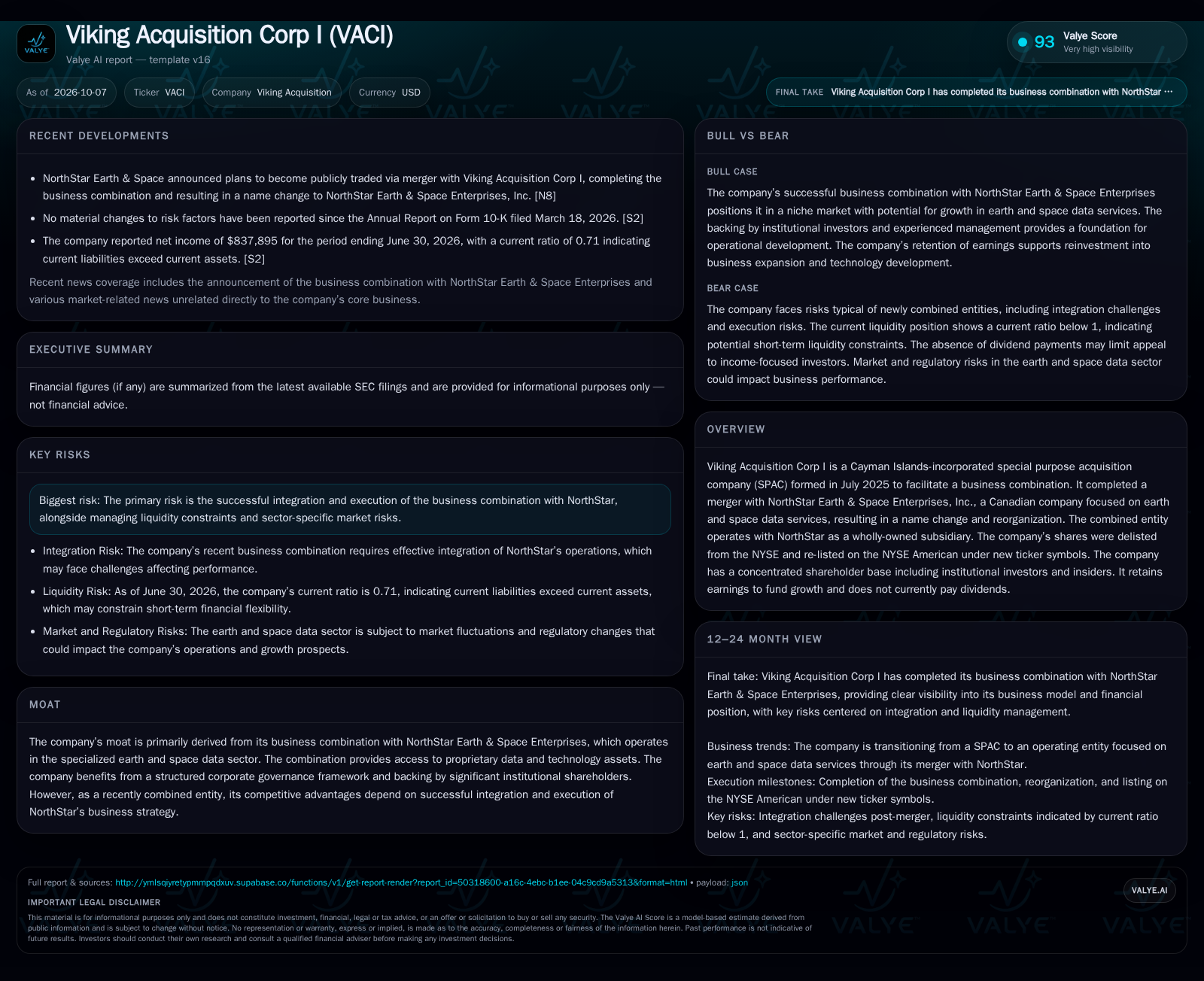
NorthStar Earth & Space (formerly Viking Acquisition) has completed its SPAC merger and now targets the commercial earth and space data market. The business is backed by institutional investors and insiders, but faces a current ratio below 1, signaling near-term liquidity pressure. Success depends on integrating operations, monetizing data assets, and establishing a sustainable business model in a sector characterized by high fixed costs and evolving competition. [S2]
With its shares now trading under new symbols on the NYSE American, the company's next phase hinges on transforming its earth and space data platform into a revenue-generating business, navigating both the high fixed costs and rapid innovation cycles of this specialized sector. The question is whether NorthStar can translate its technical promise and shareholder support into durable commercial and financial outcomes. [S1] [S2]
Recent Merger, Liquidity Snapshot, and the Transition to Operations
NorthStar Earth & Space (formerly Viking Acquisition) has completed its business combination and now operates as a single entity focused on earth and space data services. The company’s shares were delisted from the NYSE and subsequently listed on the NYSE American under new tickers (NSTR, NSTR.WS). As of October 2026, NorthStar reports 41.3 million common shares outstanding, with no preferred shares issued. [S1]
Institutional and insider ownership is high, with the sponsor and major investors collectively holding over 36% and directors/officers owning roughly 27%. [S1]
Liquidity is a pressing concern: as of June 30, 2026, NorthStar had current assets of $789,366 against current liabilities of $1,118,835, for a current ratio of 0.71 and a cash ratio of zero. This suggests the company faces near-term obligations that exceed its liquid resources, a common challenge for newly de-SPACed entities before operational cash flows are established. [S2]
Net income of $837,895 reported for Q2 2026 was driven by interest income on trust assets, not by active revenue-generating operations, underscoring the pre-commercial stage of the business. [S2]
How Earth and Space Data Could Become a Scalable Business
NorthStar’s business model aspires to monetize proprietary earth and space observation data—likely via subscription-based analytics, data feeds, or platform access for commercial and government customers. In this sector, recurring revenue is plausible if the company can deliver unique, high-frequency, or otherwise differentiated datasets that support critical applications (e.g., environmental monitoring, asset tracking, or defense intelligence).
Economically, this model is characterized by high upfront and ongoing fixed costs: satellite infrastructure, ground stations, data processing, and R&D all demand significant capital. Once deployed, incremental costs for delivering additional data to new customers are typically low, creating the potential for operating leverage if customer acquisition can outpace fixed expense growth.
Pricing power in earth data markets is often a function of data exclusivity, refresh rates, vertical integration (e.g., analytics layered on raw data), and the ability to embed products into customer workflows. However, commoditization risk is rising as more private and public satellites enter orbit and as cloud-based analytics platforms lower switching costs. For NorthStar, the path to attractive margins likely depends on achieving scale, differentiation, and customer lock-in through unique capabilities or integrations.
Given the lack of disclosed commercial arrangements or customer contracts, the company’s ability to generate and sustain recurring revenue streams remains unproven at this stage. Initial revenue, when it materializes, may be lumpy or project-based until a critical mass of recurring contracts is secured.
Strategic Positioning in a Crowded and Capital-Intensive Sector
NorthStar’s post-merger positioning is built on access to proprietary data assets and technology from the legacy NorthStar Earth & Space Enterprises platform. In theory, this could offer a moat if the company delivers unique data types or analytics unavailable from competitors.
However, the earth observation and space data sector is increasingly crowded: established satellite operators, geospatial analytics firms, and cloud-based data aggregators are all vying for market share. Barriers to entry remain high in terms of capital and regulatory requirements, but the rapid fall in satellite launch costs and proliferation of ‘new space’ entrants have increased competitive intensity.
NorthStar’s concentrated institutional and insider ownership may support focused decision-making and long-term strategy, but could also reduce public float and limit liquidity for outside investors. The lack of a dividend and stated intention to reinvest all earnings into growth may appeal to technology-focused investors but could limit interest from traditional yield-driven shareholders.
Ultimately, NorthStar’s durable advantage will depend on: (a) successful integration and scaling of its technology platform, (b) forging sticky customer relationships, and (c) maintaining a pace of innovation that keeps it ahead of commoditization and price pressure.
Unlocking Recurring Revenue by Capitalizing on Proprietary Data Assets
The most favorable outcome for NorthStar involves rapid integration and deployment of its earth and space data platform, enabling it to secure anchor customers in government, defense, or commercial verticals. If the company can demonstrate clear data superiority—via higher resolution, more frequent refresh rates, or analytics capabilities not matched by peers—it could command premium pricing and lock in multi-year contracts.
Confirmation of this scenario would come from disclosed commercial wins, recurring contract announcements, and a transition in financials from interest-driven net income to material operating revenue growth. Evidence would also include increased backlog, customer diversity, and visible expansion of the company’s data catalog or analytics offerings.
Falsification would be apparent if, after integration, NorthStar struggles to win material contracts, remains reliant on interest income, or faces customer churn due to undifferentiated offerings. A prolonged absence of revenue traction would suggest the company’s assets are not translating into commercial value.
Gradual Commercialization Amid Ongoing Capital and Execution Hurdles
The most probable near-term outcome is a gradual transition from development to commercialization, with the company moving from interest income to modest initial operating revenues as pilot programs or first contracts are signed. Integration costs and organizational challenges may persist, potentially weighing on margins and slowing the pace of scale-up.
The company may prioritize a small number of strategic customers to prove the value of its data assets before attempting broad market expansion.
Confirmation of this scenario would include announcements of pilot projects, partnerships, or first revenue-generating contracts, but with continued pressure on short-term liquidity and limited profitability. Falsification would occur if the company either rapidly accelerates revenue growth (moving toward the upside scenario) or fails to generate any commercial traction (sliding toward the downside).
Liquidity Crunch and Integration Missteps Threaten Business Continuity
The primary risk for NorthStar is a combination of ongoing liquidity pressure and failure to integrate or commercialize its platform. With current liabilities exceeding current assets and no ongoing operating revenue, the company may be forced to seek dilutive financing, restructure obligations, or delay critical investments.
Integration challenges—such as mismatched systems, cultural friction, or leadership turnover—could further erode the company’s ability to execute its strategy. Failure to differentiate its product in a crowded market could lead to lost bids, customer attrition, or price wars.
Confirmation of this scenario would include continued reliance on non-operating income, absence of contract announcements, worsening balance sheet metrics, or disclosures of going-concern risk. Falsification would require clear evidence of commercial progress and stabilization of liquidity.
How to Track NorthStar’s Progress from Integration to Market Traction
Disclosure of new commercial contracts, pilot programs, or anchor customer wins would provide direct evidence of traction in the target market.
If disclosed, growth in deferred revenue, backlog, or signed multi-year agreements would help test the durability and visibility of revenue streams.
Updates on integration milestones—such as technology platform consolidation, leadership retention, or operational restructuring—would clarify execution risk.
Changes in liquidity position, including new financing rounds, working capital improvements, or reduction in current liabilities, would signal progress (or stress) in financial management.
Announcements of product expansions, new data layers, or analytics capabilities would indicate the company’s ability to innovate and differentiate.
Customer concentration metrics, if disclosed, would help assess dependence on a small number of buyers versus a diversified client base.
Any regulatory developments affecting data licensing, satellite launches, or international market access could materially alter the risk profile.
Evidence of cost discipline, such as improved gross margins or operating leverage as scale increases, would test the path to sustainable profitability.
Disclaimer: This is research-only, informational analysis and not investment advice. It may include AI-generated interpretation and general industry context. Always verify important details using primary sources.

Comments