
Applied Digital: Scaling AI and HPC Infrastructure with Hyperscale Contracts, Execution Risks, and a Cloud Pivot
Applied Digital is aggressively expanding its AI and HPC data center footprint, leveraging long-term hyperscaler agreements and cloud partnerships to anchor future revenue. While its capital base and major contracts provide visibility, execution, regulatory, and margin risks remain as the company pivots toward high-growth, capital-intensive markets.
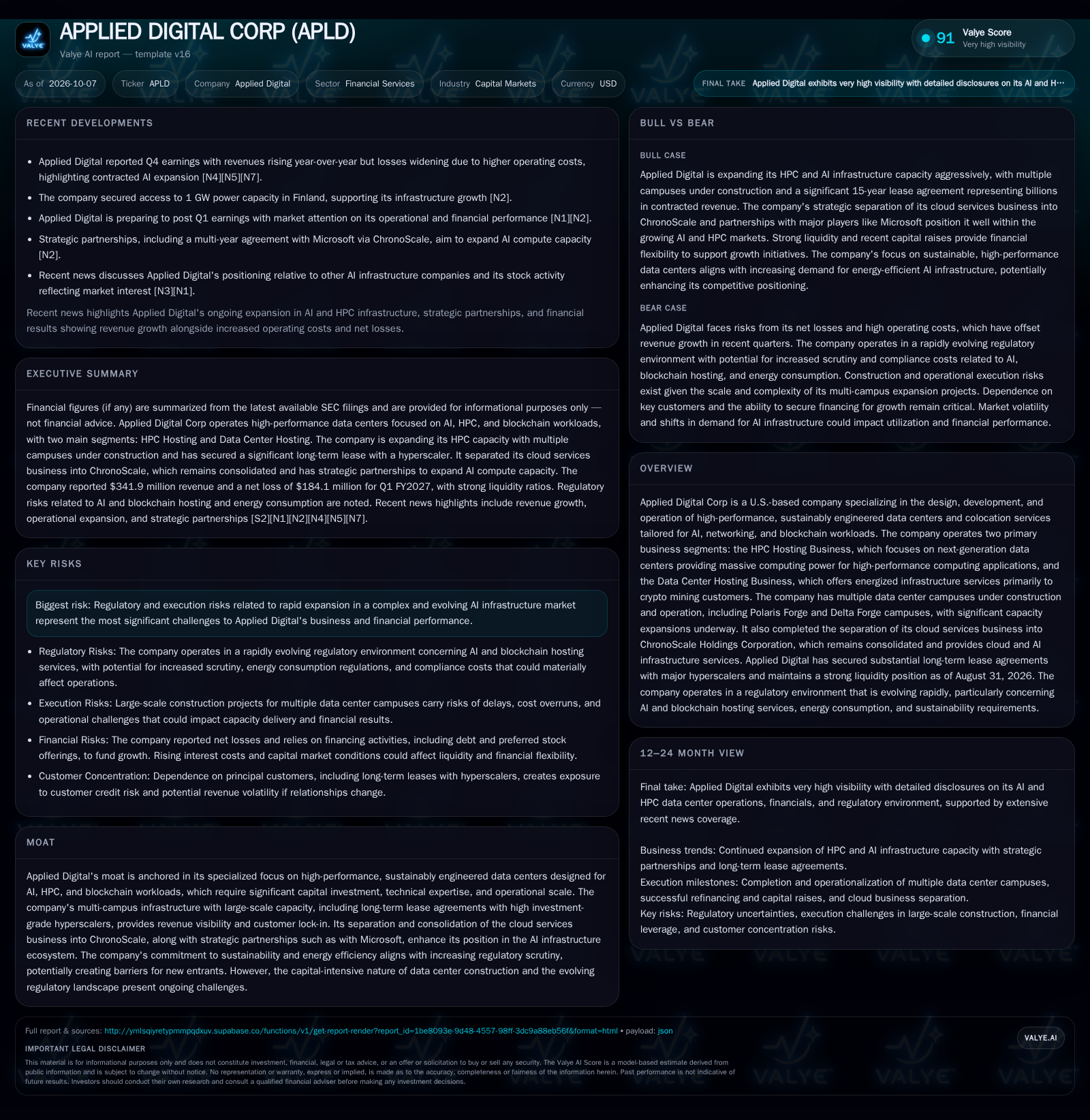
Applied Digital is building out large-scale data centers for AI, HPC, and blockchain workloads, with $5.2 billion in contracted revenue from a 15-year hyperscaler lease and new capital raised. [S2]
Applied Digital Corp is rapidly expanding its high-performance data center footprint in the U.S., targeting the fast-growing markets for AI, high-performance computing (HPC), and blockchain hosting. With a landmark $5.2 billion, 15-year lease from a top-tier hyperscaler and a major cloud partnership through its ChronoScale unit, the company is aiming to secure recurring revenue and strategic relevance in next-generation infrastructure. Yet, the path to profitability is challenged by heavy capital outlays, significant net losses, and emerging regulatory scrutiny—raising the stakes for execution as Applied Digital transitions from growth to sustainable returns.
Major Hyperscale Contracts and Cloud Partnerships Reshape the Revenue Base
The most material current development for Applied Digital is its June 2026 execution of a 15-year lease with a high investment-grade hyperscaler for a 210 MW facility at the Delta Forge 2 campus, representing approximately $5.2 billion in contracted revenue over the base term. This deal anchors long-term cash flow and signals institutional confidence in Applied Digital’s infrastructure reliability and scale [S2].
Operationally, the company has 250 MW of HPC data center capacity online at its flagship Polaris Forge 1 campus, with additional megawatt-scale buildings under construction across Polaris Forge and Delta Forge campuses. This rapid expansion supports both near-term revenue growth and capacity for future AI and HPC workloads [S2].
Applied Digital’s cloud services subsidiary, ChronoScale, remains consolidated and has entered a strategic partnership with Microsoft to deliver 50 MW of AI compute capacity over a three-year term, adding a valuable cloud ecosystem anchor [S2].
Despite these advances, Applied Digital reported a net loss of $184.1 million on $341.9 million in total Q1 FY2027 revenue, signaling that profitability is not yet in reach as operating expenses outpace top-line gains [S2].
Decoding the Economics of Hyperscale Data Center Expansion
Applied Digital’s business model is built on the design, construction, and operation of high-capacity, specialized data centers for AI, HPC, and blockchain workloads. The economics are driven by the ability to secure long-term, high-credit-quality tenants—such as the recent 15-year hyperscaler lease—which can provide revenue visibility and justify large upfront capital investments [S2].
Revenue is split between the high-performance computing (HPC) hosting business and the data center hosting business, with HPC contributing $262.6 million out of $341.9 million in the most recent quarter, indicating the strategic shift toward more advanced, higher-value workloads [S2].
Gross margins in hyperscale data centers are typically sensitive to utilization rates, power costs, and contract structure. While long-term leases create stability, they may limit upside if market pricing rises. Applied Digital’s expansion is capital-intensive, funded by recent $1.59 billion in senior secured notes and $275 million in preferred equity, which increases fixed costs and leverage [S2].
Operating leverage can be significant once facilities are fully utilized, but the current net loss suggests that ramping new capacity and managing overhead remain challenges. The ChronoScale cloud business introduces a potential recurring revenue stream, but its economics depend on resale arrangements, hardware depreciation, and the ability to compete with established cloud providers.
Specialization, Scale, and Strategic Partnerships in a Crowded Data Center Arena
Applied Digital’s competitive positioning rests on its ability to offer sustainably engineered, high-performance data centers tailored for AI and HPC—segments with rising barriers to entry due to power, cooling, and regulatory requirements. The company’s multi-campus footprint and long-term hyperscaler contracts provide differentiation from smaller, less capitalized peers.
However, the sector is crowded with incumbent data center REITs, hyperscale operators, and technology infrastructure giants, many of whom have deeper capital reserves and integrated cloud offerings. The Microsoft partnership through ChronoScale is a strategic asset, but the durability of this advantage depends on execution and the ability to scale relationships into broader, multi-year agreements.
Customer concentration is a double-edged sword: while a single hyperscaler lease provides stability, it also heightens exposure to renegotiation risk or changes in tenant strategy. Applied Digital’s focus on energy efficiency and sustainability aligns with evolving customer and regulatory demands, but competitors are also investing heavily in these areas.
Locked-In Revenue and Cloud Alliances Drive Operating Leverage
In the favorable scenario, Applied Digital successfully delivers its under-construction campuses on time and on budget, bringing new capacity online just as demand for AI and HPC workloads accelerates. The 15-year, $5.2 billion hyperscaler lease provides stable, recurring revenue and anchors occupancy at Delta Forge 2, while additional buildings at Polaris and Delta campuses rapidly fill with enterprise and cloud customers [S2].
ChronoScale’s partnership with Microsoft expands beyond the initial 50 MW, attracting further partnerships from other cloud and AI developers. As utilization rises, operating leverage improves, margins expand, and the company transitions from net losses to sustained profitability.
Evidence for this scenario would include: sequential increases in occupancy and utilization rates, new long-term contracts with creditworthy tenants, expansion of the ChronoScale partnership, and margin improvement as fixed costs are absorbed.
Capacity Expansion Meets Execution and Margin Pressure
The most plausible path is that Applied Digital continues to grow revenue as additional data center capacity comes online and as the hyperscaler contract delivers stable cash flow. However, operating costs remain elevated due to ongoing construction, labor, and energy expenses, and utilization of new campuses ramps gradually rather than instantly.
The company’s net loss narrows but does not flip to profitability in the near term, as depreciation, interest expense, and overhead weigh on margins. The ChronoScale business provides incremental growth but faces strong competition from established cloud providers and margin pressure from hardware and resale costs.
Confirmation of this trajectory would be steady but modest improvement in quarterly earnings, continued capital spending, and incremental new contracts rather than transformative deals. Margin improvement would lag revenue growth until a higher percentage of capacity is utilized.
Cost Overruns, Regulatory Shocks, and Underutilization Derail Expansion
In the adverse scenario, Applied Digital encounters construction delays or cost overruns at its multi-campus projects, leading to missed delivery timelines and higher capital needs. Regulatory changes—such as stricter energy consumption rules for AI and blockchain data centers—raise compliance costs or restrict operations, particularly in sensitive jurisdictions.
If demand for AI/HPC hosting softens or key customers reduce commitments, utilization rates could fall short of projections, leaving new facilities under-occupied and margins compressed. The company’s heavy debt load amplifies the downside, as interest expense and principal repayments strain liquidity.
Evidence for this downside would include: project delays, negative regulatory developments, customer cancellations or renegotiations, a sharp decline in utilization, and cash burn outpacing capital raises.
Metrics and Milestones That Will Define Applied Digital’s Trajectory
Quarterly occupancy and utilization rates at each major data center campus—especially newly completed buildings—will indicate how well expansion is translating into revenue.
Actual margin progression (gross, operating, and net) as additional capacity comes online, to test whether operating leverage is being realized or if costs are sticky.
Updates on the expansion and renewal of the Microsoft/ChronoScale partnership, and any new strategic cloud or hyperscaler agreements.
Capital expenditure outlays and construction timelines for facilities under development, as delays or overruns would pressure both liquidity and credibility.
Changes in regulatory landscape or compliance costs for AI and blockchain hosting—particularly any new restrictions or requirements on energy usage.
Breakdown of revenue by customer concentration, to assess exposure to any single hyperscaler or major tenant.
If disclosed, churn or renewal rates on existing contracts, which would clarify the stickiness and risk profile of the current customer base.
Disclaimer: This is research-only, informational analysis and not investment advice. It may include AI-generated interpretation and general industry context. Always verify important details using primary sources.

Comments