
Resources Connection: Portfolio Simplification, Digital Transformation, and the Challenge of Restoring Profitability
Despite a reported liquidity position and decisive portfolio moves, Resources Connection faces persistent profitability headwinds. The company’s strategic pivot toward consulting, on-demand talent, and accelerated AI adoption reflects an effort to align with evolving client needs—but the ability to translate these investments into sustainable earnings remains an open question.
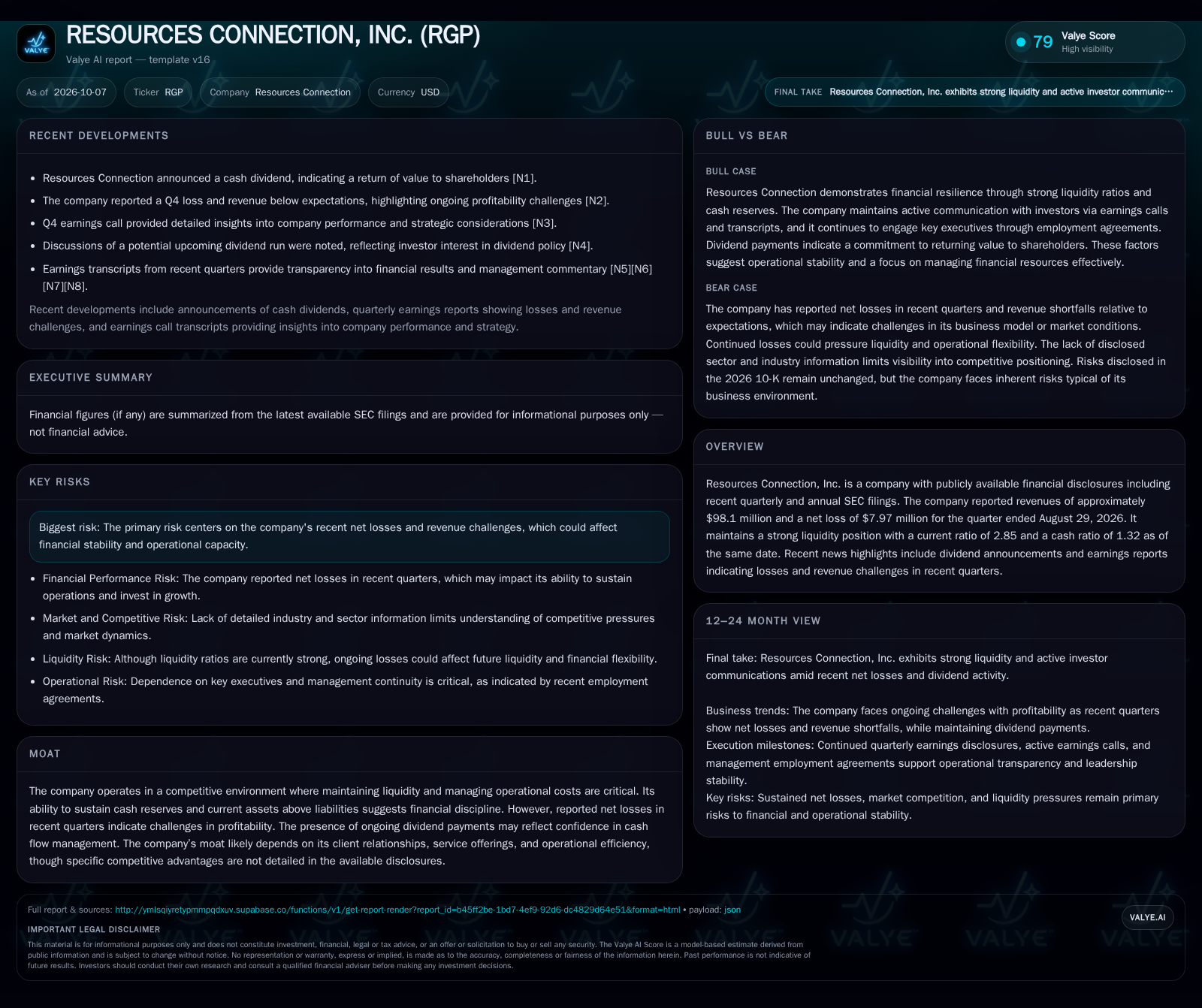
Resources Connection recently reported a quarterly net loss and revenue below expectations, despite maintaining a reported liquidity position and continuing dividend payments. The company has exited its Sitrick segment to focus on core offerings—Consulting, On-Demand Talent, and Outsourced Services—with strategic priorities including digital transformation and AI adoption. The challenge is whether these moves can restore sustainable profitability in a highly competitive, margin-sensitive environment. [S2] [N1] [N2]
Resources Connection, Inc. stands at a strategic crossroads: after divesting its Sitrick crisis communications unit and sharpening its focus on Consulting, On-Demand Talent, and Outsourced Services, the company is seeking to reposition itself for relevance and profitability in a rapidly evolving professional services landscape. The question is whether RGP’s investments in digital capabilities, AI, and a more focused portfolio can overcome competitive pressures and restore sustainable earnings growth. [S2] [N1] [N2]
Recent Results Highlight Persistent Losses and Strategic Refocusing
Resources Connection reported $98.1 million in revenue and a net loss of $7.97 million for the quarter ended August 29, 2026, continuing a pattern of recent losses and revenue shortfalls. The company reported a current ratio of 2.85 for the period. [S2] [N2] [S2] In May 2026, RGP completed the sale of its Sitrick crisis communications unit, eliminating the 'All Other' segment and signaling a commitment to portfolio simplification. [S2] The company continues to pay dividends even amid losses, suggesting management’s focus on shareholder return and confidence in its potential financial flexibility. [N1]
Revenue Dynamics, Margin Structure, and the Levers for Operating Improvement
Resources Connection’s business model centers on providing professional services—Consulting, On-Demand Talent, and Outsourced Services—to a global client base, with principal operations in North America, Europe, and Asia Pacific. [S2] Revenue is typically generated through project-based billing or time-and-materials contracts, where billable consultant hours and utilization rates are key volume drivers. Pricing power is limited by the highly competitive nature of the professional services market, putting pressure on gross margins.
One core economic lever is the pay/bill ratio—the relationship between consultant compensation and client billing rates. Sustained margin improvement depends on optimizing this spread, increasing consultant utilization, and managing overhead. Fixed costs are moderate, with variable consultant costs comprising the bulk of expenses, suggesting that scale and utilization are critical for operating leverage.
The cited source reports dividend-related activity; that disclosure alone does not establish dividend-policy continuity, management confidence, or a material constraint on capital flexibility. With $61.2 million in cash, RGP has flexibility to invest in technology, talent, and digital transformation, but persistent losses could ultimately constrain capital allocation if not reversed. [S2]
Beyond the immediate operational levers, a critical factor influencing Resources Connection’s margin trajectory is the scalability of its consulting and on-demand talent platforms. If the company can develop more standardized service offerings and leverage technology to reduce reliance on bespoke, labor-intensive engagements, it could improve margins by lowering the incremental cost of delivery. However, this shift requires significant upfront investment in process automation, knowledge management, and client engagement tools, which may pressure near-term profitability. The balance between customized client solutions and scalable productized services will be pivotal in determining sustainable margin expansion.
Service Breadth, Digital Transition, and the Realities of Professional Services Competition
RGP competes with a broad array of professional services firms, including global consulting giants, specialized boutiques, and digital talent platforms. The company’s integrated offerings—Consulting, On-Demand Talent, and Outsourced Services—aim to provide flexibility and address evolving client needs in areas like finance, technology, data, and operational transformation. [S2]
However, barriers to entry in this sector are relatively low, and client relationships are often project-based, limiting switching costs. Large competitors may offer broader service portfolios, global scale, and deeper digital capabilities, making differentiation a challenge. RGP’s ability to scale consulting solutions, expand its consultant skillset (particularly in technology and AI), and deliver measurable value will be central to defending its market position.
The company’s push to accelerate AI adoption—both internally for productivity and externally as a client solution—reflects an industry-wide shift, but incumbents with greater resources may be better positioned to invest in proprietary platforms and data analytics. Portfolio simplification and cost optimization can help sharpen focus, but sustainable advantage may hinge on execution in digital transformation and the ability to demonstrate superior client outcomes.
Unlocking Operating Leverage Through Digital Execution and Demand Uptick
A favorable scenario for RGP would see the company’s investments in consulting scale, AI capabilities, and talent base translating into renewed client demand and higher utilization rates. If RGP can successfully position itself as a nimble provider of digital transformation services—especially for mid-market clients underserved by larger consultancies—it could achieve revenue growth without proportionate increases in overhead, driving improved operating leverage.
Confirmation would come from a return to profitability, sequential margin expansion, and evidence of expanding client engagements in technology, data, and AI-related projects. Growth in high-value consulting assignments, rising consultant utilization, and an improving pay/bill ratio would indicate that digital investments are paying off. Expansion of client relationships beyond project-based work to broader, multi-year engagements would also support the upside thesis.
Incremental Progress Amid Margin Pressures and Slow Recovery
The most plausible near-term outcome is a period of incremental improvement but continued margin sensitivity. RGP may realize some cost savings from portfolio simplification and restructuring, and could capture modest revenue growth from consulting and on-demand talent as client priorities shift toward digital and operational transformation.
However, competitive pricing, low switching costs, and wage inflation for skilled consultants are likely to constrain margin recovery. The company may oscillate between small profits and losses as it works to stabilize utilization rates and align its cost structure with demand. Evidence for this scenario would include stable or slightly rising revenue, flat to modestly improving margins, and ongoing but cautious capital investment.
Sustained Losses Erode potential Financial Flexibility and Strategic Options
In a more adverse scenario, RGP fails to translate its digital and consulting investments into higher-margin growth, while competitive and macroeconomic pressures further erode revenue.
Confirmation would be continued revenue shortfalls, declining consultant utilization, and mounting losses despite restructuring efforts. If clients delay or cancel projects, or if wage inflation outpaces billing rate increases, the pay/bill ratio could deteriorate further. In this scenario, RGP could face tough choices around scaling back growth investments, restructuring debt, or seeking strategic alternatives to protect shareholder value.
Milestones That Will Gauge RGP’s Progress Toward Sustainable Value Creation
Quarterly revenue growth or contraction, especially in Consulting and On-Demand Talent, will reveal whether demand is recovering or deteriorating.
Gross margin trends and pay/bill ratio improvements would indicate success in capturing higher-value work and managing labor costs.
Consultant utilization rates—how much of the talent pool is actively billable—will be a critical operational efficiency metric.
Net income trajectory: A sustained return to profitability or narrowing of losses would provide evidence that restructuring and digital investments are working.
Client mix and engagement depth: Growth in recurring, multi-year, or digital transformation-focused contracts would support the upside case.
Progress reports on AI integration (internal productivity and client-facing solutions) would help test the digital transformation thesis.
Management commentary on win rates in competitive bids and evolving client demand for digital and AI-driven services will clarify competitive positioning.
Disclaimer: This is research-only, informational analysis and not investment advice. It may include AI-generated interpretation and general industry context. Always verify important details using primary sources.

Comments