
Regencell Bioscience: From TCM Research to Neurocognitive Market Potential
Regencell Bioscience Holdings stands at the intersection of traditional Chinese medicine and modern neurocognitive therapeutics, aiming to validate and commercialize proprietary TCM formulas for ADHD and ASD. With no approved products, ongoing clinical trials, and a reported liquidity position, the company's future hinges on regulatory success, clinical efficacy, and market acceptance amid significant skepticism and financial losses.
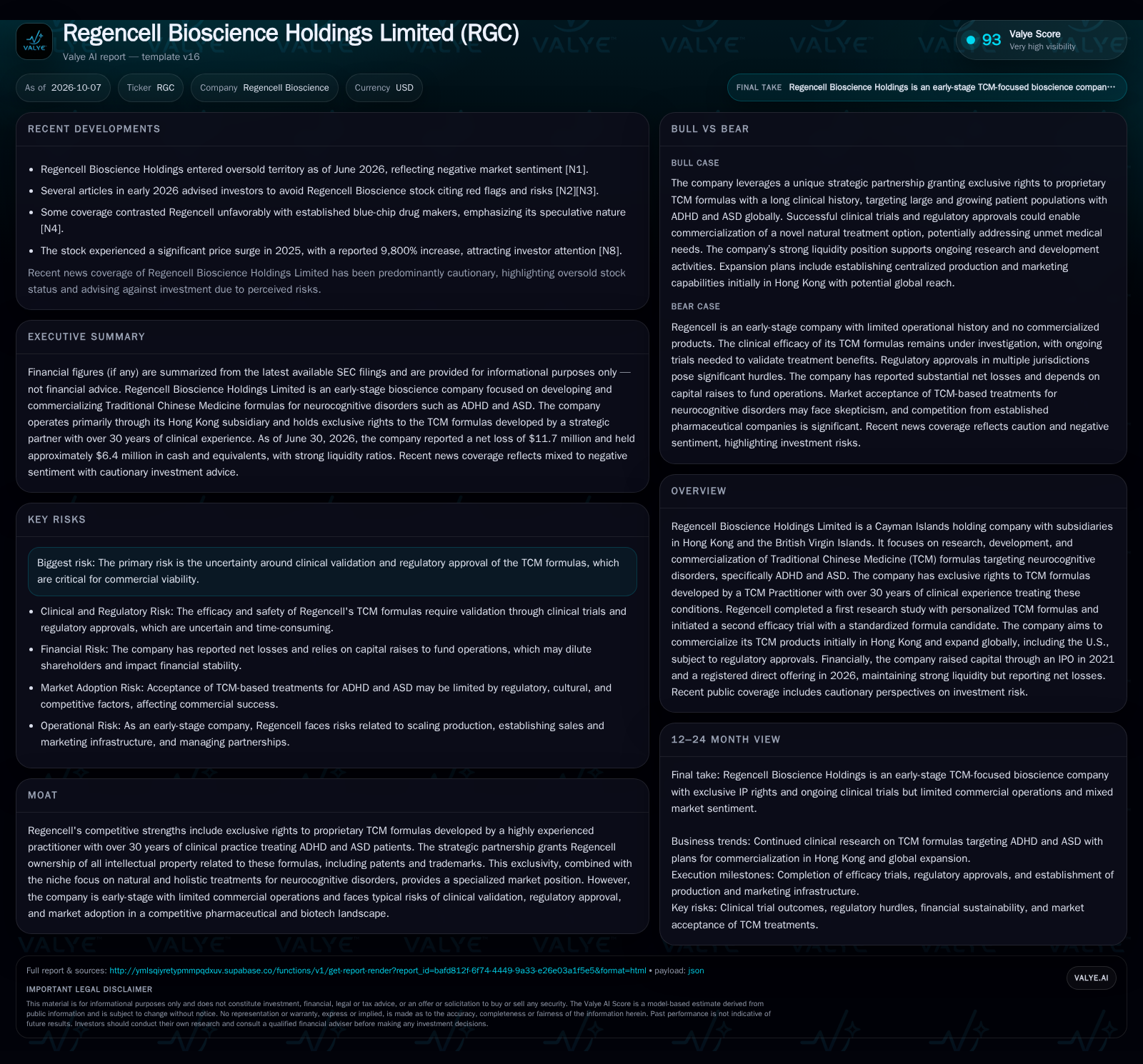
Regencell Bioscience is an early-stage Cayman holding company pursuing the development and commercialization of proprietary TCM formulas for ADHD and ASD, with operations centered in Hong Kong. The company has exclusive rights to formulas from a seasoned practitioner, is conducting clinical trials, and has no current product revenue. As of June 2026, Regencell reported $6.4 million in cash, a net loss of $11.7 million, and faces persistent skepticism over its prospects and risk profile. Success depends on achieving clinical, regulatory, and commercial milestones in a competitive, high-barrier field. [S1] [N1] [N2] [N3] [N4] [N8]
Regencell Bioscience Holdings is attempting to bridge traditional Chinese medicine and modern neurocognitive disorder treatment, pursuing the development and global commercialization of proprietary TCM formulas for ADHD and ASD. Despite a reported liquidity position snapshot and exclusive access to a unique clinical tradition, Regencell remains pre-revenue, with its business model entirely predicated on the successful clinical validation and regulatory approval of its formulas. The market has grown skeptical, as evidenced by recent negative coverage and persistent net losses, making Regencell’s next clinical and regulatory milestones pivotal to its future.
Core Details: Exclusive TCM Rights, Ongoing Trials, and Financial Challenges
Regencell Bioscience Holdings Limited is a Cayman Islands holding company with principal operations in Hong Kong, focused on developing and commercializing proprietary Traditional Chinese Medicine (TCM) formulas for neurocognitive disorders, specifically ADHD and ASD. The company holds exclusive rights to formulas developed by a veteran practitioner with over 30 years of clinical experience. As of June 30, 2026, Regencell reported a net loss of $11.7 million for the fiscal year, with cash and equivalents of $6.4 million and a current ratio of 10.77, reflecting recent capital raises but no product revenue. The company remains pre-commercial, with one small-scale personalized TCM study completed and a second standardized efficacy trial underway. News sentiment in 2026 has been predominantly negative, emphasizing investment risk and the absence of approved products or revenue. [S1] [N1] [N2] [N3] [N4] [N8]
Pathways to Profitability: Investment, Regulation, and Commercialization Dynamics
Regencell’s business model is classic early-stage biotech: substantial upfront investment in research and clinical validation with the aim of generating future high-margin revenue streams from proprietary therapies. Revenue would eventually depend on the successful approval and commercialization of its TCM formulas for neurocognitive disorders, with initial launches targeted for Hong Kong and potential expansion to the U.S. and other global markets. To date, all funding has come from equity capital, with no product sales or recurring revenues. [S1]
The cost structure is dominated by R&D expenses, regulatory compliance, and administrative overhead, with future commercial costs likely to include manufacturing (potentially outsourced to GMP-compliant partners), marketing, sales infrastructure, and pharmacovigilance. If the standardized formula passes efficacy trials and secures regulatory approval, the company could benefit from high incremental margins typical of specialty therapeutics, especially given exclusivity rights. However, variable costs could rise sharply if Regencell is forced to invest heavily in education and market-building for TCM-based neurocognitive treatments, as acceptance in Western markets is far from assured.
With no debt and strong current and cash ratios, Regencell appears to have a near-term buffer to support ongoing trials. However, persistent net losses and the absence of revenue mean the company will likely require further capital raises before achieving commercial self-sufficiency. The economics will ultimately hinge on pricing power, market penetration, and the ability to scale production cost-effectively if regulatory and clinical hurdles are cleared.
Regencell’s Market Position: Leveraging Proprietary TCM Amidst Competition
Regencell’s principal competitive asset is its exclusive access to TCM formulas developed over decades by a practitioner with a track record in treating ADHD and ASD. This differentiation is meaningful within the context of alternative and natural therapies, especially in Asian markets receptive to TCM. However, the neurocognitive disorder treatment landscape is highly competitive, dominated by established Western pharmaceutical products with robust clinical data, regulatory support, and entrenched prescriber habits.
Potential counterforces include skepticism among regulators and clinicians regarding the efficacy and standardization of TCM, especially for neurocognitive conditions where Western medicine has established protocols. New entrants or larger incumbents could also develop or acquire alternative natural or botanical treatments, leveraging greater resources and distribution reach.
Switching costs for patients and prescribers are likely low unless Regencell’s formulas can demonstrate clear, reproducible efficacy or safety advantages. Furthermore, the regulatory pathway for TCM in Western markets is complex and may limit or delay adoption, even if initial success is achieved in Hong Kong.
Successful Outcomes: Clinical Proof Bolstering Global TCM Use
The most favorable scenario for Regencell would involve its ongoing standardized TCM formula trial demonstrating statistically significant efficacy and safety, leading to regulatory approval in Hong Kong. This could be followed by successful expansion into broader Asian markets and, eventually, entry into the U.S. and other Western jurisdictions. The exclusivity of the formula and intellectual property protection would enable premium pricing, particularly if positioned as a natural alternative for patients not responding to or intolerant of conventional therapies.
If Regencell can secure reimbursement or out-of-pocket patient acceptance, early sales could fund additional trials, pipeline expansion, and infrastructure build-out. Confirmation of this scenario would require clear, peer-reviewed clinical trial data showing robust efficacy, regulatory approvals from the Hong Kong Chinese Medicines Board (and other authorities), and initial commercial traction post-launch. Signs of strategic partnerships or licensing deals with larger pharmaceutical or wellness companies would further validate the upside pathway.
Expected Developments: Continued Clinical Uncertainty and Funding Needs
The most plausible near-term outcome is that Regencell continues to advance its clinical program, incurring ongoing R&D and administrative losses with no product revenue for several years. Clinical results may be mixed or only partially positive, necessitating additional studies or regulatory clarification.
Market skepticism—as reflected in recent negative news coverage—remains, and Regencell’s valuation is driven more by future optionality than near-term fundamentals. The company’s path to commercialization is likely to be gradual, with regulatory and market adoption hurdles slowing broader uptake. Confirmation of this scenario would be continued cash burn, regular equity raises, incremental clinical updates, and no material change in commercial status over the next 12-24 months.
Risks of Setbacks: Impact of Missing Clinical or Regulatory Goals
The adverse scenario for Regencell would be the failure of its standardized TCM formula to demonstrate efficacy in ongoing clinical trials, or the inability to secure regulatory approval in Hong Kong or other key markets. Such outcomes would likely preclude near-term commercialization, forcing the company to either pivot its strategy, seek partnerships, or wind down operations. Persistent negative trial outcomes could also undermine investor confidence, making it difficult to raise additional capital and further eroding liquidity.
Confirmation of this scenario would include negative or inconclusive trial results, explicit regulatory rejections, or public statements about the need to suspend or abandon development programs. A sharp increase in cash burn without a clear path to commercialization would also reinforce this downside.
Key Milestones and Events Influencing Regencell’s Future
Clinical trial outcomes from the ongoing standardized TCM formula efficacy study—statistical significance, safety profile, and peer-reviewed publication, if disclosed.
Updates on regulatory submissions, feedback, and approvals from the Hong Kong Chinese Medicines Board or other relevant authorities.
Evidence of initial commercial traction in Hong Kong—product launch announcements, sales figures, or distribution partnerships, if disclosed.
Cash burn rate and frequency of additional capital raises relative to the pace of R&D and clinical progress.
Any new strategic partnerships, licensing deals, or co-development agreements with established pharmaceutical or wellness companies.
Operational developments such as the establishment of GMP-compliant manufacturing or in-house production capabilities, if disclosed.
Expansion of the clinical pipeline to other indications or geographies, or initiation of U.S./global regulatory pathways.
Market sentiment shifts, including reactions to trial data releases, regulatory milestones, or major news coverage.
Disclaimer: This is research-only, informational analysis and not investment advice. It may include AI-generated interpretation and general industry context. Always verify important details using primary sources.

Comments