
PepsiCo: Brand Resilience, Affordability Initiatives, and the Real Implications of Liquidity Tightness
PepsiCo’s recent quarter underscores the tension between its formidable global brand engine and near-term financial management challenges.
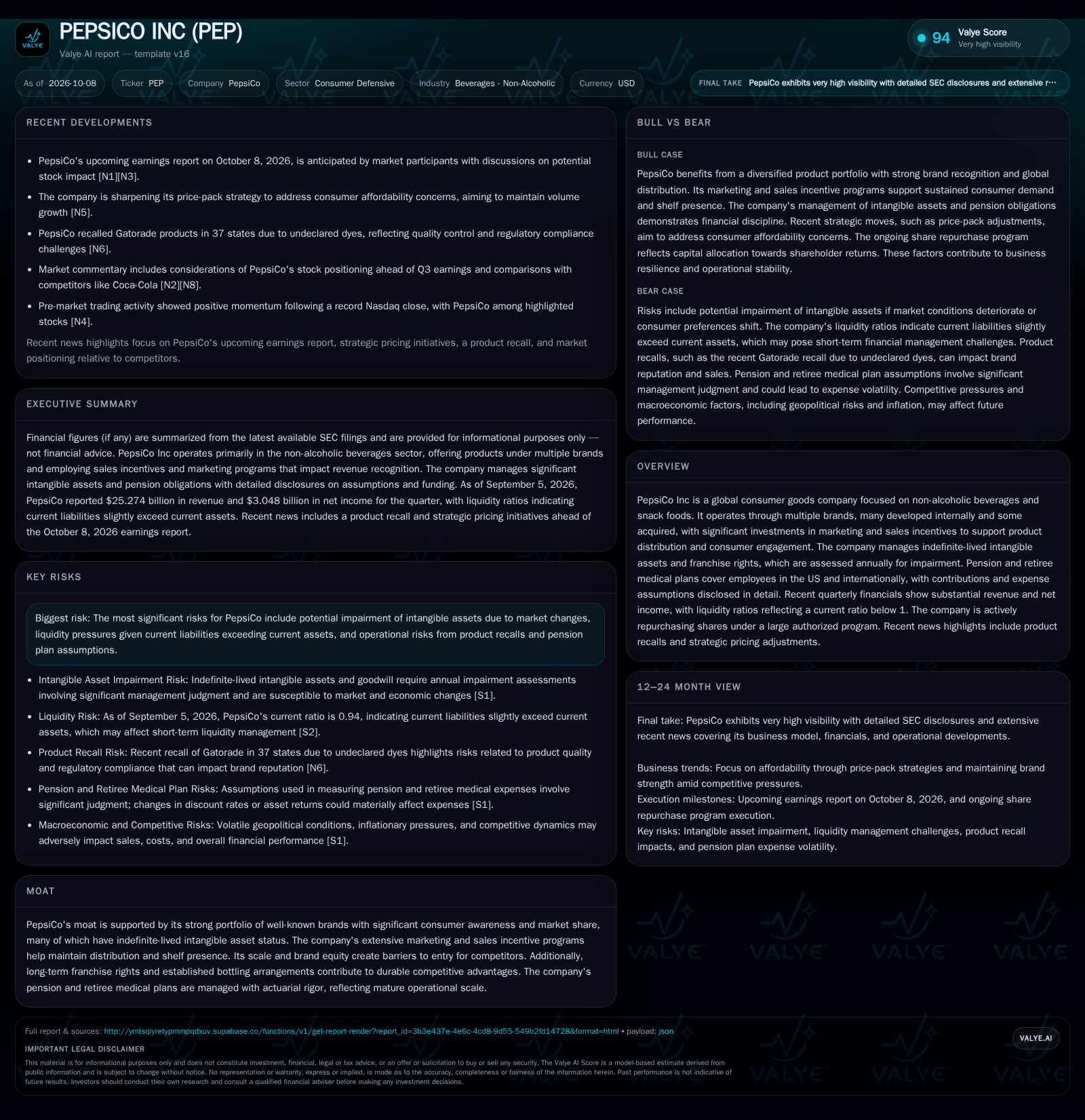
PepsiCo reported $25.3B in revenue and $3.05B in net income for the recent quarter, but its current ratio dipped below 1. The company is sharpening price-pack architecture to sustain volumes amid affordability concerns and is actively repurchasing shares. The upcoming earnings report could be a catalyst for sentiment shifts, depending on volume and margin outcomes. [S2] [N5] [N6]
The interplay between shareholder returns, operational execution, and financial discipline is now at the heart of the PepsiCo thesis.
Recent Financial Results and Strategic Moves Reshape the Near-Term Outlook
PepsiCo reported $25.274 billion in revenue and $3.048 billion in net income for the quarter ended September 5, 2026, confirming continued top-line scale and profitability. [S2]
In response to evolving consumer affordability concerns, PepsiCo is adjusting its price-pack strategy—offering smaller pack sizes or lower entry price points—to protect volumes without sacrificing brand positioning. This approach is designed to keep products within reach for price-sensitive consumers, particularly as inflationary pressures persist. [N5]
The company continues to return capital to shareholders, with a $10 billion share repurchase program authorized in February 2026 and 1.9 million shares repurchased in the most recent 12-week period. [S2]
A product recall of Gatorade in 37 states due to undeclared dyes has emerged as a near-term operational and reputational risk, potentially affecting consumer trust in one of PepsiCo’s flagship beverage lines. [N6]
How PepsiCo’s Brand Engine Converts Shelf Space and Scale into Profits
PepsiCo’s business model is anchored on the leverage of global brands across beverages and snacks, reinforced by heavy investments in marketing, sales incentives, and in-store promotions. The company’s revenue recognition is directly affected by these incentives, which are treated as reductions to gross revenue, highlighting the importance of promotional intensity in driving both top-line and share gains. [S1]
The economics of price-pack architecture are especially relevant in inflationary environments. By offering varied pack sizes and price points, PepsiCo can target multiple consumer cohorts, defend shelf space, and potentially maintain volume even as per-unit margins fluctuate. This strategy may compress margins in the short-term if lower-priced or smaller packs take share, but could preserve overall brand relevance and market share in the face of consumer downtrading.
Operating leverage is a double-edged sword: while PepsiCo’s scale enables efficient marketing and procurement, fixed costs in manufacturing, logistics, and pension obligations can magnify profit swings if volumes decline. Pension and retiree medical plans add another layer of expense variability, with costs sensitive to discount rate changes and asset returns. [S1]
With current liabilities now outpacing current assets, the margin for error in cash management may be narrowing. [S2]
Defending the Moat: Brand Equity, Distribution Reach, and Evolving Threats
PepsiCo’s moat is rooted in iconic brands, extensive distribution, and entrenched shelf presence, all of which are reinforced by ongoing investment in marketing and customer incentives. These attributes create substantial barriers to entry for new competitors and make PepsiCo a preferred partner for retailers seeking high-velocity SKUs.
However, the competitive landscape is dynamic. Peer companies in non-alcoholic beverages and snacks—including global giants and regional upstarts—compete aggressively on innovation, price, and promotional support. Private label and value brands can erode share, particularly when consumer wallets are stretched. The risk of substitution is real, especially if inflation or product recalls prompt consumers to switch to lower-cost alternatives.
Distribution partnerships and franchise rights further entrench PepsiCo’s position, but also introduce complexity. Franchisees’ financial health and willingness to invest in local execution can impact product availability and brand visibility. Regulatory scrutiny and shifting consumer preferences (e.g., health, sustainability) may also alter the long-term calculus of competitive advantage.
Intangible asset impairment is a latent risk—if brand equity deteriorates due to operational missteps or macro shocks, the carrying value of indefinite-lived intangibles could come under pressure. [S1]
If Price-Pack Strategy and Brand Investments Deliver: Pathways to Sustainable Share and Margin
In a favorable scenario, PepsiCo’s price-pack initiatives successfully keep products accessible to price-sensitive consumers without triggering a damaging race to the bottom. If these efforts sustain or even grow volume, the company could offset input cost inflation and protect gross margins through a mix of selective pricing, supply chain efficiencies, and premiumization in higher-end product lines.
The absence of further material product recalls or regulatory setbacks would allow management to focus on brand building and innovation.
Confirmation would come from reported volume growth (not just pricing), stable or expanding operating margins, and continued high return on invested capital. Investor confidence could be further bolstered by upward revisions to guidance, evidence of successful new product launches, and limited pension expense volatility.
Volume Stability Offsets Margin Pressures as PepsiCo Manages Through Macro Headwinds
The most plausible outcome is that PepsiCo achieves a delicate equilibrium: price-pack strategies prevent significant volume erosion, but increased promotional spending and a less favorable mix result in flat to slightly compressed operating margins. Pension obligations and working capital needs remain manageable but constrain incremental capital returns.
Brand equity and distribution scale allow PepsiCo to maintain its leadership position, but ongoing competition from both global peers and private label keeps pricing power in check. The company absorbs the operational impact of the recent product recall without a major loss of consumer trust, though some short-term sales softness in affected categories is possible.
Supporting evidence would include modest volume declines (if any), sequentially stable margin trends, and no significant increase in intangible asset impairment charges or pension-related expense volatility. Disconfirming evidence would be a sharp drop in volume, pronounced margin compression, or an adverse liquidity event.
Liquidity Tightens, Brand Events Escalate, and Margin Defenses Erode
If price-pack strategy fails to sustain volume, or if consumers trade down aggressively to private label after the Gatorade recall, both revenue and margin could come under pressure.
Should macroeconomic headwinds intensify or another significant product recall occur, brand equity could erode to the point where impairment of indefinite-lived intangibles becomes necessary, leading to non-cash charges and a further hit to investor confidence. Pension expense volatility could also spike if asset returns disappoint or discount rates shift materially.
In such a scenario, the company might face difficult trade-offs between sustaining capital returns and funding growth initiatives, potentially weakening investor confidence. If consumer sentiment shifts sharply due to reputational issues, recovery could require costly remediation efforts, further straining financial resources and accelerating intangible asset impairment risk.
What Will Determine Whether PepsiCo’s Brand and Balance Sheet Defenses Hold?
Quarterly volume trends by segment—especially beverages versus snacks—would help reveal whether price-pack strategies are maintaining or losing ground (if disclosed).
Gross margin and operating margin progression, particularly in the wake of promotional spending and product recall costs, will show if PepsiCo can defend profitability.
The magnitude and pace of share repurchases relative to free cash flow generation would clarify whether capital returns are sustainable.
Updates on pension expense and funding status—especially any changes in actuarial assumptions—would help test the risk of cost volatility.
Intangible asset impairment charges or related commentary in SEC filings would signal whether brand equity is under stress.
Consumer and retailer response to the Gatorade recall, as measured by shelf presence and market share, will be crucial for assessing brand resilience.
Any further product recalls or regulatory actions could compound operational and reputational risks, so tracking incident frequency and scope is important.
Disclaimer: This is research-only, informational analysis and not investment advice. It may include AI-generated interpretation and general industry context. Always verify important details using primary sources.

Comments