
Helen of Troy’s Strategic Reset: Brand Revitalization, Channel Risks, and the Road to Sustainable Growth
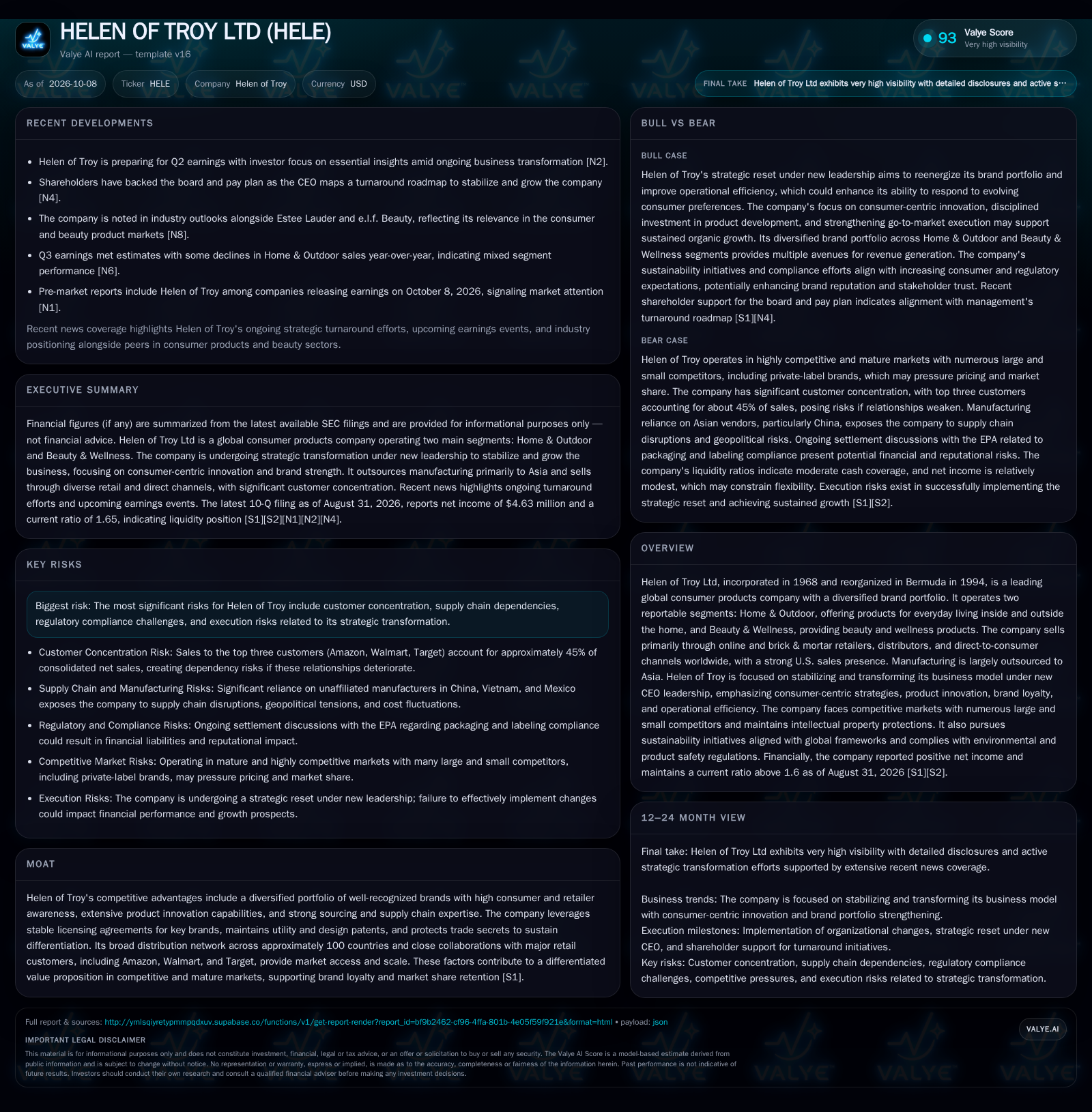
Helen of Troy is undertaking a high-visibility turnaround under new leadership, aiming to stabilize operations, energize its brand portfolio, and improve asset efficiency. While the company’s broad product reach and strong retailer relationships offer multi-segment opportunity, customer concentration and exposure to Asian supply chains pose persistent risks. Execution against its consumer-centric roadmap will likely determine whether Helen of Troy can translate modest current earnings into sustainable value.
Helen of Troy is in the midst of a strategic transformation, emphasizing brand rejuvenation and operational efficiency under new CEO leadership. With approximately 45% of sales tied to Amazon, Walmart, and Target, customer concentration is a significant risk factor.
Helen of Troy’s multi-brand consumer platform is at a pivotal juncture as new leadership attempts to reinvigorate growth through a consumer-centric, innovation-driven transformation. The company’s broad portfolio and global reach offer potential for renewed momentum, but execution risks loom large given heavy reliance on a handful of retail giants and Asian manufacturing partners. With modest recent earnings and a tightly managed balance sheet, Helen of Troy’s ability to deliver on its strategic promises will likely dictate its trajectory over the next several quarters.
Recent Performance and Strategic Reset: Turning Point or Temporary Pause?
Helen of Troy is actively implementing a strategic reset under new CEO leadership, aiming to stabilize its business, revitalize brands, and improve operational efficiency [S1] [N4]. The company’s latest quarterly net income was $4.63 million with basic EPS of $0.20, and it reported a current ratio of 1.65 as of August 31, 2026, indicating reported liquidity position but reported cash balance at $22.6 million [S2]. Notably, Amazon, Walmart, and Target together represented about 45% of consolidated net sales in fiscal 2026 [S1]. Recent segment results were mixed, with Home & Outdoor sales declining year-over-year, highlighting uneven progress across the portfolio [N6]. These factors collectively frame Helen of Troy’s current situation as one of both opportunity and significant risk, with the success of its transformation efforts likely to hinge on execution and resilience to external shocks.
How Helen of Troy’s Business Generates Value—and Where Margin Pressure Lurks
Helen of Troy’s multi-segment model leverages a portfolio of established brands across Home & Outdoor and Beauty & Wellness, selling through a mix of direct-to-consumer, e-commerce, and traditional retail channels [S1]. Revenue is driven by unit volume, product mix, and the strength of retailer relationships, with pricing power generally limited by the mature, competitive nature of its categories and the presence of private-label substitutes. The company’s outsourced manufacturing model, with 83% of finished goods sourced from Asia, supports variable cost flexibility but exposes it to supply chain volatility, input cost inflation, and potential tariff/geopolitical disruptions [S1].
Operating leverage is present but constrained: while scale in distribution and marketing can yield efficiencies, fixed costs in brand management and regulatory compliance remain significant. The company reported cash and liquidity metrics for the period; these figures do not by themselves establish operating runway, investment capacity, financial flexibility, or financing capacity. [S2] Capital needs are moderate, but execution on asset efficiency and inventory management will be critical to freeing up cash for strategic initiatives. The company’s ability to drive higher-margin innovation, reduce SKU complexity, and deepen direct-to-consumer engagement could be key to enhancing future profitability.
Brand Breadth Versus Battle for Shelf Space: Helen of Troy’s Place in a Crowded Market
Helen of Troy’s main advantage lies in its diversified, recognized brand portfolio—spanning OXO, Hydro Flask, Vicks, Braun, and more—which delivers both consumer awareness and leverage with retail partners [S1]. However, the competitive environment is intense, with numerous large multinational consumer goods firms and a steady stream of private-label entrants targeting both Home & Outdoor and Beauty & Wellness niches. The company’s reliance on a handful of major retailers amplifies the risk of unfavorable terms or shelf space loss if category performance lags or if retailers push private-label alternatives.
Defensive moats include ongoing investment in utility and design patents, trade secret protection, and stable licensing agreements. Yet, these are not insurmountable barriers—especially as consumer preferences shift rapidly and as competitors invest in digital engagement and influencer-driven marketing. Helen of Troy’s ability to maintain retailer mindshare, respond to evolving consumer trends, and differentiate through innovation will be decisive in defending share. Its global sourcing and distribution expertise are assets but may not fully offset the structural power of its largest channel partners or the risk of supply chain friction.
If Brand Revitalization and Supply Chain Stability Align, Margin Expansion Could Follow
A favorable outcome for Helen of Troy would involve successful execution of its consumer-centric transformation, resulting in revitalized brands, improved product innovation, and stronger direct-to-consumer engagement. If the company can leverage its broad portfolio to anticipate and meet changing consumer preferences—while using data-driven insights to optimize assortment and pricing—organic growth could accelerate. Enhancing operational efficiency, reducing inventory drag, and extracting better terms from suppliers and retailers would further support margin expansion.
Confirmation of this scenario would come from sustained improvement in segment sales (especially in Home & Outdoor), evidence of market share gains in targeted categories, and rising gross margin. Additional indicators would include improved cash flow from operations, reduced inventory levels, and increased direct-to-consumer penetration (if disclosed). Conversely, failure to demonstrate revenue or margin momentum, or continued volatility in key segments, would call the upside case into question.
Consumer Demand Remains Choppy as Helen of Troy Seeks to Stabilize Operations
The most plausible near-term scenario is a period of gradual stabilization, with uneven performance across the portfolio as the company works through its turnaround plan. Helen of Troy is likely to experience modest organic growth in some brands and categories, offset by softness in others, particularly if discretionary consumer spending remains muted. Pricing pressure from both branded competitors and private-label offerings will likely cap margin gains, even as cost discipline and operational improvements limit downside.
This base case would be confirmed by flat to modestly positive revenue growth at the consolidated level, stable or slightly improved segment margins, and continued support from major retail partners. The scenario would be challenged if there are significant customer losses, persistent supply chain disruptions, or margin compression beyond management’s control.
Disruption in Retail or Supply Chains Could Trigger Margin Erosion and Strategic Setbacks
A negative outcome could materialize if Helen of Troy’s largest retail partners reduce orders, shift shelf space to private-label products, or demand deeper concessions—directly impacting nearly half of the company’s sales [S1]. Simultaneously, any significant supply chain disruption (such as geopolitical instability in Asia or logistics bottlenecks) could lead to inventory shortages, higher costs, or missed sales windows. Regulatory or reputational setbacks—such as adverse outcomes from pending EPA settlement discussions—could further strain resources and brand equity.
This scenario would be confirmed by sharper-than-expected sales declines, particularly among top customers, deteriorating gross margins, or a spike in working capital needs. Additional red flags would include a drop in the current ratio, rising short-term debt, or negative free cash flow. Evidence of execution delays or failed product launches would further validate the downside case.
Benchmarks for Testing Helen of Troy’s Turnaround and Growth Ambitions
Quarterly sales trends and gross margin by segment, especially in Home & Outdoor and Beauty & Wellness, to assess whether the turnaround is driving improved performance.
Market share movements in key categories—if disclosed—would help evaluate the effectiveness of brand revitalization and innovation strategies.
Direct-to-consumer revenue growth (if disclosed), indicating success in building consumer relationships and reducing reliance on major retail partners.
Inventory turnover and working capital metrics to gauge operational efficiency and cash generation potential.
Customer concentration metrics and any changes in sales mix by major retailer, monitoring risk of over-reliance on Amazon, Walmart, and Target.
Progress on supply chain diversification, such as sourcing shifts away from Asia or investments in logistics resilience—if discussed.
Updates on regulatory matters, particularly the EPA settlement process and any associated financial or reputational impacts.
Disclaimer: This is research-only, informational analysis and not investment advice. It may include AI-generated interpretation and general industry context. Always verify important details using primary sources.

Comments