
NOVAGOLD: High-Stakes Project Advancement Hinges on Donlin Gold Feasibility and Financing
NOVAGOLD’s investment case is defined by its singular focus on advancing the Donlin Gold project—a world-class undeveloped gold resource in Alaska—through feasibility, permitting, and eventual construction. With no current production or cash flow, the company’s future is tethered to successful project de-risking, ongoing access to capital, and the volatile interplay of gold prices and regulatory outcomes.
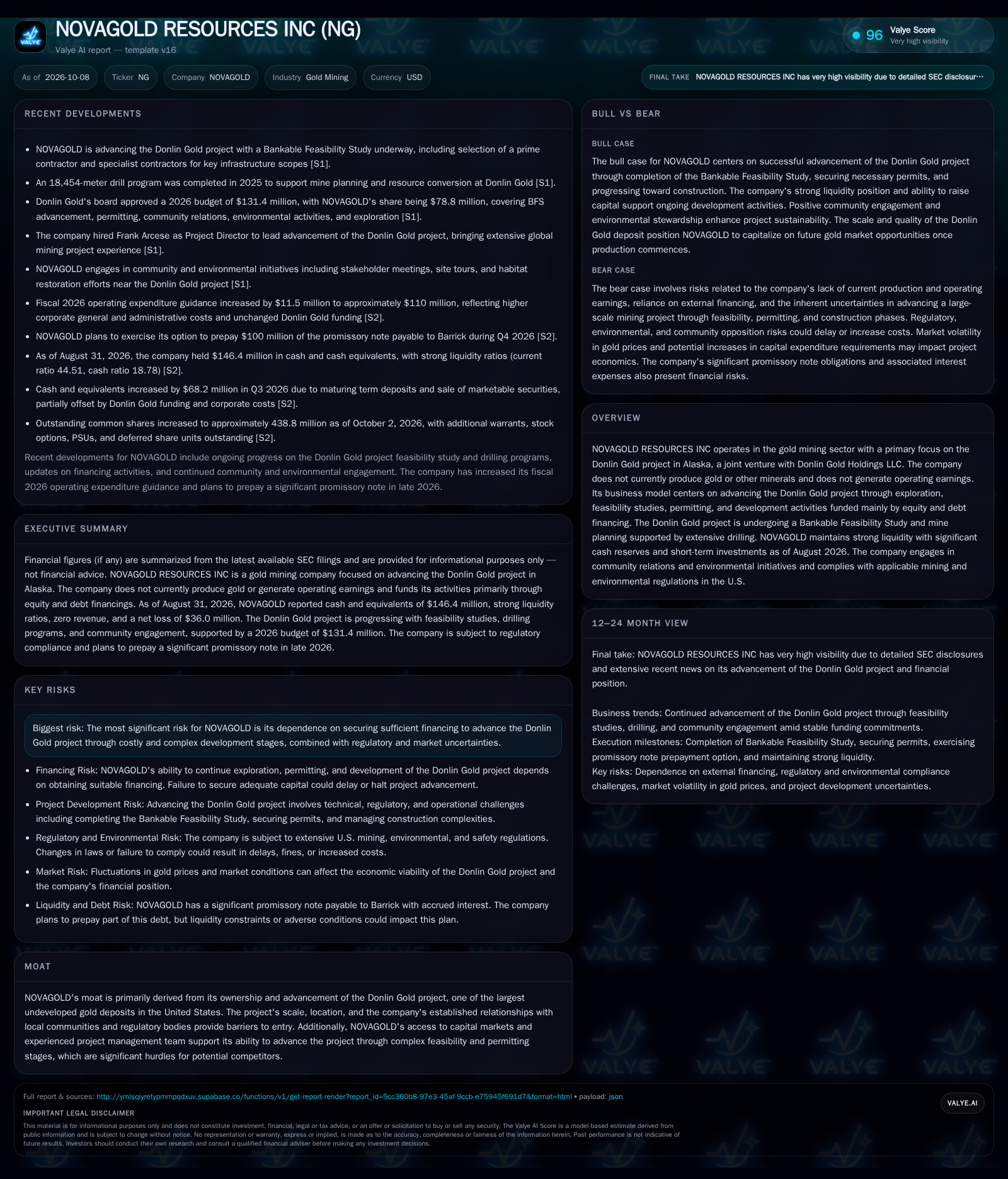
NOVAGOLD is a pre-production gold mining company with no current revenue, entirely dependent on progressing the Donlin Gold project in Alaska. The critical test for the equity is whether feasibility milestones and external funding can be sustained until Donlin Gold reaches a construction-ready state—and whether gold prices remain favorable enough to justify eventual build-out. [S2]
NOVAGOLD RESOURCES INC is a pure-play development-stage gold miner, wholly focused on the massive Donlin Gold project in Alaska. With no current gold production or operating earnings, the company’s strategy is to advance Donlin Gold through feasibility, permitting, and community engagement, funded by its substantial cash reserves and ongoing access to capital markets. [S2]
Donlin Gold Advancement and Near-Term Financial Commitments Define NOVAGOLD’s Current Position
NOVAGOLD’s operational and financial reality is shaped by three interlocking facts: First, the company is not generating revenue and reported a net loss of $36.0 million for the period ending August 31, 2026. Second, it maintains a reported liquidity position with $146.4 million in cash and equivalents, a current ratio of 44.51, and a cash ratio of 18.78. Third, NOVAGOLD is advancing the Donlin Gold project through a Bankable Feasibility Study (BFS), with a 2026 budget of $131.4 million (of which NOVAGOLD’s share is $78.8 million), following a major drill program and the hiring of an experienced Project Director. The company is also preparing to prepay $100 million on a promissory note due to Barrick in Q4 2026. These facts matter because they highlight NOVAGOLD’s status as a capital-intensive, pre-production developer with a single-asset focus—where liquidity, project milestones, and financial obligations are tightly interwoven and time-sensitive. [S2]
Project-Stage Economics: Capital Flows, Funding Cycles, and Eventual Leverage to Gold Prices
NOVAGOLD’s business model is classic single-asset project development: it spends capital to de-risk and advance the Donlin Gold project but generates no operating cash flow until (and if) the mine is built and commissioned. The company’s economics depend on periodic equity and debt financings, asset sales, and option exercises to fund its share of project expenses, which include feasibility studies, permitting, community relations, and environmental work. Operating leverage is negative in the current phase—costs are fixed or rising (notably, 2026 operating expenditure guidance rose by $11.5 million year-over-year due to higher corporate G&A), while revenue remains zero. [S2]
If Donlin Gold advances to construction and eventually production, NOVAGOLD’s economics would shift dramatically: the project’s large resource base could provide significant scale benefits, and the company would become highly leveraged to gold prices. However, this upside is theoretical until the project clears all feasibility, permitting, and financing hurdles. The capital requirements to build Donlin Gold are likely to be in the billions, requiring further equity dilution, joint venture arrangements, project debt, or a potential sale to a larger operator. Until then, NOVAGOLD’s value is a function of its ability to sustain funding and hit development milestones without excessive dilution or cost overruns.
Barriers and Counterforces: Donlin’s Scale vs. Industry Capital Discipline and Permitting Headwinds
NOVAGOLD’s principal competitive advantage is its 50% stake in Donlin Gold, one of the world’s largest undeveloped gold deposits located in a tier-one jurisdiction (Alaska, USA). This provides a substantial barrier to entry: few new projects globally combine scale, grade, jurisdictional stability, and advanced permitting. The company’s long-standing community engagement and regulatory compliance efforts may also reduce local opposition risks compared to greenfield entrants.
However, the competitive landscape in gold mining is shaped by several counterforces. First, capital markets have become more disciplined toward funding large, high-capex projects, especially those with long lead times and permitting risk. Peer companies with producing assets or royalty models may be favored by investors seeking lower risk or earlier cash flow. Second, permitting in North America has become more challenging, with environmental, indigenous, and regulatory hurdles that can delay or derail major projects. Third, alternative investment vehicles—such as gold ETFs or streaming/royalty companies—offer investors gold price exposure without project execution or permitting risk.
In sum, Donlin’s size and location are unique assets, but realizing their value requires overcoming significant sector-wide skepticism about capital intensity, permitting timelines, and development execution.
What a Re-Rating Would Require: Feasibility Success, Permitting Progress, and Gold Market Tailwinds
A favorable scenario for NOVAGOLD would see the Donlin Gold project successfully complete its Bankable Feasibility Study, with results confirming robust project economics even under conservative gold price assumptions. Permitting would proceed without major delays, supported by ongoing community engagement and environmental stewardship. The company would secure additional funding on favorable terms—potentially via strategic partnerships, royalty streams, or non-dilutive project finance—enabling it to move Donlin toward construction readiness without excessive dilution.
In this scenario, external catalysts such as a rising gold price environment would further enhance project NPV and investor appetite. NOVAGOLD shares could re-rate as the market prices in a credible path to production, with the company’s resource leverage and jurisdictional safety becoming more attractive.
Evidence that would confirm this scenario includes: positive BFS outcomes with clear cost estimates and IRR, timely receipt of key permits, new financing or joint venture announcements with minimal equity dilution, and continued positive momentum in gold prices. Conversely, failure to deliver a robust BFS, major permitting setbacks, or inability to secure funding would falsify this upside.
Development Continues, But Value Remains Latent Pending De-Risking Milestones
The most plausible near-term scenario is that NOVAGOLD continues to advance Donlin Gold through feasibility and permitting, funded by its current cash reserves and ongoing access to capital markets. The company exercises its planned $100 million promissory note prepayment, reducing near-term debt risk, and maintains good standing with local stakeholders and regulators.
However, the project remains years from construction and production, and the equity continues to trade as an option on eventual de-risking rather than as a cash-generating business. The market remains skeptical of large, high-capex projects, and NOVAGOLD’s valuation is capped by the uncertainties of permitting, financing, and gold price volatility.
Confirmation of this scenario would be steady, incremental progress on feasibility and permitting milestones, additional (but not transformative) funding rounds, and continued net losses without new sources of revenue. Evidence that would shift the thesis would include either a major permitting breakthrough (which could accelerate timelines) or a significant funding gap or regulatory setback (which could force a strategic reset).
Execution Stumbles, Capital Dries Up, or Permitting Delays Erode Option Value
In a negative scenario, NOVAGOLD faces material project delays or cost overruns in the Bankable Feasibility Study, eroding investor confidence and increasing the risk of funding shortfalls. Permitting challenges—whether from regulatory, environmental, or community opposition—could delay or block project advancement, consuming cash with no path to near-term value realization.
If gold prices weaken significantly, investor appetite for high-capex, long-duration projects could evaporate, further limiting NOVAGOLD’s ability to raise capital without punitive dilution. The company’s cash burn, coupled with ongoing obligations (including the large promissory note to Barrick), could force asset sales, a distressed financing, or even a strategic sale of its Donlin interest at a discount.
Evidence that would confirm this downside includes: negative or inconclusive BFS results, major permitting or legal setbacks, failed or highly dilutive capital raises, or a rapid erosion in gold price sentiment. A useful falsification would be the company’s ability to secure new funding at reasonable terms even in a weak gold market.
Milestones and External Factors That Will Shape NOVAGOLD’s Trajectory
Progress and outcomes of the Donlin Gold Bankable Feasibility Study—including updated capital cost and IRR estimates—will be critical signals for project viability and market perception.
Updates on permitting milestones: timely receipt of state and federal approvals, as well as evidence of continued local and indigenous community support, will be essential for project advancement.
The company’s ability to execute its planned $100 million prepayment on the Barrick promissory note in Q4 2026 as scheduled, and the impact on future interest obligations.
Disclosure of additional financing events—equity, project debt, royalty/streaming deals, or joint venture partnerships—and the terms of such funding, will test the sustainability of NOVAGOLD’s capital model.
Updates on the company’s operating expenditure guidance, especially if G&A or project costs trend higher than expected, would help assess cash burn and runway.
Gold price trends and investor sentiment toward large-scale, high-capex mining projects, which will affect both NOVAGOLD’s equity valuation and its ability to raise capital.
A useful metric (if disclosed) would be the company’s projected cash runway under various development and permitting timelines, factoring in all committed and contingent obligations.
Any significant change in the regulatory or political environment in Alaska or at the federal level that could accelerate or impede the Donlin Gold permitting process.
Disclaimer: This is research-only, informational analysis and not investment advice. It may include AI-generated interpretation and general industry context. Always verify important details using primary sources.

Comments