
Byrna Technologies: Liquidity Strength, Product Innovation, and the Challenge of Achieving Sustainable Profitability in Non-Lethal Protection
Byrna Technologies maintains reported liquidity position amid ongoing net losses, a recent CEO transition, and persistent revenue headwinds. The company’s future hinges on converting product innovation and e-commerce reach into market acceptance and margin improvement in a competitive and highly regulated non-lethal protection landscape.
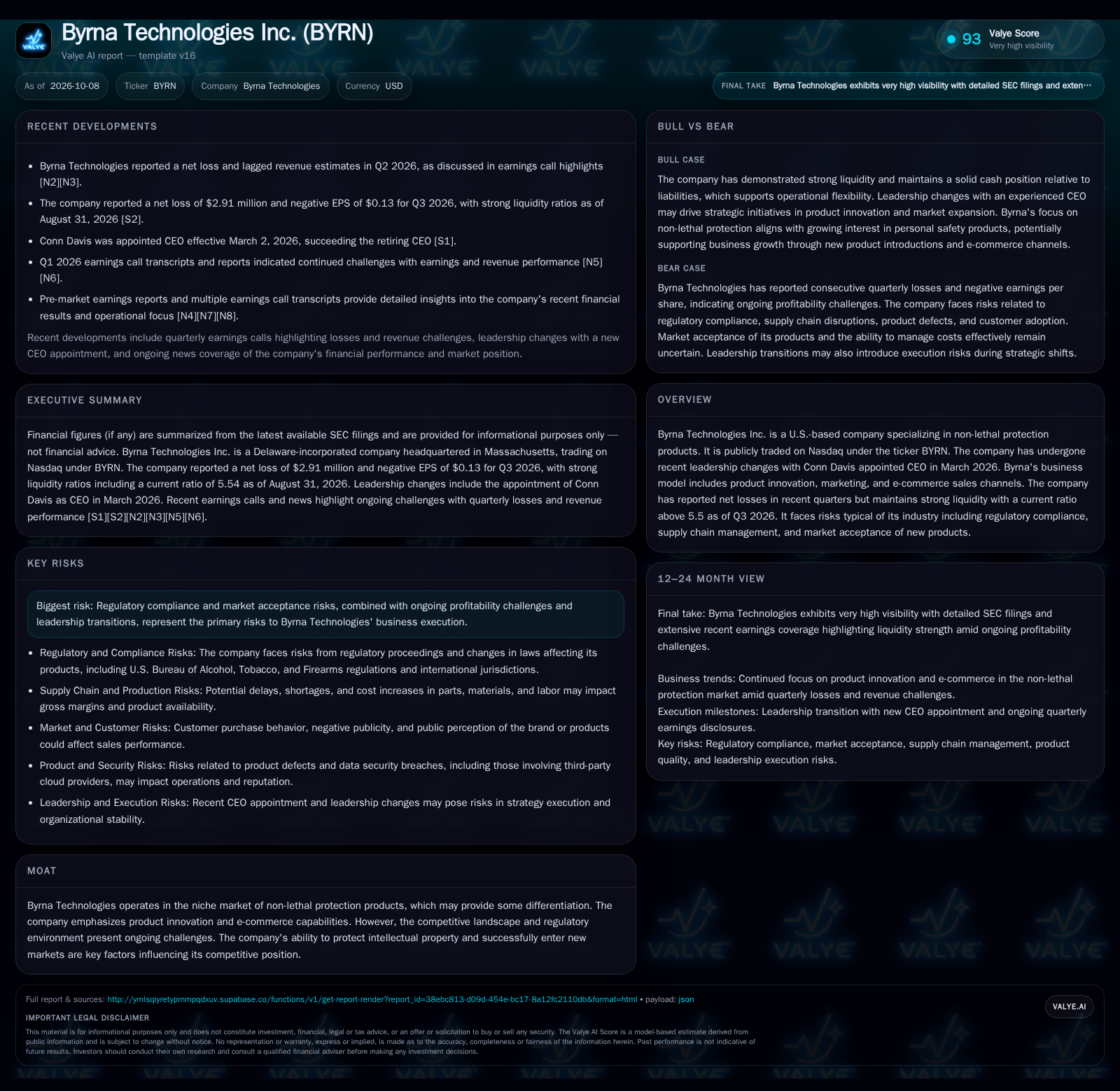
Byrna Technologies, a U.S.-based provider of non-lethal protection products, reported a Q3 2026 net loss of $2.91 million despite a reported current ratio and cash position. The appointment of CEO Conn Davis in March 2026 signals a new strategic phase, but ongoing revenue and profitability challenges underscore the need to translate product and channel investments into sustainable growth and earnings [S2].
Byrna Technologies, operating in the niche market of non-lethal personal protection, finds itself at a critical juncture. The recent CEO transition aims to revitalize Byrna’s strategy, but sustainable profitability will depend on successfully translating product innovation and e-commerce initiatives into market traction, while navigating regulatory and operational headwinds [S2].
Liquidity Outpaces Profit Amid Leadership Transition
Byrna Technologies reported a net loss of $2.91 million and negative EPS of $0.13 for the quarter ended August 31, 2026, extending a string of recent quarterly losses [S2]. The company reported cash and liquidity metrics for the period; these figures do not by themselves establish operating runway, investment capacity, financial flexibility, or financing capacity. [S2] The company also underwent a significant leadership change in March 2026, appointing Conn Davis as CEO, which may signal a shift in strategic priorities or operational approach [S1]. These developments set the stage for a business that is financially stable in the short run, but in need of a credible path to profitability and growth.
Liquidity alone does not mitigate the risks posed by ongoing net losses, which, if persistent, could erode potential financial flexibility and increase reliance on external financing. Additionally, the leadership transition introduces both opportunities and uncertainties: new strategic directions may accelerate operational improvements but also require upfront investments that strain cash flow before benefits materialize. Monitoring the cadence and effectiveness of management’s execution under the new CEO will be vital to assessing whether liquidity can be preserved or enhanced over time.
Non-Lethal Protection: Product-Driven Model with E-Commerce Potential
Byrna operates in the non-lethal personal protection market, focusing on product innovation and marketing through e-commerce and potentially other retail channels [N2] [N3] [N5]. Revenue generation likely depends on a combination of direct-to-consumer sales—leveraging e-commerce for reach and margin—and wholesale to retailers or distributors. The economics of this model may be characterized by relatively high gross margins if the company can maintain premium pricing, but also by significant fixed costs in R&D, regulatory compliance, and marketing. Operating leverage could materialize if Byrna achieves higher sales volumes, allowing fixed costs to be spread over a larger base.
The economics of Byrna’s business model hinge on balancing innovation-driven product differentiation with scalable distribution and cost control. Given the fixed-cost intensity of R&D and regulatory compliance, achieving sufficient sales volume is essential to unlocking operating leverage. However, the niche nature of non-lethal protection products may limit market size and growth velocity, which constrains the pace at which fixed costs can be absorbed. Moreover, the reliance on e-commerce channels introduces variability in customer acquisition costs and requires sustained investment in digital marketing and fulfillment capabilities. If Byrna can optimize its channel mix to favor higher-margin direct sales while maintaining wholesale relationships for broader reach, it could enhance unit economics. Conversely, failure to improve customer retention or increase average order value may perpetuate margin pressure.
Differentiation and Barriers: Navigating a Crowded, Regulated Landscape
Byrna’s competitive position rests on innovation in non-lethal protection products and the ability to differentiate via branding, product features, and distribution reach. The company operates in a niche, but not uncontested, space—facing competition from other non-lethal device makers (such as pepper spray, taser, and less-lethal firearm manufacturers), as well as broader security and self-defense solution providers. Regulatory complexity, both in the U.S. and abroad, creates barriers to entry but also ongoing compliance costs and risks. Intellectual property protection may offer some moat, but the risk of imitation or substitution is real unless Byrna can build a compelling ecosystem or strong customer loyalty. E-commerce capabilities could provide an edge in customer acquisition and data-driven marketing, but these advantages are not unique and can be eroded by larger, better-capitalized rivals or new entrants if market adoption stalls.
In an environment characterized by regulatory complexity and evolving consumer preferences, Byrna’s ability to maintain differentiation depends not only on product innovation but also on building a resilient brand and customer ecosystem. Intellectual property protections can provide a temporary moat, but competitors may circumvent these through alternative technologies or lower-cost substitutes. Therefore, sustained competitive advantage may require continuous innovation cycles and investments in customer engagement to foster loyalty. Additionally, regulatory compliance costs and potential shifts in legal frameworks introduce operational risks that can disproportionately affect smaller players. While e-commerce offers agility and data-driven marketing benefits, these advantages are susceptible to diminishing returns as competition intensifies and customer acquisition costs rise. Strategic partnerships or exclusive distribution agreements could help Byrna mitigate these risks and reinforce market positioning.
Market Acceptance and Channel Scale Unlock Margin Expansion
In a favorable scenario, Byrna successfully leverages its product innovation pipeline and e-commerce strategy to drive accelerated sales growth and improved operating leverage. Key catalysts could include a breakout product that resonates with consumers, viral marketing or influencer-driven adoption, and successful entry into new geographic or demographic markets. Robust e-commerce execution could yield better margins relative to wholesale channels, while increased scale would help absorb fixed costs and move the company toward sustained profitability. Evidence supporting this scenario would include a return to revenue growth, narrowing quarterly losses, and positive operating cash flow, as well as expanded gross margins and growing market share—if disclosed in future filings or earnings calls.
Incremental Progress Amid Persistent Margin Pressure
The most plausible near-term path for Byrna is one of incremental improvement: modest revenue growth driven by ongoing product launches and marketing, but continued margin pressure from competition, regulatory costs, and supply chain volatility. The company may be able to stabilize losses through cost controls and operational efficiencies, but a rapid return to profitability is unlikely without a step-change in demand or a significant reduction in input costs. Confirmation of this scenario would come from stable or slightly improving revenue and gross margin trends, continued but narrowing net losses, and steady liquidity metrics. Conversely, further revenue stagnation or widening losses would challenge even this moderate outlook.
Liquidity Erosion If Revenue and Cost Structure Remain Misaligned
If Byrna fails to gain traction with its products or faces unforeseen regulatory, supply chain, or reputational setbacks, the current pattern of losses could accelerate. Key warning signs would be a rapid drawdown in cash and short-term investments, a deteriorating current ratio, and persistent or deepening net losses. External shocks such as regulatory bans, product recalls, or negative publicity could further amplify downside risks.
What Will Determine Byrna’s Next Phase: Milestones to Track
Quarterly revenue growth trends: Sustained top-line improvement would indicate progress in market acceptance and channel execution.
Gross margin trajectory: Improvements may signal better product mix, pricing power, or cost control; deterioration would raise red flags.
Operating cash flow, if disclosed: Positive cash flow from operations is critical to self-funding growth and reducing reliance on the balance sheet.
Rate of cash and short-term investment drawdown: Accelerating cash burn could foreshadow liquidity stress, while stability would support resilience.
Updates on regulatory or legal proceedings: Material developments could affect market access, cost structure, or product roadmap.
Product launch cadence and adoption metrics (if disclosed): Evidence of successful new product introductions or strong customer uptake would validate the innovation strategy.
Management commentary on channel strategy and cost management: Concrete disclosures about e-commerce traction, wholesale relationships, or cost-reduction initiatives would clarify the business model’s scalability.
Any signals of external capital needs or debt financing: Announcements of new financing or credit facilities may indicate balance sheet pressure or planned growth investments.
Disclaimer: This is research-only, informational analysis and not investment advice. It may include AI-generated interpretation and general industry context. Always verify important details using primary sources.

Comments