
AngioDynamics: Margin Expansion, Med Tech Momentum, and the Strategic Stakes of Leadership Change
AngioDynamics is leveraging strong growth and margin improvement in its Med Tech segment to offset persistent net losses and external headwinds. With a new CEO at the helm and an expanding portfolio of minimally invasive devices, the company’s ability to navigate macroeconomic, regulatory, and competitive pressures will determine whether recent operational improvements can translate into sustainable profitability.
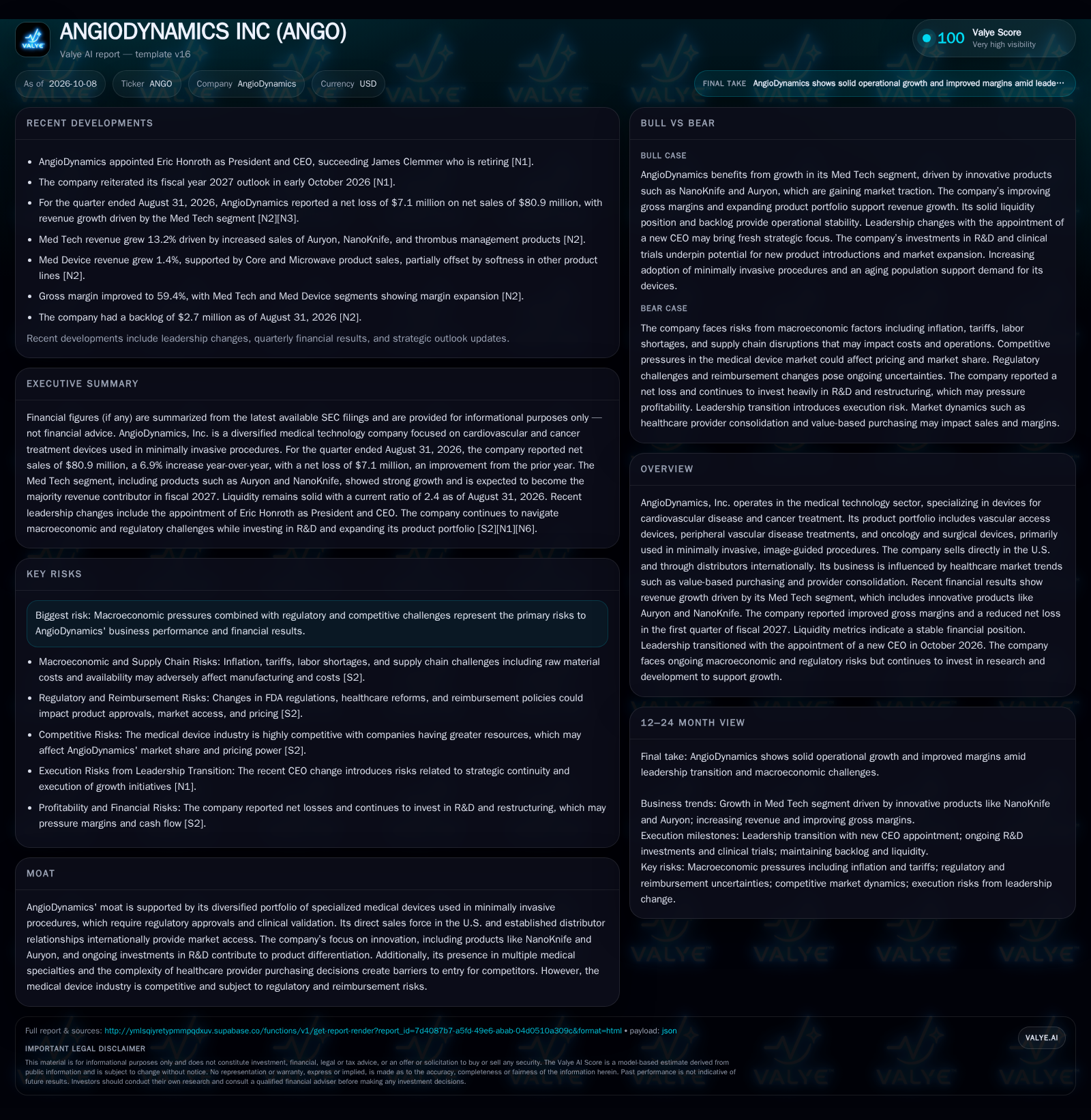
AngioDynamics reported a 6.9% year-over-year sales increase, gross margin expansion to 59.4%, and a narrowed net loss for the quarter ending August 31, 2026. Growth is concentrated in the Med Tech segment, led by platforms such as Auryon and NanoKnife. The appointment of a new CEO introduces both strategic opportunity and execution risk. The company faces ongoing macroeconomic, regulatory, and competitive challenges, with its core thesis hinging on whether innovation and operational discipline can drive durable margin gains and eventual profitability. [S2] [N1] [N2]
AngioDynamics enters FY27 with tangible momentum in its Med Tech segment, reflected in double-digit revenue growth and significant gross margin gains. Yet, despite narrowing its net loss and maintaining a reported liquidity position, the company continues to operate at a loss amid persistent external and internal headwinds. The recent leadership transition brings both an opportunity for strategic renewal and the risk of execution missteps. With its core markets shaped by healthcare consolidation, value-based purchasing, and intensifying competition, AngioDynamics’ ability to translate innovation and operational improvements into sustained profitability remains the central question.
Recent Results Highlight Operational Gains and Strategic Transition
For the quarter ended August 31, 2026, AngioDynamics reported net sales of $80.9 million, up 6.9% year-over-year, with growth concentrated in the Med Tech segment, which expanded 13.2% compared to a modest 1.4% increase in Med Device [S2]. Gross margin improved to 59.4%, up from 55.3% in the prior year, with Med Tech margins notably higher at 66.2% [S2]. [S2] The appointment of Eric Honroth as CEO marks a significant leadership change, introducing both strategic opportunity and execution risk [N1].
Med Tech Outperformance and the Pursuit of Operating Leverage
AngioDynamics generates revenue by selling a mix of disposable and temporarily implanted medical devices for minimally invasive procedures, primarily through direct sales in the U.S. and distributors internationally [S2]. The company’s product mix is shifting toward higher-value, innovation-driven platforms in the Med Tech segment—particularly Auryon (atherectomy), NanoKnife (IRE cancer therapy), and thrombus management—which carry structurally higher gross margins compared to legacy Med Device offerings. This mix shift contributed to the reported gross margin expansion, with Med Tech reaching 66.2% versus 52.7% for Med Device [S2].
Despite these gains, AngioDynamics remains loss-making, underscoring the drag from fixed costs (SG&A, R&D) and the need to reach greater scale or cost efficiency to achieve sustainable profitability. The business is capital-intensive, requiring ongoing R&D investment for clinical validation, regulatory clearances, and product lifecycle management. If the Med Tech segment becomes the majority of revenue, as management has indicated is possible in FY27 [N6], blended margins could continue to rise, but the pace and sustainability of this transition are key variables.
Innovation, Regulatory Barriers, and the Challenge from Larger Device Players
AngioDynamics operates in highly competitive segments of the medical device industry, facing both global diversified device manufacturers and focused niche players. The company’s competitive positioning is anchored in its specialized platforms for minimally invasive procedures, which require significant regulatory approvals and clinical validation, creating moderate barriers to entry for new competitors. Its direct sales force in the U.S. and established international distribution channels provide access, but do not guarantee share retention in the face of well-capitalized rivals.
Product innovation—exemplified by the Auryon and NanoKnife platforms—offers differentiation, but sustaining this edge requires ongoing R&D and successful clinical adoption. Larger competitors may have greater resources to invest in clinical trials, marketing, and pricing flexibility, potentially pressuring AngioDynamics’ market share and margins. Additionally, healthcare provider consolidation and the shift to value-based purchasing models may favor vendors with broader portfolios or bundled solutions, raising the importance of scale and integration capabilities.
Med Tech Scale and Margin Expansion Drive a Path to Profitability
A favorable scenario for AngioDynamics would see continued double-digit growth in the Med Tech segment, with Auryon and NanoKnife gaining greater adoption driven by clinical evidence, expanded indications, and successful reimbursement strategies. As Med Tech becomes the majority of revenue, the company’s blended gross margin could rise further, narrowing or potentially eliminating net losses if operating expenses are contained or scale efficiently.
Confirmation of this scenario would come from sustained Med Tech revenue outperformance, further gross margin improvement, and a trend toward positive operating income. Additional signals would include new product launches, favorable clinical trial results, and expanded payer coverage for flagship platforms. A durable backlog and stable or improving liquidity would support the ability to invest in growth. Evidence that would falsify the upside case includes stalled Med Tech growth, margin compression, or an inability to control fixed costs despite revenue gains.
Margin Gains Offset by External Headwinds and Slower Device Growth
The most plausible path is that AngioDynamics continues to grow Med Tech revenue at a healthy, but potentially moderating, pace while legacy Med Device growth remains sluggish. Gross margins improve incrementally as mix shifts, but net losses persist due to ongoing R&D investment, inflationary cost pressures, and the need to maintain a broad commercial infrastructure.
This scenario would look like quarterly revenue growth in the mid-single digits, gross margin gains of 100–200 basis points per year, and a slow narrowing of operating losses. Confirmation would come from steady Med Tech growth, contained operating expenses, and resilience in the face of macroeconomic and reimbursement headwinds. Falsification would include a reversal in margin trends, accelerating losses, or evidence of market share erosion due to competitive or regulatory setbacks.
Margin Pressure and Execution Risks Undermine the Med Tech Growth Thesis
A negative scenario could unfold if macroeconomic pressures—such as inflation, tariffs, or supply chain disruptions—raise input costs faster than AngioDynamics can offset through price or volume gains. Regulatory setbacks, unfavorable reimbursement changes, or clinical trial failures could stall adoption of Med Tech platforms, stalling or reversing revenue growth and compressing margins.
Leadership transition risk is also material; if the new CEO’s strategic changes disrupt execution or alienate key customers, commercial momentum could be lost. This scenario would be confirmed by declining Med Tech sales, margin contraction, rising net losses, and potential liquidity strain if cash burn accelerates. Additional warning signs would include increased customer churn, regulatory warnings, or the need for external financing.
Benchmarks That Will Clarify AngioDynamics’ Path to Sustainable Margin Gains
Quarterly Med Tech segment revenue growth: Sustained double-digit growth would support the margin expansion thesis, while a slowdown would raise questions about adoption and competitive positioning.
Gross margin by segment: Continued improvement, especially in blended and Med Tech gross margins, would indicate successful mix shift and pricing discipline.
Net loss and operating cash flow trends: A narrowing net loss and movement toward positive operating cash flow would signal progress toward sustainable profitability.
R&D expense as a percentage of sales: Monitoring whether R&D investments are yielding commercial returns or pressuring margins will be essential.
Backlog evolution: Growth or stability in backlog, if disclosed, would provide early visibility into future demand.
Major regulatory or reimbursement developments: Approvals, denials, or policy shifts affecting key platforms would have a direct impact on growth prospects.
Execution under new CEO: Evidence of strategic clarity, retention of key talent, and successful product launches would help test whether the leadership transition strengthens or weakens the company’s trajectory.
Disclaimer: This is research-only, informational analysis and not investment advice. It may include AI-generated interpretation and general industry context. Always verify important details using primary sources.

Comments