
Richardson Electronics: Margin Stability and Segment Growth Meet Global Trade and Mix Pressures
Richardson Electronics achieved a 9.4% year-over-year sales increase in fiscal 2026, returning to profitability with $6.4 million in net income and a 31.2% gross margin.
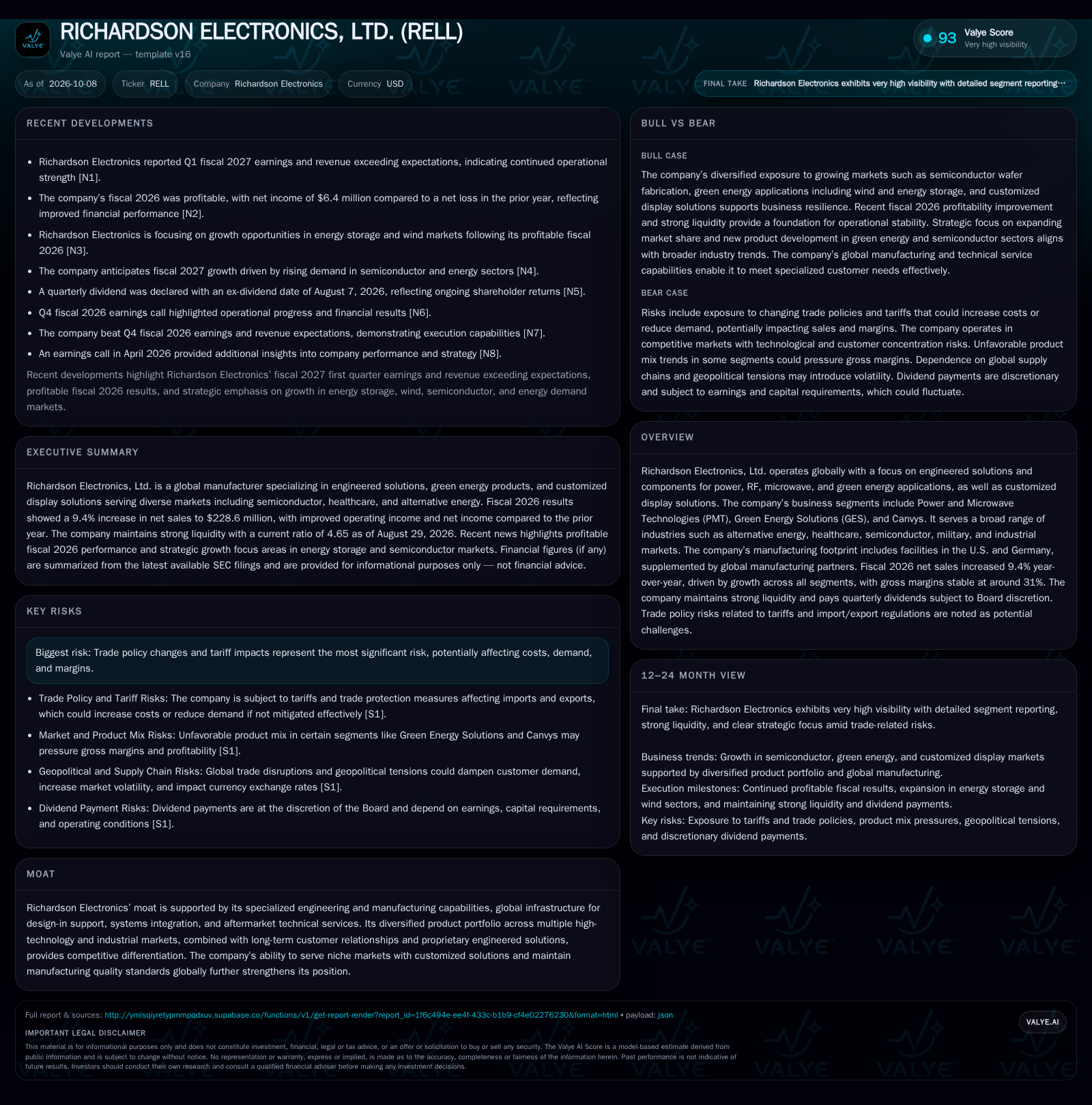
Richardson Electronics achieved a 9.4% year-over-year sales increase in fiscal 2026, returning to profitability with $6.4 million in net income and a 31.2% gross margin. All business segments contributed to growth, but product mix effects varied, with PMT margins improving and GES and Canvys margins pressured. [S1] [S2]
Richardson Electronics enters fiscal 2027 with renewed profitability, stable gross margins, and segment-wide sales momentum. As a diversified supplier to semiconductor, green energy, and industrial sectors, the company’s financial turnaround in fiscal 2026 underscores its ability to capture growth opportunities across its Power and Microwave Technologies, Green Energy Solutions, and Canvys segments. Yet, the path forward is shaped by its exposure to global trade policies, product mix headwinds in certain segments, and the critical need to execute in emerging energy and semiconductor markets, which will determine whether recent gains prove durable.
Fiscal 2026: Segment Growth, Margin Stability, and Profit Recovery
Richardson Electronics posted a 9.4% increase in net sales for fiscal 2026, reaching $228.6 million, with all three segments—Power and Microwave Technologies (PMT), Green Energy Solutions (GES), and Canvys—reporting positive growth. PMT sales rose 9.1%, GES increased 7.3%, and Canvys grew 12.4%. Gross margin improved marginally to 31.2%, up from 31.0%, driven by a favorable product mix in PMT, though GES and Canvys experienced margin pressure from less favorable mixes. The company returned to profitability, generating $6.5 million in operating income and $6.4 million in net income after a loss in the prior year. As of August 29, 2026, Richardson Electronics reported $36.9 million in cash and equivalents, a current ratio of 4.65, and a cash ratio of 0.96. The cited source reports dividend-related activity; that disclosure alone does not establish dividend-policy continuity, management confidence, or a material constraint on capital flexibility. [S1] [S2]
Segment Dynamics and the Economics of Diversification
Richardson Electronics’ revenue streams are diversified across engineered power systems, green energy components, and customized display solutions. Each segment exhibits distinct economic profiles: PMT benefits from higher-margin, specialized RF/microwave components and aftermarket services that can command premium pricing and recurring demand in sectors like semiconductor manufacturing and defense. GES is exposed to fast-growing but price-competitive markets such as wind and energy storage, where innovation and scale are critical for margin expansion but product commoditization can pressure profitability. Canvys, as a provider of customized displays, serves OEMs with design-driven, lower-volume orders—typically yielding solid gross margins but susceptible to swings based on client project timing and mix.
Operating leverage is evident in the swing from operating loss to profit as sales rose, suggesting a cost base that can support incremental volume without proportional increases in expenses. However, the company’s exposure to global supply chains and tariff regimes means that variable input costs (especially in GES) can fluctuate, impacting gross margin sustainability. Capital intensity is moderate: manufacturing occurs both in-house (notably in the U.S. and Germany) and with global partners, supporting flexibility but also introducing supply chain complexity. The company reported cash and liquidity metrics for the period; these figures do not by themselves establish operating runway, investment capacity, financial flexibility, or financing capacity.
Niche Engineering, Global Reach, and Competitive Friction
Richardson Electronics occupies a differentiated position by combining proprietary engineering, global manufacturing, and technical service capabilities. In PMT, it competes with both large diversified electronics suppliers and niche component specialists, where barriers include qualification cycles, technical know-how, and long-term customer relationships. The GES segment faces competition from both established industrial conglomerates and emerging green tech firms, with the pace of innovation and cost structure as key battlegrounds. Canvys competes in a fragmented market for customized display solutions, where integration, reliability, and responsiveness are valued but price competition remains intense.
Switching frictions for customers can be meaningful in highly regulated or mission-critical applications (e.g., medical imaging tubes, semiconductor manufacturing), where qualification and support requirements are high. However, in green energy and display solutions, substitution risk is higher due to commoditization and the presence of multiple global suppliers. Richardson’s moat is reinforced by its ability to deliver highly engineered, customized solutions and its global service network, but it must continuously invest in R&D and customer support to stay ahead of both established players and fast-moving innovators.
What Sustained Execution in Energy and Semiconductor Markets Could Unlock
The most favorable outcome arises if Richardson Electronics capitalizes on rising demand in semiconductor manufacturing and energy storage, successfully scaling new product introductions and capturing share in higher-margin niches. In this scenario, sustained double-digit growth in GES and PMT, along with continued margin improvement, could drive operating leverage and further earnings expansion. The company’s global manufacturing and design-in capabilities would allow it to respond quickly to customer needs, while its diversified segment mix would buffer against volatility in any single market.
Evidence confirming this scenario would include: accelerating segment sales growth in PMT and GES above market averages; gross margin expansion driven by better product mix; new multi-year customer wins in semiconductor and energy storage sectors; and increased R&D investment translating to differentiated product launches. Additional signs would be stable or growing dividends and further improvement in operating income and net income, suggesting that the company is not only growing but doing so profitably. [N3] [N4] [S1]
Mixed Product Dynamics and Global Volatility Shape the Near-Term Trajectory
The most plausible outlook is that Richardson Electronics maintains modest revenue growth across all three segments, with margin trends determined by the ongoing tug-of-war between favorable PMT mix and pressure in GES and Canvys. The company continues to benefit from secular demand in semiconductors and green energy, but faces periodic headwinds from trade policy shifts, input cost inflation, and competitive pricing in lower-margin product lines.
Under this scenario, gross margin remains in the low-30s, with operating income and net income tracking incremental sales growth rather than dramatic margin expansion. Confirming evidence would include steady (but not accelerating) segment growth, stable gross margins near historical averages, and continued generation of positive operating cash flow. Falsification would be a material swing in margins—up or down—or an abrupt sales contraction in a core segment driven by external shocks or loss of major customers. [S1] [N4]
Trade Disruptions and Adverse Mix Could Erode Profitability
An adverse scenario unfolds if global trade tensions escalate, resulting in higher tariffs or supply chain disruptions that raise input costs or delay deliveries—especially affecting GES and globally sourced components. Simultaneously, if unfavorable product mix trends persist in GES and Canvys—such as a shift toward lower-margin, commoditized offerings—gross margins could compress, eroding operating profitability. This would be exacerbated if demand in key end markets (e.g., semiconductors, alternative energy) slows due to macroeconomic or policy shocks.
Evidence supporting this scenario would be a sequential decline in gross margins below 30%, a return to operating losses, or the suspension/reduction of dividend payments. Additional signs would include management commentary highlighting tariff-related cost increases, disruptions in global manufacturing or logistics, or declining segment sales in GES and Canvys. A useful metric would be the degree of pass-through pricing power Richardson retains in the face of rising input costs—if disclosed. [S1]
Metrics and Milestones That Will Reveal Richardson Electronics’ Trajectory
Quarterly and annual segment sales growth in PMT, GES, and Canvys—especially compared to market growth rates and peers.
Gross margin trends by segment, with particular attention to the sustainability of margin improvement in PMT and the trajectory of GES and Canvys margins.
Product mix disclosures within each segment, if provided, to assess the shift toward higher- or lower-margin offerings.
New customer wins, contract awards, or multi-year agreements in semiconductor and energy storage markets—a useful metric would be disclosed backlog or pipeline.
Updates on tariff, trade policy, or supply chain disruptions, including management’s mitigation strategies and cost pass-through ability.
R&D and capital expenditure levels, indicating ongoing investment in differentiated product development and manufacturing capabilities.
Disclaimer: This is research-only, informational analysis and not investment advice. It may include AI-generated interpretation and general industry context. Always verify important details using primary sources.

Comments