
APPlife Digital Solutions: Severe Liquidity Pressures and Structural Risks Challenge Business Viability
Despite generating modest revenue, APPlife Digital Solutions faces critical solvency and governance challenges. With defaults on debt, a near-absence of liquidity, and governance concentrated among insiders, the company’s ability to operate as a going concern is highly uncertain, and any operational improvement will require urgent capital restructuring.
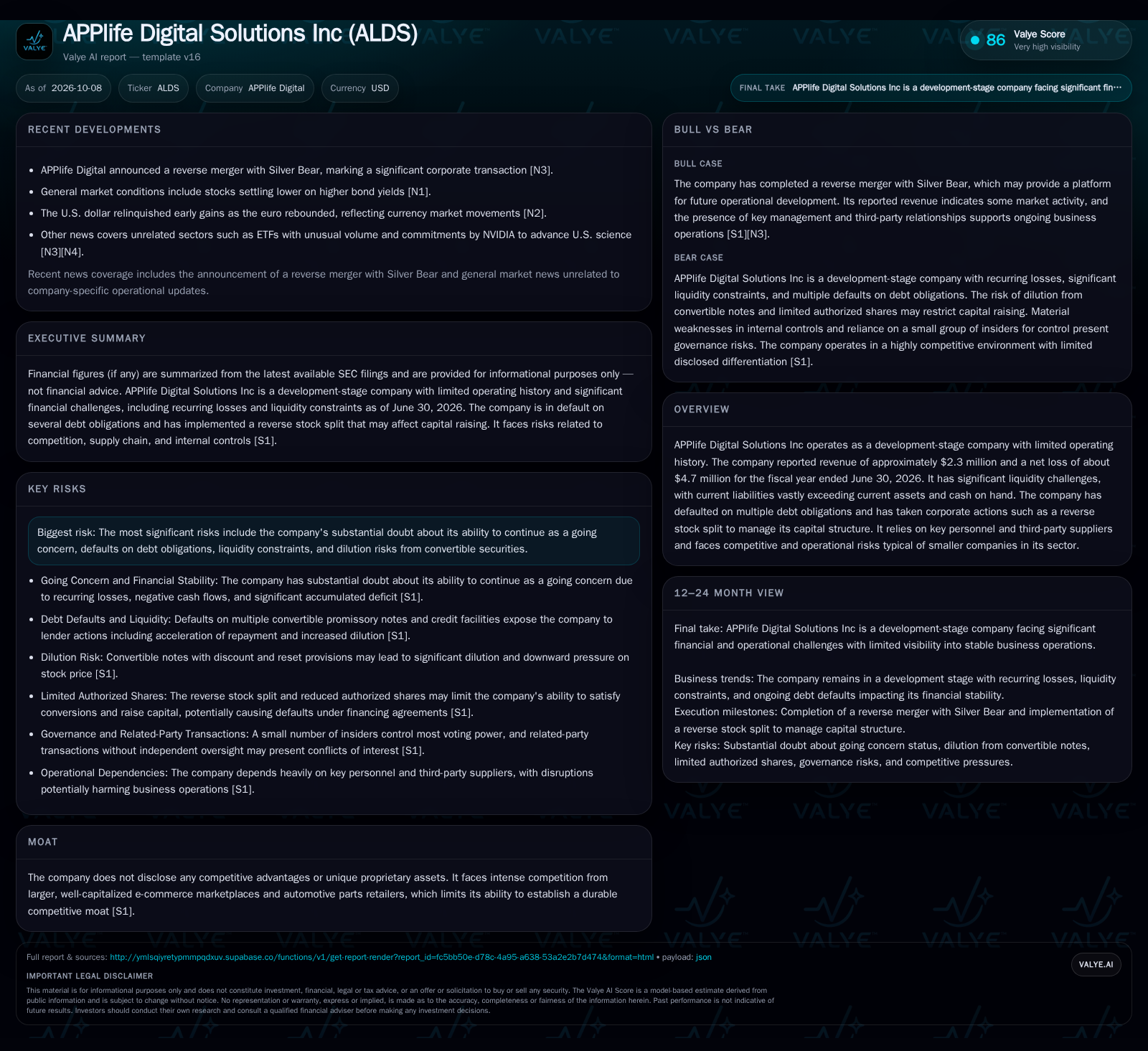
APPlife Digital Solutions Inc reported $2.3 million in revenue but a net loss of $4.7 million for FY2026. The company’s liquidity is critically constrained, with just $21,725 in cash against $4.1 million in current liabilities and multiple debt defaults. A recent 1-for-250 reverse stock split and reduced authorized shares further limit capital-raising flexibility. Insider control, related-party transactions, and material weaknesses in internal controls compound governance and operational risks, leaving the company’s future highly dependent on external capital or restructuring [S1].
APPlife Digital Solutions Inc’s financial position as of June 30, 2026 is stark: the company is operating with minimal cash, outsized liabilities, and in default on several debt instruments. While it managed to generate $2.3 million in revenue, its losses are mounting, and the reverse stock split has curtailed its flexibility to raise equity capital. The concentration of control among insiders and material weaknesses in internal controls further cloud the company’s prospects, making APPlife’s path to sustainability contingent on a dramatic improvement in both financial structure and operational execution [S1].
Liquidity Crisis and Debt Defaults Define the Immediate Outlook
As of June 30, 2026, APPlife Digital Solutions Inc reported $2,297,200 in revenue but a net loss of $4,673,550, continuing its pattern of recurring losses. Liquidity is at crisis levels, with only $21,725 in cash and current assets of $68,327 compared to $4,080,949 in current liabilities—a current ratio of 0.02 and a cash ratio of 0.01. The company is in default on several convertible promissory notes and a credit card facility, giving lenders the option to accelerate repayment or pursue other remedies. In an effort to manage its capital structure, APPlife effected a 1-for-250 reverse stock split on June 12, 2026, which also reduced authorized common shares to 20 million. This move, while intended to facilitate compliance and capital raising, may now restrict the company’s ability to satisfy conversions and issue new shares for financing. These facts collectively point to a business in acute financial distress, with survival hinging on immediate external capital or radical restructuring [S1].
Revenue Model, Cost Structure, and the Mechanics of Negative Operating Leverage
APPlife Digital Solutions primarily generates revenue from the sale of automotive lift kits and accessories through its online platform, recognizing revenue at the point of shipment or delivery in accordance with ASC 606 [S1]. This direct-to-consumer e-commerce model is typically characterized by variable costs tied to product procurement, shipping, and platform fees, with gross margins sensitive to supplier pricing and logistics efficiency.
Despite $2.3 million in revenue, the company posted a net loss more than double its top line, indicating substantial negative operating leverage. Fixed costs—such as management, platform maintenance, and compliance—are likely disproportionately high relative to sales, and the company’s scale does not appear sufficient to absorb these burdens. The absence of recurring revenue or contractual backlog, coupled with reliance on third-party suppliers, makes volume unpredictable and cost control challenging.
APPlife’s capital needs are acute: with minimal cash and substantial current liabilities, near-term funding requirements are likely to be met, if at all, only through highly dilutive equity or punitive debt—both options now constrained by the reduced authorized share count and defaults. The company’s ability to invest in growth, technology, or customer acquisition is severely limited by its current financial position.
Competing with Scale: The Structural Disadvantages Facing APPlife
APPlife Digital operates in a highly competitive sector, facing entrenched e-commerce platforms and large automotive parts retailers with substantial brand recognition, supply chain leverage, and marketing budgets. Without evidence of proprietary technology, exclusive supplier relationships, or a differentiated value proposition, APPlife is likely to be a price-taker in its niche.
Larger competitors can offer broader product assortments, faster fulfillment, and customer loyalty programs that drive repeat business—advantages that APPlife, operating with thin resources and limited scale, is unlikely to match. The company’s reliance on third-party suppliers adds further vulnerability to margin compression and supply disruptions.
In addition, the lack of disclosed competitive advantages or unique assets, combined with material internal control weaknesses and thin trading liquidity, makes it difficult for APPlife to attract or retain strategic partners, institutional investors, or premium customers. The company’s current structure and governance profile—dominated by insiders—also reduces its appeal as an acquisition target or joint-venture partner.
What a Turnaround Would Require: Capital Infusion, Cost Rationalization, and Niche Focus
A favorable scenario for APPlife would require a rapid, substantial capital infusion—either from a strategic investor, new equity holders, or a debt restructuring that extends maturities and relieves immediate repayment pressure. With new liquidity, the company could invest in operational improvements, renegotiate supplier terms, and potentially carve out a defensible niche in specialty automotive products.
The upside would be confirmed by the announcement of a successful capital raise, the settlement or restructuring of defaulted debt, and evidence of cost rationalization—such as a marked reduction in SG&A relative to revenue. Additional confirmation would come from improved gross margins, recurring customer activity, and a reversal of negative operating leverage. Falsification of this scenario would occur if the company fails to secure external funding or if dilution from convertible notes renders existing shares nearly worthless.
Survival Mode: Debt Overhang and Ongoing Losses Dominate
The most plausible near-term trajectory for APPlife Digital is continued financial distress, with the company operating on a cash-constrained, reactive basis. Incremental revenue gains may be offset by ongoing losses and the burden of servicing or negotiating with creditors. The company could attempt to stretch payables, slow inventory purchases, or seek out bridge financing, but these are temporary solutions at best.
In this scenario, management’s efforts would focus on operational triage—minimizing discretionary spending, prioritizing critical supplier payments, and attempting to preserve customer relationships. Any improvement in liquidity would likely be short-lived unless accompanied by a fundamental change in the company’s capital structure or business model. Confirmation would come from continued defaults, negative working capital, and the absence of meaningful new financing announcements. A falsification would be a sudden, credible capital injection or a strategic transaction that addresses the structural deficit.
Potential for Insolvency and Forced Restructuring
If APPlife is unable to secure new capital or negotiate with creditors, the company risks entering formal insolvency proceedings. Lenders could accelerate repayment of defaulted notes, pursue legal remedies, or force asset sales, while trade creditors could tighten terms or halt shipments, disrupting operations.
In this scenario, equity holders would likely be wiped out or diluted to near-zero by creditor conversions or bankruptcy-driven restructuring. The lack of independent oversight, related-party transactions, and material control weaknesses could further complicate any restructuring process, reducing recoveries for outside investors. Confirmation would be the initiation of bankruptcy proceedings, forced asset sales, or public disclosure of creditor actions. Falsification would require clear, credible evidence of a negotiated settlement or new funding that materially improves the balance sheet.
Operational and Financial Outcomes That Will Determine APPlife’s Future
Evidence of a completed capital raise, debt restructuring, or other external financing that meaningfully improves liquidity would directly address the going-concern risk.
Disclosure of updated customer acquisition costs, gross margin trends, or recurring revenue metrics (if disclosed) would help test whether the core business model is scalable and sustainable.
Announcements regarding the resolution or acceleration of defaulted convertible notes and the company’s ability to satisfy conversion demands would clarify dilution and solvency risks.
Progress on addressing material weaknesses in internal control over financial reporting—including the addition of independent directors or audit committee members—would signal improved governance.
Supplier and platform relationship updates, especially any disruptions or renegotiations, would impact both cost structure and revenue continuity.
Changes in insider control, related-party transaction practices, or the appointment of outside directors would test the company’s willingness to address governance concerns.
Any indication of a shift in business focus, customer segment, or product strategy—such as a move toward higher-margin or recurring-revenue products—would provide evidence of adaptive strategy.
Regular reporting of working capital trends and cash burn rates would help investors gauge runway and the urgency of additional financing needs.
Disclaimer: This is research-only, informational analysis and not investment advice. It may include AI-generated interpretation and general industry context. Always verify important details using primary sources.

Comments