
Village Super Market: Operating Through Margin Pressure, Competitive Shifts, and Weather Volatility
Village Super Market reported $572.6 million in Q3 sales but saw net income decline year-over-year due to weather-related disruptions.
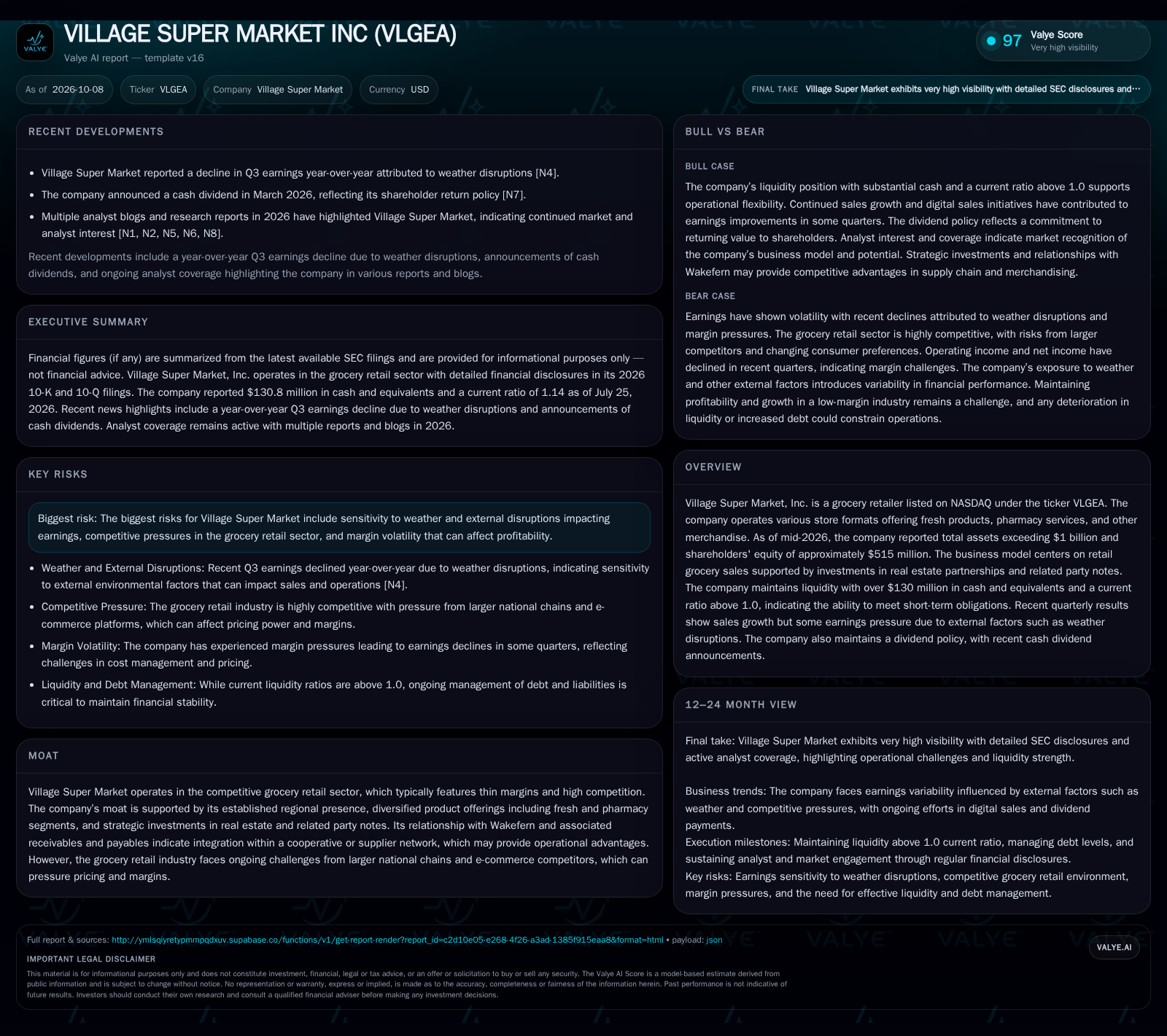
Village Super Market reported $572.6 million in Q3 sales but saw net income decline year-over-year due to weather-related disruptions. With over $130 million in cash and a current ratio above 1.0, the company remains liquid, yet faces margin pressures in a highly competitive grocery sector. Ongoing dividends and analyst attention reflect operational stability, but future performance hinges on mitigating external risks and capitalizing on digital and supply chain advantages. [S1] [S2] [N4] [N7]
Village Super Market, a regional grocery retailer, faces a familiar but intensifying set of pressures: thin margins, unpredictable weather events, and relentless competition from both traditional chains and digital-first entrants. Its most recent quarter saw sales growth but a notable decline in net income, underscoring the sector’s vulnerability to external shocks and cost pressures. The company’s future trajectory will depend on its ability to balance cost containment, digital adaptation, and supply chain leverage amid persistent industry volatility.
Earnings Under Pressure: Weather Disruptions and Margin Squeeze
Village Super Market reported net income of $8.96 million for the 13 weeks ended April 25, 2026, a decrease from $11.16 million in the prior year period. This earnings decline was primarily attributed to weather disruptions that impacted store operations and sales. Despite the setback, the company generated $572.6 million in sales and $160.8 million in gross profit, maintaining a positive operating income of $8.4 million. [S1] [S2] [N4] [N7]
Grocery Retail Economics: Fixed Costs, Low Margins, and Scale Imperatives
Village Super Market’s core business model revolves around high-volume, low-margin retail grocery sales. Revenue is predominantly driven by merchandise turnover across fresh, pharmacy, and center-store categories, with the potential for variable mix effects based on consumer trends and promotional strategies. The sector’s economics are characterized by significant fixed costs—labor, occupancy, logistics, and utilities—which means that operating leverage is achieved primarily through sales volume growth rather than margin expansion.
Gross profit, at $160.8 million on $572.6 million in sales for the latest quarter, underscores the modest spread typical of grocery retailing. Operating income of $8.4 million reflects the intense margin compression common in the sector, where even minor cost increases or sales disruptions can materially impact bottom-line results. Capital needs for store maintenance, modernization, and potential digital infrastructure investments are ongoing, but Village’s substantial asset base ($1.008 billion) and liquidity support these requirements for now. The cited source reports dividend-related activity; that disclosure alone does not establish dividend-policy continuity, management confidence, or a material constraint on capital flexibility. [S1] [S2]
The interplay between fixed and variable costs in grocery retail creates a delicate balancing act for profitability. While fixed costs remain largely inflexible in the short term, variable costs such as inventory procurement and promotional spending can be adjusted to some extent. However, aggressive cost-cutting in areas like labor or store upkeep risks undermining customer experience and operational efficiency, potentially eroding sales volume. Therefore, scale economies and operational discipline are crucial to absorb cost shocks without sacrificing competitive positioning. Additionally, capital allocation decisions—whether to prioritize store modernization, technology upgrades, or supply chain enhancements—must be carefully weighed against expected returns and margin impact in a low-margin context.
Defending Regional Ground: Cooperative Ties and Competitive Pressures
Village Super Market competes in a landscape dominated by larger national chains, discounters, and an expanding array of digital-first grocers. Its regional presence and integration within the Wakefern cooperative provide some insulation via supply chain efficiencies, purchasing power, and merchandising support. These advantages can help offset the scale disadvantage relative to national players, but they do not eliminate the sector’s inherent pricing pressures or the risk of customer attrition to lower-cost or more convenient alternatives.
The company’s diversified product mix, including fresh and pharmacy offerings, aims to drive traffic and basket size, but these segments are also targeted by competitors. E-commerce adoption in grocery is accelerating, raising the bar for digital fulfillment, delivery, and loyalty programs. Without explicit disclosure of digital penetration or retention metrics, it remains an open question whether Village Super Market’s investments in online channels can materially offset competitive threats or margin dilution. The company’s real estate investments and long-standing community relationships may offer switching friction for some customers, but this is not a structural moat against disruptive business models.
The cooperative model underpinning Village Super Market’s supply chain integration offers both strengths and limitations. While collective purchasing power can reduce input costs and improve product assortment, it may also constrain agility in responding to local market nuances or rapid competitive shifts. Regional players must therefore complement cooperative benefits with tailored marketing, localized merchandising, and community engagement to sustain customer loyalty. Moreover, the accelerating digital transformation in grocery retail imposes new competitive benchmarks. Success depends not only on e-commerce adoption but also on seamless omnichannel integration, data-driven personalization, and efficient last-mile delivery. Without transparent metrics on digital channel performance, it is challenging to gauge whether these investments translate into meaningful competitive differentiation or merely incremental costs.
Margin Recovery Through Cost Discipline and Digital Execution
A favorable outcome for Village Super Market would involve stabilizing or expanding margins through rigorous cost control, continued sales growth, and successful digital strategy execution. If the company can leverage its cooperative supply chain to negotiate better terms, optimize labor scheduling, and reduce shrink or waste, incremental operating leverage could emerge even in a low-margin environment. In addition, effective digital engagement—such as higher online order penetration, improved fulfillment efficiency, or loyalty program gains—could help drive repeat traffic and higher basket sizes.
Evidence supporting this scenario would include sequential improvement in operating and net income despite external shocks, clear disclosure of digital sales growth or retention rates, and sustained or increased gross profit margins. Further analyst upgrades or positive coverage would reinforce the perception of operational momentum.
Cost discipline can be further enhanced through advanced analytics and supply chain optimization, enabling more precise demand forecasting and inventory management. This reduces waste and markdowns, directly supporting margin improvement. Additionally, digital execution that leverages customer data to tailor promotions and improve loyalty program effectiveness can increase basket size and frequency, partially offsetting margin pressure. Strategic investments in automation—such as self-checkout or warehouse robotics—may also yield labor cost savings over time, though initial capital outlays must be justified by sustainable operating cost reductions. The ability to demonstrate consistent margin expansion amid sector headwinds would validate the operational resilience and strategic focus necessary for long-term value creation.
Navigating Volatility: Earnings Fluctuate Around Tight Margins
The most plausible path for Village Super Market is continued earnings volatility tied to external factors—such as weather, inflation, or labor cost swings—against a backdrop of stable, but unremarkable, sales growth. Digital initiatives may provide incremental growth or customer retention, but are unlikely to offset the competitive intensity and structural low-margin reality of grocery retail.
Confirmation of this scenario would be quarter-to-quarter variability in net and operating income, modest growth in sales, and a steady or slightly declining gross margin.
Intensified Margin Compression from Disruption and Competitive Attrition
A negative trajectory could unfold if Village Super Market experiences further margin compression due to persistent external shocks (such as adverse weather, supply chain disruptions, or inflation) and increased customer defection to lower-priced or more convenient competitors. Should sales volumes stagnate or decline while fixed costs remain high, operating leverage would turn negative, potentially eroding both operating and net income below sustainable levels.
This scenario would be confirmed by consecutive quarters of declining net income, deteriorating gross profit margins, or negative operating income. Loss of analyst coverage or negative research notes could signal waning market confidence.
Metrics and Milestones to Gauge Village Super Market’s Strategic Resilience
Sequential changes in operating income and net income, especially relative to gross profit, will show whether cost controls and sales mix are improving margin resilience.
Gross margin trends, both quarterly and annually, are critical for assessing the impact of supply chain management and pricing strategy in a low-margin sector.
Digital sales penetration, retention, and fulfillment efficiency—if disclosed—would help test whether online initiatives are offsetting physical store challenges.
Same-store sales growth (if disclosed) remains a fundamental indicator of underlying demand and competitive positioning in core markets.
Labor and operating cost trends, especially in relation to sales growth, can reveal whether the company is achieving necessary productivity gains.
Updates on supply chain integration or changes in cooperative terms (if disclosed) could materially impact gross margin outlook and competitive dynamics.
Disclaimer: This is research-only, informational analysis and not investment advice. It may include AI-generated interpretation and general industry context. Always verify important details using primary sources.

Comments