
Tilray’s Diversification Play: Multi-Segment Expansion Meets Integration and Regulatory Headwinds
Tilray Brands, Inc. leverages a diverse portfolio across cannabis, beverages, and wellness, but faces persistent integration, margin, and regulatory challenges. Recent acquisitions and licensing deals expand its global footprint, yet the path to sustainable profitability and potential financial flexibility remains uncertain as segment performance diverges and covenant restrictions tighten.
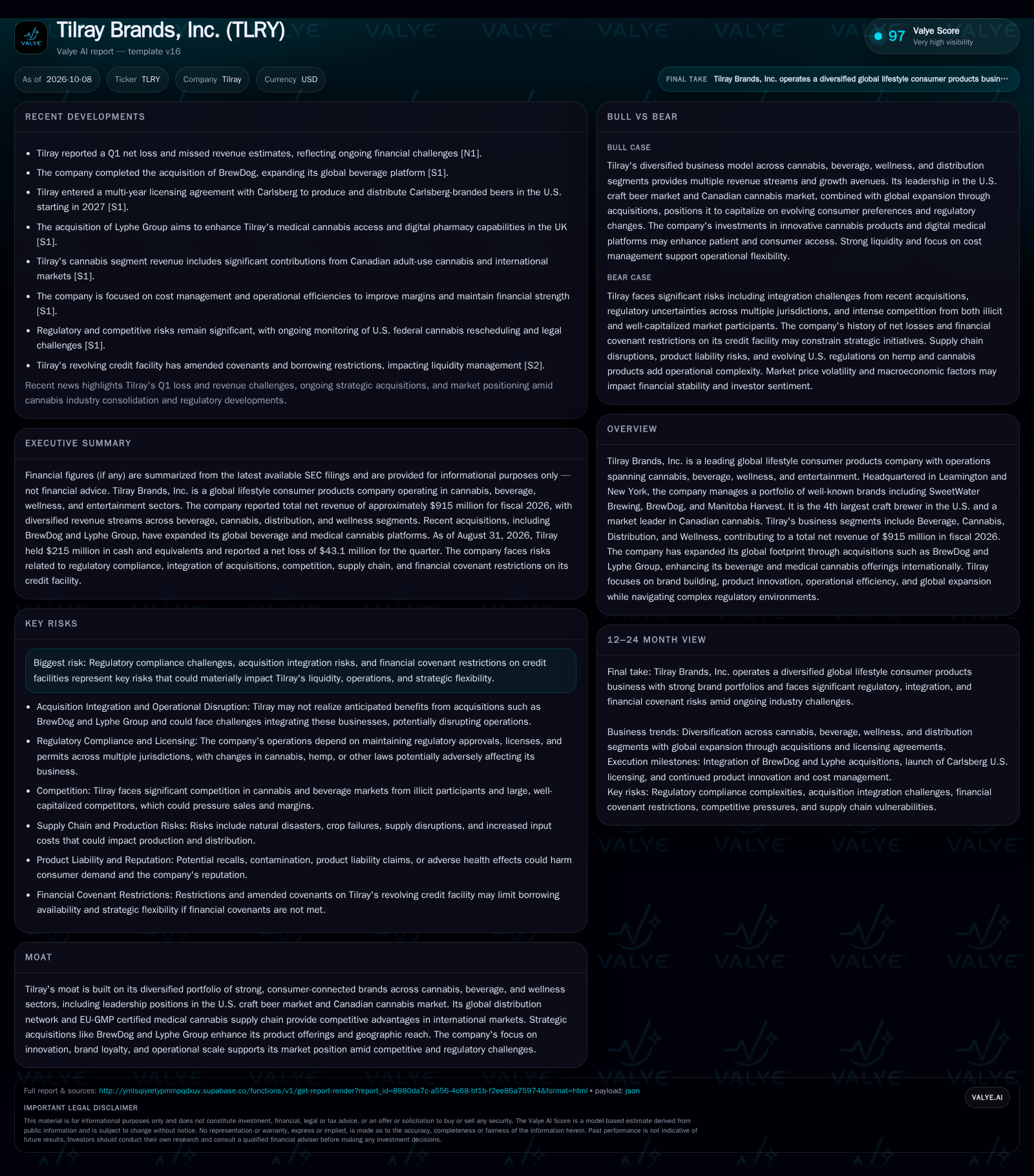
Tilray’s fiscal 2026 results reflect aggressive expansion into beverages and international medical cannabis, highlighted by the BrewDog and Lyphe Group acquisitions and a Carlsberg U.S. licensing deal. While net revenue reached $915.5M and the beverage segment now rivals cannabis in scale, the company reported a net loss and faces covenant-constrained liquidity. Canadian cannabis sales are declining, and integration risks, regulatory dependencies, and competition could determine whether Tilray’s cross-segment strategy delivers durable value or exposes further downside risk. [S1] [S2] [N1]
Tilray Brands, Inc. stands at an inflection point as its multi-segment expansion strategy brings both new opportunities and heightened risks. Recent moves—acquiring BrewDog to bolster its global beverage presence, launching a Carlsberg licensing deal for the U.S., and acquiring Lyphe Group to deepen medical cannabis access—reflect an ambition to diversify revenue sources and achieve global scale. Yet, this breadth comes with integration hurdles, regulatory uncertainty across markets, and persistent net losses. As segment performance diverges and financial covenants restrict flexibility, the company’s ability to translate its diversified platform into sustainable value is far from assured.
Recent Acquisitions and Segment Shifts Reshape Tilray’s Revenue Mix
In fiscal 2026, Tilray reported total net revenue of $915.5 million, with the beverage segment (28%) now nearly matching the cannabis segment (29%) in scale [S1]. This shift is partly driven by the completed acquisition of BrewDog in early 2026, which expands Tilray’s beverage business from a U.S.-centric operation to a global platform. Additionally, the company secured a multi-year licensing agreement with Carlsberg Group to produce and distribute Carlsberg-branded beers in the U.S. starting January 2027, signaling a deeper commitment to beverage growth [S1].
On the cannabis side, Canadian adult-use and wholesale revenues declined in the quarter ended August 31, 2026, while international cannabis revenue increased 21% year-over-year, reflecting geographic divergence [S2]. As of August 31, 2026, Tilray’s liquidity stood at $215 million in cash and equivalents, with a current ratio of 1.88, but the company posted a net loss of $43.1 million for the quarter. The company reported cash and liquidity metrics for the period; these figures do not by themselves establish operating runway, investment capacity, financial flexibility, or financing capacity. [S2]
Economic Model: Margin Leverage and Integration Complexity Across Segments
Tilray’s business model is built on diversified revenue streams—cannabis, beverage, wellness, and distribution—each with distinct economic drivers. The beverage segment’s expansion via BrewDog and Carlsberg could provide greater fixed-cost leverage and cross-brand distribution synergies, as branded alcohol typically offers higher gross margins than commoditized cannabis, especially in premium and craft categories. However, integration costs, brand portfolio overlap, and the capital intensity of beverage production and distribution may dilute near-term margin gains.
The cannabis segment faces a mix of regulated pricing, excise taxes, and operational complexity. Canadian adult-use cannabis is pressured by oversupply, price compression, and competition from illicit markets, driving down margins and volumes. International medical cannabis, by contrast, can command higher prices and faces less direct competition, but is highly dependent on regulatory approvals and the company’s ability to navigate local market entry barriers.
Wellness and hemp-based foods, led by Manitoba Harvest, offer potentially more stable, lower-regulation cash flows, but are less material to overall profitability. Operating leverage across the entire portfolio depends on Tilray’s ability to integrate acquisitions, rationalize SKUs, and capture cost efficiencies at scale. Capital needs remain significant as the company invests in brand building, production upgrades, and geographic expansion, all while managing net losses and covenant-restricted credit.
Cross-Segment Brand Scale Versus Nimble Rivals and Regulatory Bottlenecks
Tilray’s competitive position relies on its breadth: it is the fourth largest craft brewer in the U.S., the Canadian cannabis market leader, and a major international medical cannabis distributor [S1]. Its multi-category brand portfolio offers cross-promotional and distribution advantages, particularly as regulations evolve and consumer preferences shift toward premium, branded products.
However, scale is not an automatic moat. In cannabis, Tilray faces intense competition from both illicit and well-capitalized legal players, with pricing pressure and product commoditization eroding margins. In beverages, consolidation among craft and premium brewers intensifies shelf competition, while global giants and regional upstarts challenge for consumer loyalty. Regulatory risk is a constant: any shift in U.S. federal cannabis law, Canadian market rules, or European medical cannabis frameworks could abruptly alter market access, cost structures, or compliance burdens.
Tilray’s ability to leverage its global supply chain and EU-GMP certified production for medical cannabis could be a differentiator in certain markets, but this advantage is contingent on regulatory harmonization and successful brand localization. The integration of recent acquisitions like BrewDog and Lyphe Group will test whether scale can be converted into sustainable category leadership.
Unlocking Synergies: How Cross-Segment Integration and Regulatory Tailwinds Could Deliver Profitability
In a favorable scenario, Tilray successfully integrates BrewDog and Lyphe Group, extracting cost synergies and leveraging its expanded distribution network to drive both beverage and medical cannabis sales. The Carlsberg licensing deal enables rapid U.S. market penetration with a globally recognized brand, boosting beverage volume and margin mix. If international medical cannabis adoption accelerates and regulatory barriers ease—particularly with potential U.S. federal cannabis rescheduling—Tilray could expand its addressable market and command premium pricing.
Confirmation of this scenario would include: sustained growth in international cannabis revenues outpacing declines in Canada, margin expansion in the beverage segment post-integration, and a return to positive operating cash flow. Evidence of successful cross-selling, SKU rationalization, and improved gross margins across segments would further validate the upside thesis. A reduction in net losses, restoration of full credit facility access, and management guidance on profitable growth would also support this outcome.
Mixed Segment Traction and Ongoing Financial Constraints Define the Most Likely Outcome
The more plausible outcome is a period of mixed results: beverage and international cannabis segments grow modestly but are offset by continued declines in Canadian cannabis and integration costs. Net losses persist as Tilray invests in operational alignment, brand marketing, and regulatory compliance, while covenant restrictions on credit facilities limit potential financial flexibility and strategic opportunism.
This scenario would be confirmed by flat or low-single-digit consolidated revenue growth, stable but unspectacular gross margins, and continued negative EPS. Canadian cannabis revenue would remain under pressure, with international medical and beverage growth providing only partial offset. Regular disclosures of integration expenses, muted operating leverage, and limited improvement in cash flow would further indicate that Tilray’s diversification has yet to produce a step-change in profitability or risk profile.
Integration Missteps and Regulatory Setbacks Could Compound Losses and Liquidity Pressure
In a downside scenario, Tilray struggles to integrate BrewDog and Lyphe Group, leading to operational disruptions, higher-than-expected costs, and loss of key talent or customers. The beverage segment fails to achieve forecasted synergies, while Canadian cannabis volumes continue to fall and international medical cannabis growth stalls due to regulatory delays or competitive encroachment. Supply chain issues or product recalls could further erode brand equity and operational efficiency.
Under this scenario, net losses widen, cash burn accelerates, and covenant breaches trigger further restrictions or forced asset sales. Deteriorating gross margins, declining segment revenues, and negative working capital trends would confirm this outcome. A failure to restore access to the full revolving credit facility, combined with negative management commentary on integration or regulatory headwinds, would further validate the downside case.
Milestones That Will Determine if Tilray’s Diversification Delivers Shareholder Value
Sustained growth in international cannabis revenue, especially in Europe and emerging medical markets, would help validate the global expansion thesis.
Gross margin trends in the beverage segment post-BrewDog and Carlsberg integration—if disclosed—would test whether scale and brand leverage are improving profitability.
Quarterly updates on integration costs and realized synergies for BrewDog and Lyphe Group would clarify whether recent acquisitions are accretive or dilutive.
Canadian cannabis revenue and market share trends: stabilization or recovery would indicate competitive resilience; ongoing declines would highlight sector headwinds.
Operating cash flow trajectory—whether Tilray approaches breakeven or continues to burn cash—will be critical for long-term viability.
Regulatory developments in key markets (U.S., Canada, EU) that could materially expand, restrict, or reshape Tilray’s addressable markets and compliance costs.
If disclosed, customer retention and cross-selling rates between beverage and cannabis segments would test the strategic rationale for a multi-segment portfolio.
Disclaimer: This is research-only, informational analysis and not investment advice. It may include AI-generated interpretation and general industry context. Always verify important details using primary sources.

Comments