
Linkers Industries: Custom Manufacturing, Capital Infusion, and the Profitability Challenge
Linkers Industries leverages decades of wire harness expertise, recent capital infusions, and global OEM relationships to pursue growth, but faces persistent profitability hurdles, compliance risks, and legal headwinds that complicate its investment case.
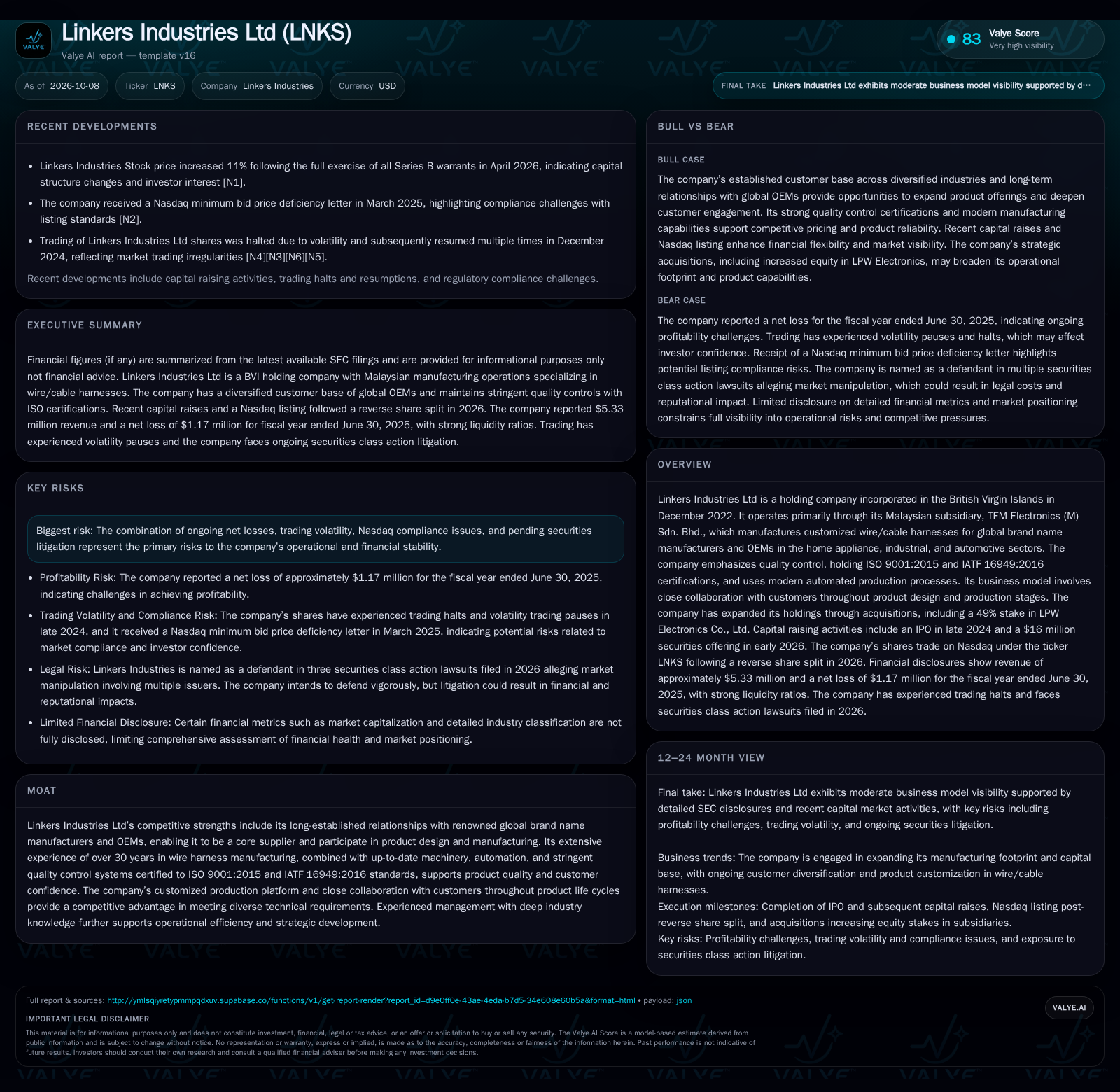
Linkers Industries Ltd, a BVI-based holding company with core Malaysian wire/cable harness manufacturing operations, recently raised $16 million and completed a Nasdaq listing, but continues to operate at a net loss despite reported liquidity position. Its customized production model and established OEM relationships offer commercial potential, though the path to sustainable profitability is clouded by ongoing legal, compliance, and trading volatility risks. Monitoring margin trends, customer concentration, and progress in operational efficiency will be critical for assessing long-term viability. [S1] [N1] [N2]
Linkers Industries Ltd sits at the intersection of established manufacturing expertise and the volatility of public capital markets. With over 30 years of wire/cable harness production experience through its Malaysian subsidiary, the company serves a roster of global OEMs but has yet to achieve profitability, reporting a $1.17 million net loss on $5.33 million in revenue for fiscal 2025. Recent capital raises, a Nasdaq listing, and a reverse split signal ambition and access to funding, yet ongoing legal disputes, trading irregularities, and persistent operating losses underscore the uncertainty of its business transformation. The core question is whether Linkers can leverage its customer relationships and quality platform into sustainable economics amid intensifying scrutiny and industry headwinds. [S1] [N1] [N2]
Recent Capitalization, Persistent Losses, and Legal Scrutiny Define the Near-Term Landscape
The most material developments shaping Linkers Industries' current outlook are: (1) a $16 million securities offering and successful Nasdaq listing following a reverse split, (2) the company’s continued net loss of $1.17 million on $5.33 million in revenue for the fiscal year ended June 30, 2025, (3) reported liquidity position with a current ratio of 4.72 and cash ratio of 1.57, and (4) the emergence of three securities class actions alongside recent trading halts and volatility. [S1] [N1] [N2]
These facts matter because they highlight both the company’s ability to access capital markets—potentially enabling investment and expansion—and the ongoing challenge of converting operational activity into profit. The legal and compliance backdrop adds uncertainty, potentially distracting management and impacting investor confidence.
Decoding Linkers’ Custom Manufacturing Model: Economics, Leverage, and Constraints
Linkers Industries operates a made-to-order, low- to mid-volume manufacturing model centered on wire/cable harnesses for OEMs in the home appliance, industrial, and automotive sectors. Revenue is driven by project-based orders, with pricing typically negotiated based on design complexity, material costs, and volume commitments. The highly customized nature of the products can command premium pricing for technical complexity but also exposes the business to volatile order flow and thin margins, especially when customer bargaining power is high.
Cost of goods sold is dominated by raw materials—sourced primarily from Malaysia, China, and Europe—and direct labor, with automation and quality certifications (ISO 9001:2015, IATF 16949:2016) supporting process efficiency and qualification for demanding customers. However, as with many contract manufacturers, variable costs scale closely with revenue, limiting operating leverage unless the company achieves higher utilization or a shift in product mix toward higher-margin, value-added services (such as design or prototyping).
The need for ongoing capital investment in automation and compliance, coupled with relatively low absolute scale ($5.33 million in annual revenue), suggests that Linkers must grow revenue meaningfully or structurally improve margins to achieve break-even. The recent capital raise provides a cushion, but the persistent net loss underscores the challenge of scaling fixed costs against a lumpy, project-driven revenue base. [S1]
Customization, Certifications, and Customer Relationships: Assessing Competitive Differentiation
Linkers Industries’ competitive positioning rests on three pillars: long-standing relationships with global OEMs, technical and quality certifications (ISO/IATF), and the ability to deliver highly customized wire/cable harnesses in close collaboration with customers. These attributes can create switching frictions and embed Linkers in the design and production cycles of its customers, making it more difficult for competitors to displace them on existing programs.
However, the contract manufacturing landscape is intensely competitive, with regional players in Southeast Asia and China often competing aggressively on price, scale, and delivery speed. Larger competitors may offer broader product portfolios and global logistics, while smaller shops may undercut on cost. The risk is that Linkers’ technical integration and certifications enable retention of complex or regulated business, but commoditized or low-complexity orders could migrate to lower-cost rivals.
The company’s ability to maintain and expand its role in customer product development cycles is a potential source of stickiness, but there is limited evidence of recurring revenue contracts or long-term volume guarantees. The question is whether Linkers can leverage its reputation and certifications to consistently win higher-margin, design-intensive business, or whether it remains exposed to price-driven churn and project volatility.
Unlocking Operating Leverage Through Scale and Value-Added Expansion
The most favorable scenario for Linkers Industries involves leveraging its recent capital infusion to invest in automation, expand capacity, and deepen integration with OEM customers. If the company can move up the value chain—offering more design, prototyping, or engineering services in addition to assembly—it may be able to command higher margins, reduce revenue cyclicality, and achieve better utilization of its fixed cost base.
Confirmation of this scenario would require evidence of: (1) sustained revenue growth from existing and new customers, (2) improvement in gross and operating margins, (3) announcements of multi-year contracts or strategic partnerships, and (4) a reduction in customer concentration risk. Structural margin improvement—rather than temporary cost control—would be the clearest signal that the company is capturing more value per unit of output.
Falsification would come from continued lumpy, project-based revenue, stagnant or declining margins, or an inability to win higher-value business despite capital investments.
Incremental Revenue Gains Offset by Margin Pressure and Overhead Drag
The most plausible near-term outcome is a continuation of modest revenue growth through existing OEM relationships and gradual expansion of the customer base, but with profitability constrained by competitive pricing, input cost volatility, and the fixed costs associated with maintaining certifications and automation.
The company remains exposed to the risk of customer project delays, adverse mix shifts, and incremental legal or compliance costs. Confirmation would come from flat or slightly improving revenue and net loss figures, absence of a step-change in margin structure, and continued focus on incremental process improvements rather than transformative business model shifts.
Falsification would occur if Linkers demonstrates a clear inflection in margins, signs multi-year recurring contracts, or if legal/compliance costs escalate to the point of threatening operational stability.
Legal, Compliance, and Market Risks Compound Operating Weakness
In a negative scenario, Linkers Industries could face a convergence of adverse factors: protracted net losses erode cash reserves, legal expenses from securities class actions escalate, and trading volatility undermines investor confidence or restricts access to capital markets. If customer orders soften—due to macro slowdown, loss of key programs, or competitive displacement—the company could be forced to scale back operations or raise dilutive capital at unfavorable terms.
Confirmation of this scenario would include: (1) declining revenue, (2) widening operating losses, (3) adverse legal rulings or costly settlements, (4) further Nasdaq compliance issues or delisting risk, and (5) evidence of customer attrition or project cancellations.
Falsification would come from stabilization or improvement in operating results, resolution of legal matters with limited financial impact, and maintenance of customer relationships despite industry or market headwinds.
Milestones That Will Clarify Linkers’ Path to Sustainable Value Creation
Quarterly gross and operating margin trends—if disclosed—will indicate whether scale and automation investments are translating into improved economics.
Revenue growth from new customers or geographies, particularly outside the core Asia-Pacific footprint, would suggest progress in diversification and market penetration.
Disclosure of multi-year contracts or strategic partnerships (if any) would help assess the stability and predictability of future cash flows.
Updates on the status, cost, and resolution of pending securities class action lawsuits will be critical for assessing legal overhang and potential financial impact.
Any additional Nasdaq compliance communications, such as further bid price deficiencies or listing warnings, would signal ongoing market risk.
Changes in customer concentration—especially if top customers account for a large share of revenue—would help evaluate exposure to key account losses.
Evidence of successful integration and contribution from recent acquisitions, such as the increased stake in LPW Electronics, would provide insight into inorganic growth effectiveness.
Detailed capital expenditure disclosures, including automation and production upgrades, would clarify how new funds are being deployed to support operational efficiency.
Disclaimer: This is research-only, informational analysis and not investment advice. It may include AI-generated interpretation and general industry context. Always verify important details using primary sources.

Comments