
KB HOME: Margin Resilience, New Community Expansion, and the Challenge of Macroeconomic Sensitivity
KB HOME continues to deliver profitability and expand its community footprint, but faces mounting headwinds from higher interest rates and inflationary pressures. The company's Q3 earnings and recent development activity highlight strong operational execution, yet the durability of demand and margin structure remains tightly linked to the broader economic environment.
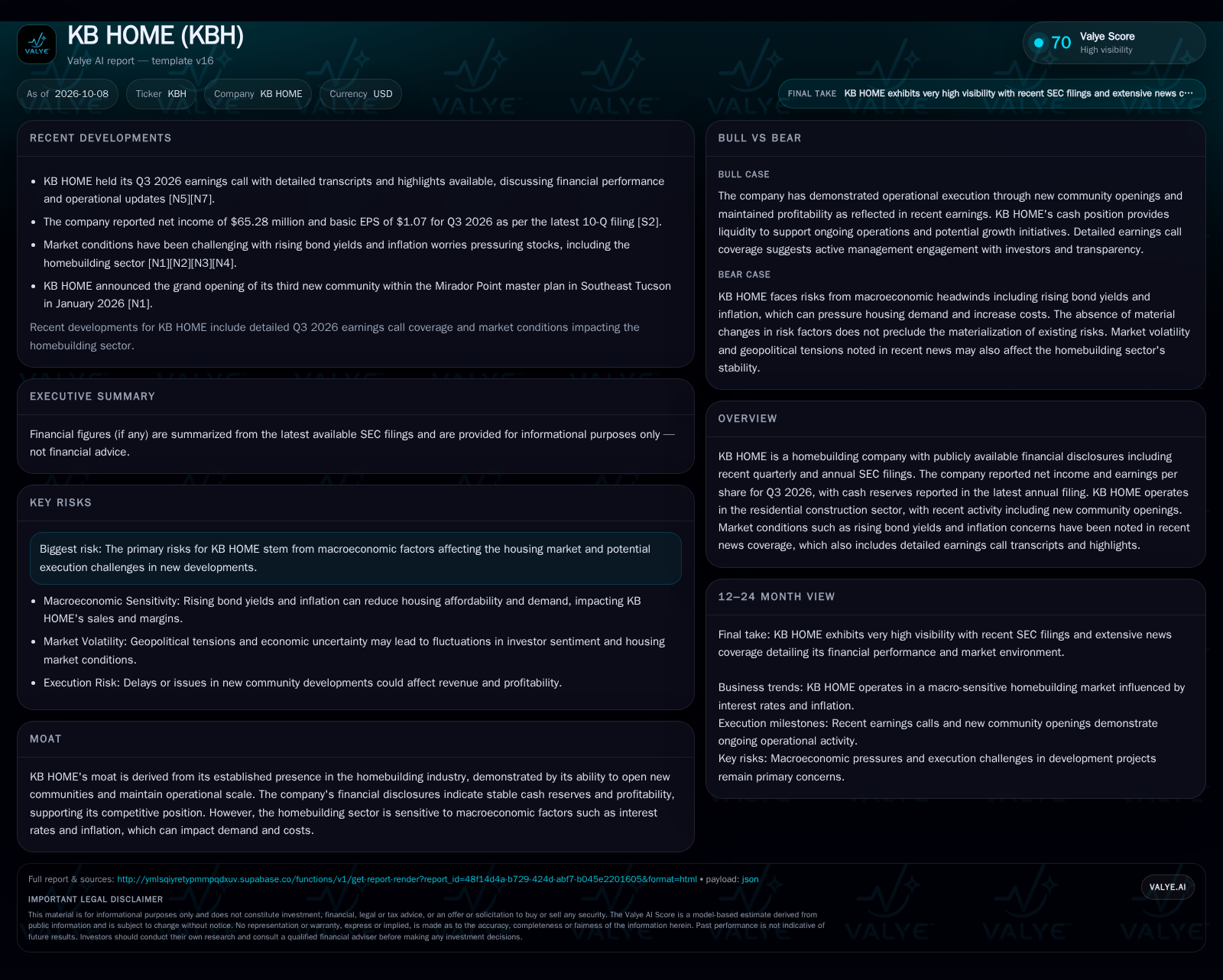
KB HOME reported Q3 2026 net income of $65.28 million and basic EPS of $1.07, demonstrating ongoing profitability despite a challenging macro backdrop. The company opened a new Tucson community in early 2026, signaling continued growth initiatives. However, rising bond yields and inflation concerns could pressure future sales and margins, making housing affordability and demand the central variables for forward performance. Recent earnings calls and financial disclosures underscore a stable operational base, but the outlook depends on macro conditions and the company’s ability to manage costs and execution risks. [S2] [N5] [N7]
KB HOME stands out for its ability to sustain profitability and expand its development footprint in a period of macroeconomic turbulence. The company’s Q3 2026 results show solid earnings, while its latest community launch in Tucson highlights an ongoing commitment to growth. However, with rising interest rates and inflation weighing on consumer affordability and sentiment, the company’s future trajectory will be determined by its ability to navigate a volatile housing market and execute efficiently on new projects. The core question for investors is whether KB HOME can maintain margins and demand resilience if macro headwinds persist.
Recent Profitability and Expansion Activities Define KB HOME’s Operating Environment
KB HOME reported net income of $65.28 million for Q3 2026, with basic earnings per share of $1.07 and diluted EPS of $1.05, indicating that the company remains solidly profitable despite sector-wide uncertainties. The company has also signaled ongoing growth by opening a new community in Tucson in January 2026, expanding its presence within the Mirador Point master plan. Detailed earnings call coverage in September 2026 further underlines management’s engagement with operational performance and investor communication. These facts establish KB HOME as an active and profitable operator entering the latter part of 2026, but against a backdrop of heightened economic uncertainty and sectoral headwinds. [S2] [N5] [N7]
Homebuilding Economics: Margin Structure, Cost Pressures, and Leverage Dynamics
The fundamental economics of homebuilding for a company like KB HOME are driven by the interplay between land acquisition costs, construction input prices, selling prices, and operating leverage. Gross margins fluctuate with housing demand, input costs (notably labor and materials), and the company’s ability to pass on cost increases to buyers. KB HOME’s profitability in Q3 2026 suggests it has thus far managed to balance these variables, but the sector is highly sensitive to interest rates, which directly affect mortgage affordability and buyer willingness.
Operating leverage in homebuilding can be significant: incremental sales from new communities like the Tucson project can drive higher margins if fixed costs are spread over more units. However, margin erosion is a risk if input costs rise faster than selling prices or if demand softens due to higher mortgage rates. The capital intensity of land development and home construction requires careful inventory and cash management, especially as the cycle turns. Liquidity and access to credit become more critical if the sales pace slows or if the company needs to support larger land banks in anticipation of future demand.
Competitive Landscape: Scale, Geographic Reach, and Sensitivity to Substitutes
KB HOME competes with both large national builders and regional players, each vying for market share in high-demand geographies. Its established presence and ability to launch new communities provide some scale advantages, such as purchasing power for materials and greater marketing reach. However, these advantages are not absolute; local builders can often move faster and adapt to micro-market trends, while larger peers can absorb shocks with more diversified land portfolios.
The threat of substitutes in homebuilding is largely tied to rental market dynamics and broader housing alternatives. When mortgage rates rise, some would-be buyers defer purchases in favor of renting, pressuring order flow for builders. In the current environment, KB HOME’s ability to differentiate through product mix, build quality, and community amenities may help defend share, but pricing power is constrained by overall affordability and the willingness of buyers to stretch for new homes.
How KB HOME Could Outperform: Demand Resilience and Cost Discipline
A favorable scenario for KB HOME would unfold if housing demand proves more resilient than expected, perhaps due to a pause or reversal in interest rate hikes, improved consumer sentiment, or supply shortages in key markets. In this case, the company could benefit from both increased volume and the ability to maintain or expand margins. Successful execution on new community launches—such as the Tucson development—would translate into higher sales absorption rates and stronger operating leverage.
Evidence that would confirm this scenario includes: steady or rising net new orders, limited cancellation rates, stable or improving gross margins in subsequent quarters, and management commentary pointing to robust demand pipelines. Additionally, if the company is able to manage construction costs despite inflationary pressures, reported margins would validate effective cost controls. Strong cash flow generation and disciplined land acquisition would further support this bullish outcome.
Steady-State Execution Under Macro Pressure
The most plausible path for KB HOME is one of continued profitability, but with limited margin expansion given the ongoing macroeconomic headwinds. Order volumes may remain stable or grow modestly, but selling price increases are likely to be capped by affordability constraints as mortgage rates remain elevated. In this scenario, KB HOME would focus on operational discipline—managing inventory, controlling costs, and selectively pursuing new community openings to align with demand pockets.
Confirmation of this scenario would come from quarterly reports showing consistent, if unspectacular, earnings and cash generation, with gross and operating margins holding within recent historical ranges. Absence of large write-downs on land or inventory, coupled with stable community count and absorption rates, would also support this base case. On the other hand, a material decline in orders, rising cancellations, or margin compression would suggest a deviation from this moderate trajectory.
Affordability Shock and Margin Compression as Primary Risks
A more adverse outcome for KB HOME could arise if rising bond yields and persistent inflation further erode housing affordability, causing a significant drop in new home demand. In this scenario, the company would likely face higher cancellation rates, declining order volumes, and increased price competition, all of which would pressure both top-line revenue and margins. Fixed costs, especially related to land holdings and community infrastructure, could become a drag if sales slow sharply.
Confirmation of this negative scenario would include: a notable decline in net orders and backlog, sequential or year-over-year margin contraction, and management commentary emphasizing market uncertainty or the need to discount to move inventory. Additional warning signs would be rising inventory days, negative operating cash flow, or announcements of delayed or cancelled community launches. Persistent macro headwinds could also lead to higher impairment charges if land values reset lower.
Metrics and Events That Will Determine the Resilience of KB HOME’s Model
Net new order trends and cancellation rates, as reported quarterly, will be essential in gauging real-time demand health and the impact of macro conditions on buyer behavior.
Gross margin and operating margin evolution over the next several quarters will clarify whether KB HOME can offset input cost inflation and maintain profitability.
Community count and absorption rates (if disclosed) will illuminate the success of new launches and the company’s ability to match pace with market demand.
Inventory levels and land acquisition activity, as revealed in future filings, will signal how aggressively KB HOME is positioning for future growth versus managing downside risk.
Cash flow from operations and changes in working capital should be monitored to assess balance sheet resilience and flexibility under shifting sales cycles.
Management’s forward guidance and qualitative commentary during earnings calls will provide leading indicators of sentiment, strategy pivots, or anticipated market changes.
Any disclosed changes in pricing, incentives, or discounting practices could signal shifts in competitive dynamics or pressure on sales velocity.
Macro indicators such as mortgage rate movements and housing affordability indices will act as external barometers for the addressable market and buyer capability.
Disclaimer: This is research-only, informational analysis and not investment advice. It may include AI-generated interpretation and general industry context. Always verify important details using primary sources.

Comments