
HyOrc Corporation: Early Commercialization in Clean Energy Amid Severe Liquidity Strain
HyOrc is pushing forward with modular hydrogen engines, waste-to-methanol platforms, and rail retrofit projects, aiming to address decarbonization in heavy industry and transport.
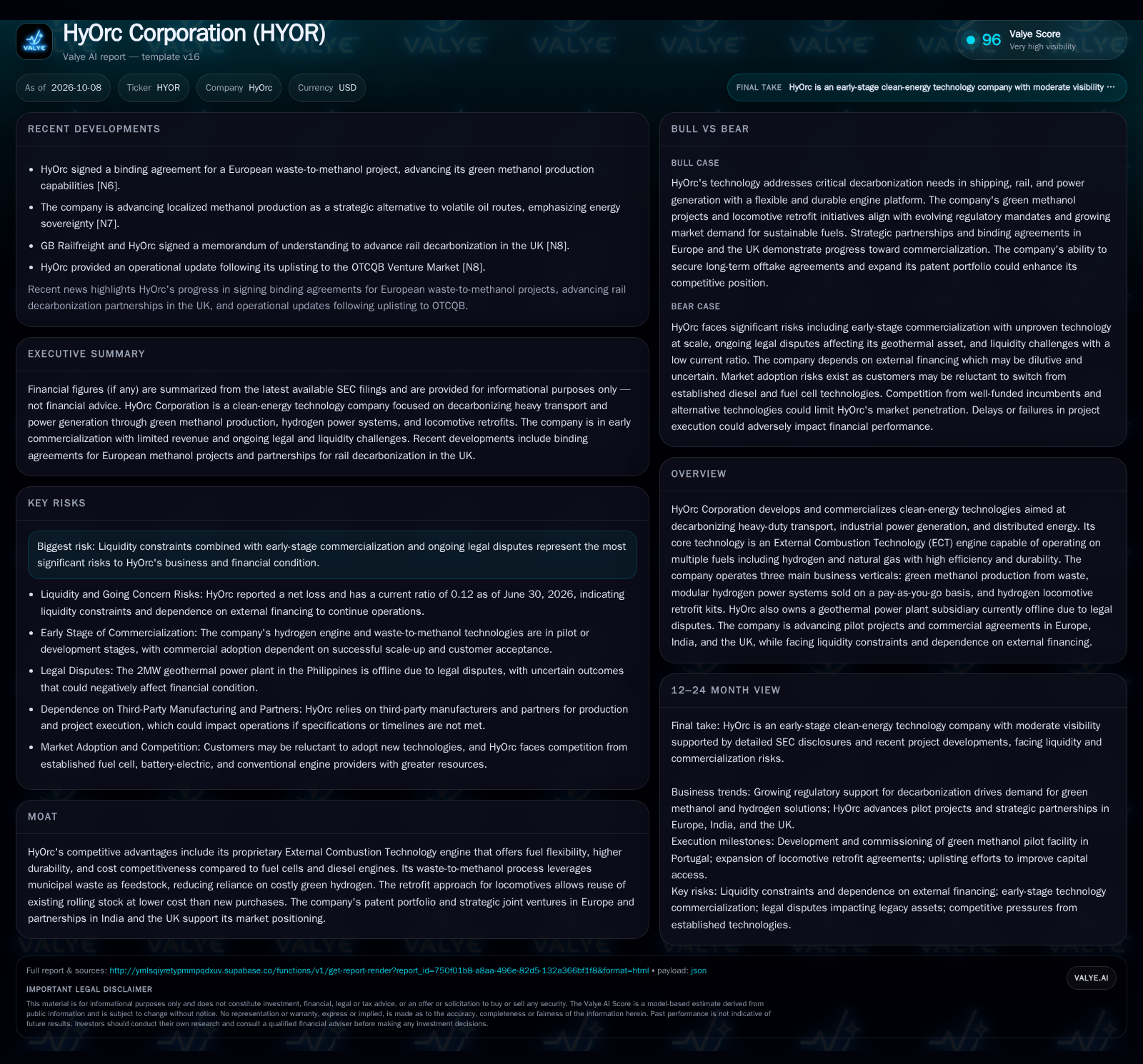
HyOrc Corporation is attempting to carve out a niche in clean-energy solutions for heavy-duty sectors with flexible, multi-fuel engine technology and green methanol projects. [S2] [N6] [N8]
HyOrc Corporation is positioning itself at the intersection of energy transition and heavy-industry decarbonization, offering a technology suite spanning hydrogen-fueled engines, waste-to-methanol production, and rail retrofits. Whether HyOrc can convert pilot projects and partnerships into scalable, cash-generating businesses—in the face of entrenched competition and uncertain funding—will determine its long-term relevance in the clean-energy landscape. [S2] [N6] [N8]
Recent Agreements and Financial Strain Define HyOrc’s Current Position
HyOrc has made notable progress on the commercial front, signing a binding agreement for a European waste-to-methanol project and a 10-year offtake term sheet for its pilot facility in Porto, Portugal. The company is also advancing rail decarbonization through a memorandum of understanding with GB Railfreight for hydrogen and natural gas locomotive retrofits in the UK. However, these commercial advances contrast sharply with HyOrc’s financial condition: for the quarter ended June 30, 2026, the company reported just $24,000 in revenue, a net loss of $689,712, and a current ratio of 0.12, underscoring an urgent need for external financing. Its geothermal subsidiary remains offline due to legal disputes, removing a potential income source and adding further uncertainty. [S2] [N6] [N8]
Commercialization Model: Capital Intensity and Revenue Pathways
HyOrc’s business model depends on scaling three high-potential, yet capital-intensive verticals: (1) waste-to-methanol plants, (2) modular hydrogen power systems, and (3) locomotive retrofits. The waste-to-methanol platform, if successful, could generate revenue through both direct methanol sales (supported by long-term offtake agreements) and technology licensing. The modular hydrogen power systems—targeted at off-grid and backup power markets—may offer recurring revenue if deployed on a pay-as-you-go basis, but require upfront capital for equipment manufacturing, deployment, and customer acquisition. Locomotive retrofits, if adopted at scale, could deliver a mix of one-time conversion fees and ongoing service or licensing revenue.
All three lines face classic clean-tech commercialization hurdles: high upfront capital requirements, long sales cycles, and the need for customer trust in new technology. Fixed costs are likely significant given R&D, manufacturing, and project development, with meaningful operating leverage possible only if HyOrc can scale deployments or secure licensing deals. Until then, the company is heavily reliant on external financing to fund operations, bridge working capital gaps, and invest in pilot infrastructure.
Each of HyOrc’s verticals presents distinct capital allocation challenges that necessitate strategic prioritization. For example, waste-to-methanol plants require substantial upfront investment in feedstock processing infrastructure and chemical synthesis equipment, with returns dependent on securing long-term offtake agreements to mitigate commodity price volatility. In contrast, modular hydrogen power systems may offer more flexible deployment options but hinge critically on achieving economies of scale in manufacturing to reduce per-unit costs. Locomotive retrofits involve complex integration with existing rail assets, demanding tailored engineering solutions and potentially lengthy customer qualification cycles. HyOrc’s ability to balance these competing capital demands while maintaining operational liquidity will be a key determinant of sustainable growth.
The revenue recognition profiles for HyOrc’s offerings are also heterogeneous and carry implications for cash flow management. Waste-to-methanol projects may generate steady revenue streams post-commissioning but often involve protracted development timelines and regulatory approvals that delay cash inflows. Modular hydrogen engines, if offered as a service, could provide recurring revenue but require upfront capital outlays and ongoing maintenance commitments. Locomotive retrofits may yield upfront conversion fees but depend on ongoing aftermarket service contracts to sustain profitability. Understanding the timing and scale of these cash flows is critical for investors and management to assess funding needs and operational sustainability, especially under constrained liquidity conditions.
Competing Against Incumbents and Alternatives in Decarbonization
HyOrc’s core ECT engine technology is positioned as a flexible, durable, and cost-competitive alternative to both diesel and hydrogen fuel cell solutions. The ability to operate on multiple fuels—including hydrogen, LPG, biogas, and natural gas—provides a theoretical advantage in markets with variable feedstock availability. Its waste-to-methanol process leverages municipal waste, potentially lowering feedstock costs and sidestepping some challenges of pure green hydrogen production.
However, HyOrc faces intense competition from established fuel cell manufacturers, battery-electric powertrain providers, and traditional engine OEMs with greater scale and capital resources. In rail, battery and fuel cell retrofits are being piloted by incumbents, while in methanol, large chemical and energy companies are investing heavily in production capacity. Customer inertia, regulatory uncertainty, and the conservative risk appetite of industrial buyers further complicate adoption. HyOrc’s patent portfolio and European/UK partnerships may help carve a niche, but the durability of these advantages will depend on execution and the ability to demonstrate superior economics or regulatory alignment.
Scaling Pilots into Commercial Projects and Unlocking Recurring Revenue
A favorable scenario for HyOrc sees its Porto green methanol pilot successfully commissioned, with offtake partner Prio Bio ramping up purchases under the 10-year term sheet. This would validate both the technology and business model, potentially unlocking further project financing, technology licensing, or additional joint ventures across Europe. Simultaneously, successful demonstration projects with GB Railfreight could catalyze broader adoption of hydrogen retrofits in the UK and India, leveraging regulatory pressure to decarbonize rail.
Confirmation would come from securing project-level financing for the Porto plant, reporting material revenue from methanol sales or technology licensing, and announcing additional commercial retrofit contracts or meaningful pilot deployments in critical power markets. A successful Nasdaq uplisting could provide broader access to capital, while positive resolution of the Biliran legal dispute would restore a potential revenue stream and strengthen the balance sheet.
Gradual Progress Tempered by Funding and Execution Challenges
The most plausible trajectory is that HyOrc demonstrates incremental technical and commercial progress—such as commissioning the Porto pilot, advancing rail retrofit pilots, and expanding its offtake or partnership pipeline—but struggles to rapidly scale revenue or achieve positive cash flow. External financing remains essential, potentially leading to dilutive equity raises or higher-cost project debt. Customer adoption is likely slow, as industrial buyers demand proven reliability, clear regulatory support, and bankable economics before making large-scale commitments.
Evidence of this scenario would include further delays in project commissioning, revenue remaining limited to pilot scale or technical services, continued net losses, and ongoing working capital stress. If HyOrc is unable to secure a Nasdaq uplist or resolve its legal disputes, its ability to attract sufficient capital and talent could be further constrained.
Liquidity Crunch and Project Delays Threaten Business Continuity
The adverse scenario unfolds if HyOrc cannot raise sufficient external capital to fund ongoing operations and pilot deployments. Acute liquidity constraints—signaled by a current ratio of 0.12 and reported cash balance—could force the company to halt development, delay commercial launches, or enter restructuring. Continued legal uncertainty around the Biliran plant deprives HyOrc of a potential revenue source and asset value. Project partners or customers may lose confidence if milestones are missed or funding gaps emerge, further eroding commercial momentum.
Confirmation would come from public disclosures of project delays, missed debt or payables obligations, workforce reductions, or the inability to meet listing standards. A failure to secure new financing or resolve legal entanglements would make business continuity increasingly untenable.
Milestones and Metrics That Will Determine HyOrc’s Trajectory
Commissioning and commercial operation of the Porto green methanol pilot facility; reported methanol production volumes and revenue if disclosed.
Execution of the 10-year offtake agreement with Prio Bio—tracking contracted versus actual methanol sales and any pricing/margin details if available.
Securing project-level or corporate financing sufficient to fund development and working capital through at least the next 12–24 months.
Resolution of legal disputes related to the Biliran geothermal plant and any update on asset status or income restoration.
Announcements of additional binding agreements, joint ventures, or retrofit contracts—especially in rail or distributed power markets.
Progress toward a Nasdaq uplist, including satisfaction of listing requirements and any associated capital raises.
Disclosure of recurring revenue streams from pilot deployments or licensing, and any indication of customer retention or expansion.
Updates on patent grants, regulatory approvals, or technology demonstrations that could influence adoption or protect market position.
Disclaimer: This is research-only, informational analysis and not investment advice. It may include AI-generated interpretation and general industry context. Always verify important details using primary sources.

Comments