
Micron’s Advanced Memory Ramp: AI Demand, Competitive Pressures, and the Economics of Scale in 2026
Micron Technology’s 2026 results highlight a sharp pivot to leading-edge DRAM and HBM for AI-centric workloads, record revenue and profitability, and a market context defined by both unprecedented demand and intensifying pricing and geopolitical pressures. The company’s ability to leverage manufacturing scale and technology leadership will be tested as memory cycles, customer mix, and regulatory risks evolve.
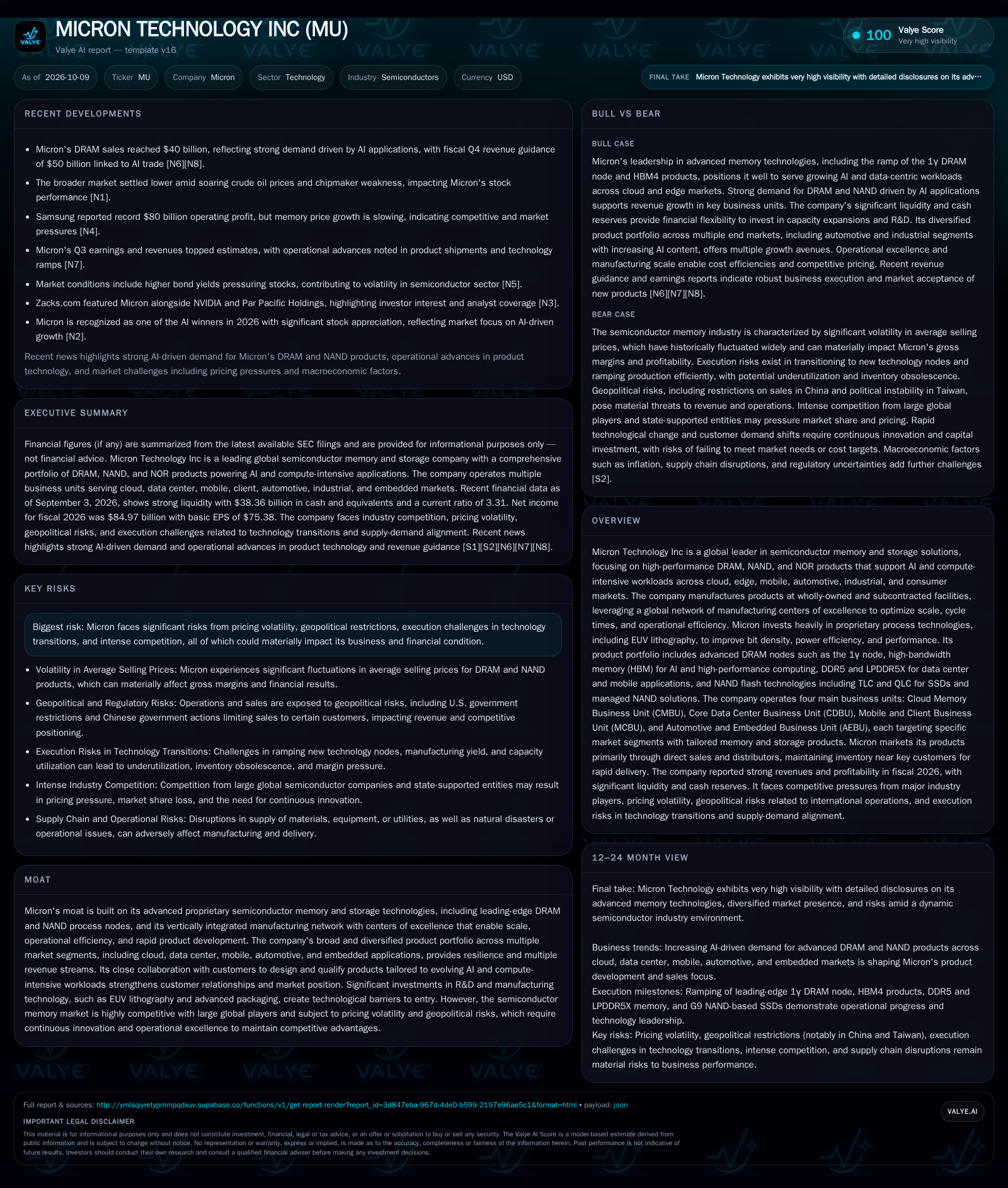
Micron’s 2026 performance is anchored by high-volume shipments of 1γ DRAM, rapid expansion of HBM for AI and HPC, and a diversified market footprint. [S1] [S2] [N4] [N6] [N8]
Micron Technology’s 2026 operating snapshot captures a company at the center of the global AI and compute memory race. With record DRAM and NAND revenues, the successful ramp of cutting-edge 1γ DRAM and HBM4, and a substantial liquidity cushion, Micron is well-positioned to address surging demand in cloud, data center, and AI markets. Yet, the company’s fortunes remain tightly linked to memory-price cycles, execution risks in node transitions, and geopolitical fractures that threaten access to key customers and supply chains. The interplay between technology leadership and market volatility will define Micron’s next phase.
Micron’s 2026 Inflection: Technology Ramp, Record Profitability, and Market Risks
In 2026, Micron achieved significant operational milestones: the ramp of its 1γ (1-gamma) DRAM node—using advanced EUV lithography—became its highest-volume DRAM product by Q4, while high-bandwidth memory (HBM4) entered volume production to support AI and high-performance computing demand [S1]. DRAM revenue reached $100.68 billion, with NAND at $31.79 billion, and net income for the year was $84.97 billion [S1].
The company exited consumer-branded products in December 2025 to sharpen focus on high-value components and solutions. Its balance sheet as of September 2026 reflects $38.36 billion in cash and equivalents and a current ratio of 3.31 [S1].
However, Micron faces acute risks: U.S. and Chinese government restrictions are constraining sales to critical customers, particularly in China, while the broader industry is experiencing slowing memory price growth and intensifying competition, as evidenced by Samsung’s record profit but decelerating pricing power [N4] [S2].
Memory Economics: Bit Density, Cost Curve, and Operating Leverage in a Volatile Cycle
Micron’s core business economics are defined by scale manufacturing, technology transitions, and relentless cost-per-bit reduction. The company’s profitability is highly levered to average selling prices (ASPs) for DRAM and NAND, which are cyclical and can swing sharply with shifts in demand or oversupply [S2].
The move to 1γ DRAM and advanced NAND nodes enables higher bit density and lower per-bit costs, creating operating leverage as fixed costs are spread over greater output. However, this leverage works both ways: underutilization of fabs during downcycles or slow ramps can rapidly erode margins, while inventory risk rises if demand does not materialize as projected.
Micron’s reported net income of $84.97 billion on $38.36 billion in cash suggests a period of unusually strong pricing and/or mix, likely driven by AI and data center demand [S1]. Yet, the capital intensity of memory manufacturing remains high, requiring ongoing investment in R&D and fab upgrades to maintain competitiveness and cost leadership.
Competing in the Memory Arena: Scale, Technology, and the Challenge from East Asian Giants
Micron operates in a highly concentrated global memory market dominated by a handful of players: Samsung, SK hynix, Kioxia, Sandisk, and emerging Chinese competitors such as CXMT and YMTC [S1]. These rivals have the scale, technology roadmaps, and—in some cases—state support to compete aggressively on both innovation and price.
The company’s edge comes from rapid deployment of advanced nodes (e.g., 1γ DRAM, HBM4), proprietary process technologies, and a diversified product mix spanning cloud, data center, mobile, automotive, and embedded markets. However, the same factors that support differentiation also create execution risk: any delay in node transitions or yield issues can quickly translate into lost share or margin compression.
Geopolitical actions, particularly U.S. restrictions on high-end chip sales to China and reciprocal Chinese actions, risk segmenting the global market and shifting competitive dynamics. Micron’s exposure to both Western and Asian supply chains and customers means that regulatory changes can have outsized impact on both revenue and cost structure [S2].
How Sustained AI-Driven Demand Could Extend Micron’s Profit Cycle
The most favorable scenario for Micron is that AI and high-performance computing workloads continue to drive robust, non-cyclical demand for advanced DRAM and HBM, outpacing any softness in traditional PC or mobile memory. If the company maintains its technology lead, with 1γ and HBM4E nodes ramping on schedule and yields stabilizing, operating leverage could remain strong even as industry supply grows.
Key evidence for this scenario would include further upward revisions to revenue guidance, continued high utilization rates in fabs, and premium ASPs for leading-edge memory. Additional signs would be a sustained order pipeline from hyperscale/cloud customers and rapid adoption of new DRAM/NAND generations in AI, automotive, and industrial segments [N6] [N8].
This outcome could be challenged if competitors accelerate their own node transitions or if AI memory demand proves more cyclical than expected. Monitoring customer mix, pricing trends for HBM/DDR5, and the pace of technology adoption will be essential to confirm or falsify this trajectory.
Navigating Cycles: Mixed Demand, Pricing Volatility, and Execution Risk
The most plausible path forward is a blend of strong AI-driven growth in select segments and ongoing cyclicality in others, particularly as memory price growth slows industry-wide [N4]. Micron likely continues to benefit from a leadership position in advanced DRAM and HBM, but pricing pressure and competitive catch-up from Samsung, SK hynix, and Chinese entrants may compress margins over time.
Execution risk around new node ramps, yield, and capacity utilization remains acute; any misstep could result in costly underutilization or inventory build. Geopolitical restrictions may limit access to some Chinese customers, offsetting some of the upside from global AI adoption [S2].
Validation of this scenario would include stable (but not rapidly rising) revenue and margin trends, a steady cadence of technology introductions, and ongoing capital intensity to maintain leadership. Evidence against would be a sharp reversal in pricing or a major new regulatory action impacting key markets.
When Memory Cycles Turn: ASP Collapse, Geopolitics, and Underutilized Capacity
A negative scenario for Micron is triggered by a sharp reversal in memory pricing—whether due to global oversupply, a pause in AI infrastructure buildout, or aggressive price competition from Samsung, SK hynix, or Chinese players. In this case, Micron’s high fixed costs and capital commitments could amplify the impact on gross margins and net income.
Geopolitical escalation—such as expanded U.S. export controls or Chinese restrictions on Micron’s sales to infrastructure operators—could further fracture the addressable market, leading to stranded capacity or the need to rapidly realign supply chains [S2].
Evidence of this scenario would be a sudden drop in ASPs, negative earnings surprises, rising inventory, or commentary about fab underutilization. Additional warning signs include new regulatory actions or customer concentration risks materializing in quarterly disclosures.
What Will Test Micron’s AI Memory Thesis and Strategic Resilience?
Trends in average selling prices for DRAM and NAND—especially for 1γ and HBM4 nodes—will directly impact gross margin and profit trajectory.
Utilization rates of Micron’s advanced fabs and any commentary on underutilization or yield issues would help gauge operational leverage and risk.
Revenue mix by business unit (CMBU, CDBU, MCBU, AEBU) and end market, particularly the proportion exposed to hyperscale/cloud and China, will clarify concentration risks.
Updates on U.S. and Chinese regulatory actions restricting sales or technology transfers, and their quantified impact on sales and capacity plans.
Pace of customer adoption for new product nodes—such as HBM4, DDR5, and G9 NAND—across AI, automotive, and industrial applications.
Inventory levels and days of inventory outstanding, which can signal demand-supply alignment or early signs of a memory cycle turn.
R&D/capex guidance and actual spend, which will indicate management’s confidence in continued technology leadership and anticipated demand.
Any evidence of competitor price wars, technology leapfrogging, or major customer wins/losses reported in quarterly updates or industry news.
Disclaimer: This is research-only, informational analysis and not investment advice. It may include AI-generated interpretation and general industry context. Always verify important details using primary sources.

Comments