
New Horizon Aircraft: Pioneering Hybrid-eVTOL for Regional Air Mobility, But Facing the Long Road to Commercialization
New Horizon Aircraft’s patented hybrid-electric Cavorite X7 targets underserved regional routes with innovative fan-in-wing technology and all-weather ambitions, but faces steep regulatory, adoption, and funding hurdles before revenue generation can begin.
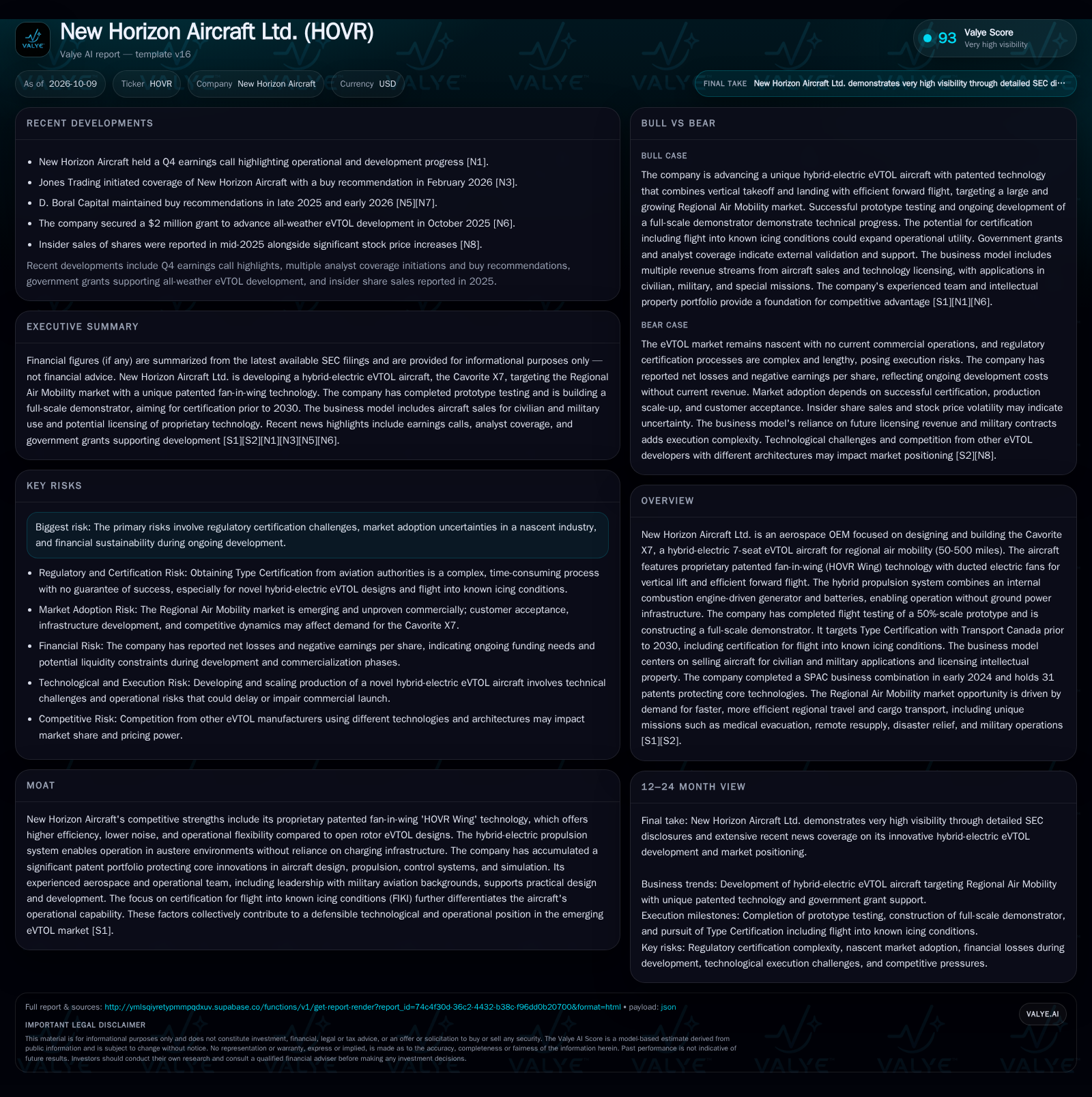
New Horizon Aircraft is developing the Cavorite X7, a hybrid-electric eVTOL aircraft designed for regional air mobility. It has completed a 50%-scale prototype, is building a full-scale demonstrator, and holds 31 patents. The company reported a net loss and no revenue as of August 2026, reflecting ongoing development costs and pre-commercial status. Its business model depends on future aircraft sales and licensing, with progress contingent on regulatory certification, technological execution, and market adoption. A recent government grant and analyst coverage show external interest, but the risks of certification delays, market uncertainty, and financial runway remain significant. [S1] [S2] [N1] [N3] [N6]
New Horizon Aircraft Ltd. is positioning itself at the forefront of the emerging regional air mobility market with its Cavorite X7, a hybrid-electric eVTOL aircraft boasting proprietary fan-in-wing technology. The company has demonstrated technical progress through successful subscale prototype flights and is now building a full-scale demonstrator, but it remains pre-revenue and continues to post significant net losses as it invests in development and certification. The path to commercialization will be shaped by regulatory hurdles, customer adoption, and the company’s ability to scale operations and secure additional funding in a highly competitive and nascent industry. [S1] [S2] [N6]
Recent Milestones and Their Strategic Implications
New Horizon Aircraft is currently developing the Cavorite X7, a 7-seat hybrid-electric eVTOL aircraft that leverages a patented fan-in-wing design for vertical takeoff and efficient forward flight. The company has completed flight testing of a 50%-scale prototype and is constructing a full-scale demonstrator, targeting Type Certification from Transport Canada before 2030, including for flight into known icing conditions. As of August 2026, the company remains pre-revenue, reporting a net loss of $5.3 million for the recent period. The company reported a current ratio of 2.85 for the period. Recent external validation has come in the form of a $2 million government grant for all-weather eVTOL development and multiple analyst buy recommendations. [S1] [S2] [N3] [N6]
How the Cavorite X7 Could Reshape Regional Aviation Economics
New Horizon Aircraft’s business model is predicated on selling the Cavorite X7 to civilian and military operators, with supplementary licensing of its patented fan-in-wing and hybrid-electric propulsion technologies. The target market—regional air mobility—focuses on routes between 50 and 500 miles, a segment that is underserved by both traditional aviation and ground transport. The X7’s hybrid system (combining an internal combustion generator with batteries) is designed to bypass the limitations of current charging infrastructure, which could enable more flexible operations in remote or austere environments.
If the company achieves certification, potential revenue streams could include direct aircraft sales, after-sales support, spares, and possibly recurring licensing income from OEMs or integrators adopting its technology. However, as of the latest filings, New Horizon has not generated any commercial revenue, and its ongoing net losses reflect the capital-intensive nature of aerospace development and the fixed costs of R&D, certification, and compliance. Operating leverage would only materialize once production ramps and deliveries begin, but this inflection point is still several years away and contingent on regulatory and technical milestones. [S1] [S2]
The capital needs for developing, certifying, and scaling production of a novel eVTOL aircraft are substantial. Most comparable aerospace projects have required hundreds of millions—if not billions—of dollars before breakeven, suggesting New Horizon will need to secure significant additional funding or strategic partnerships to maintain momentum and reach commercialization.
Assessing Technological Differentiation and Market Defenses
New Horizon Aircraft’s proprietary HOVR Wing technology—featuring fan-in-wing ducted electric fans for vertical lift and transition to efficient forward flight—offers theoretical advantages in noise reduction, safety, and aerodynamic efficiency compared to open-rotor eVTOL and legacy helicopters. The hybrid-electric propulsion system is specifically designed to operate independently of ground charging infrastructure, which could provide operational flexibility in remote or emergency scenarios.
The company’s portfolio of 31 issued and allowed patents covers not only the core fan-in-wing design but also hybrid propulsion, control software, and digital simulation. This intellectual property base, if defensible, could enable licensing revenues or deter fast followers. However, the eVTOL landscape is crowded with well-funded players pursuing different architectures (pure electric, tilt-rotor, lift+cruise), and the market is not yet proven—no manufacturer has achieved large-scale commercial deployment or demonstrated sustainable economics.
Competing OEMs, including both startups and established aerospace firms, may have greater access to capital, deeper customer relationships, and more regulatory experience. The X7’s unique value proposition—hybrid range, speed, payload, and all-weather capability—could carve out a niche, but only if certification and operational validation are achieved ahead of rivals. Switching costs for customers may be high if New Horizon’s technology proves mission-critical, but only after adoption and demonstrated reliability.
Unlocking Value Through Certification and Early-Mover Advantage
The most favorable scenario for New Horizon Aircraft would see the company successfully complete full-scale flight testing, achieve Type Certification (including for flight into known icing conditions) before major eVTOL competitors, and demonstrate superior operational performance in real-world missions. Early adoption by regional carriers, medical evacuation operators, or defense agencies could validate the technology and provide anchor customers.
This could trigger a flywheel: certification drives customer adoption, which in turn attracts more funding and enables scaling of production, further reducing unit costs and increasing margins. Successful demonstration of the X7’s hybrid range and austere-environment capability could lead to licensing deals with other OEMs, opening a second revenue stream. Confirmation of this scenario would include major customer orders, successful completion of certification milestones, and public demonstrations of all-weather and range capabilities.
Falsifying this scenario would be delays in certification, lack of anchor customers, or technical challenges that prevent real-world performance from matching claims.
Incremental Progress Amid Extended Timelines and Ongoing Losses
The most likely scenario is that New Horizon Aircraft continues to make technical progress—completing the full-scale demonstrator and advancing through key certification steps—but at a slower pace than optimists expect. The company may secure additional non-dilutive funding (such as grants) and potentially raise new equity, but will continue to burn cash and post net losses as R&D and compliance costs remain high.
Commercial operations and revenue generation would still be several years away, with initial production runs likely limited and dependent on pilot projects or small-scale deployments. The company’s ability to maintain momentum will depend on its success in hitting development milestones, managing cash burn, and demonstrating clear technical differentiation to investors and potential customers.
Evidence confirming this scenario would include steady but unspectacular milestone progress, continued government or strategic support, and modest increases in analyst coverage. Falsification would come from either a breakthrough (major order, early certification) or a setback (runway crisis, technical or regulatory roadblock).
When Delays, Funding Gaps, or Market Shifts Derail Commercialization
The adverse scenario sees New Horizon Aircraft encountering significant delays in obtaining Type Certification, possibly due to regulatory uncertainty around novel hybrid-electric architectures or the challenge of certifying for flight into known icing conditions. Mounting R&D and compliance costs, in the absence of near-term revenue or major new funding, could force the company to slow development, seek emergency financing on unfavorable terms, or even restructure.
Meanwhile, the competitive landscape could evolve rapidly, with better-funded rivals achieving certification and market entry first, capturing early customers and setting performance or price benchmarks that make it harder for late entrants to compete. Technological or operational setbacks—such as failure of the hybrid system in testing or inability to demonstrate all-weather performance—could erode investor and customer confidence.
Confirmation of this scenario would include missed milestones, negative regulatory feedback, difficulty raising funds, or announced layoffs and program slowdowns.
Milestones and Metrics That Will Determine New Horizon’s Trajectory
Completion and public demonstration of the full-scale Cavorite X7 technical demonstrator, including successful transition from vertical to forward flight.
Progress updates and disclosures related to Transport Canada Type Certification, especially for flight into known icing conditions (FIKI).
Announcements of customer MOUs, LOIs, or binding orders—civilian, military, or special mission—if disclosed.
Securing additional non-dilutive funding (grants, strategic investments) or successful equity/debt raises to extend development runway.
Evidence of licensing deals or partnerships leveraging the company’s patent portfolio, if disclosed.
Updates on the company’s cash burn and projected runway, as well as any changes in net loss trajectory.
Competitor certification or product launch announcements that could alter the market adoption curve or set new regulatory precedents.
Any significant insider buying or selling activity, especially if correlated with major technical or commercial milestones.
Disclaimer: This is research-only, informational analysis and not investment advice. It may include AI-generated interpretation and general industry context. Always verify important details using primary sources.

Comments