
COTWO Advisors Physical European Carbon Allowance Trust: Passive Exposure to a Structurally Evolving Carbon Market
COTWO Advisors Physical European Carbon Allowance Trust offers investors direct, regulated access to EU carbon allowances without speculative trading. With its NAV-aligned share issuance and redemption, the Trust tracks EUA price movements, but remains exposed to regulatory and market volatility inherent in the EU ETS framework.
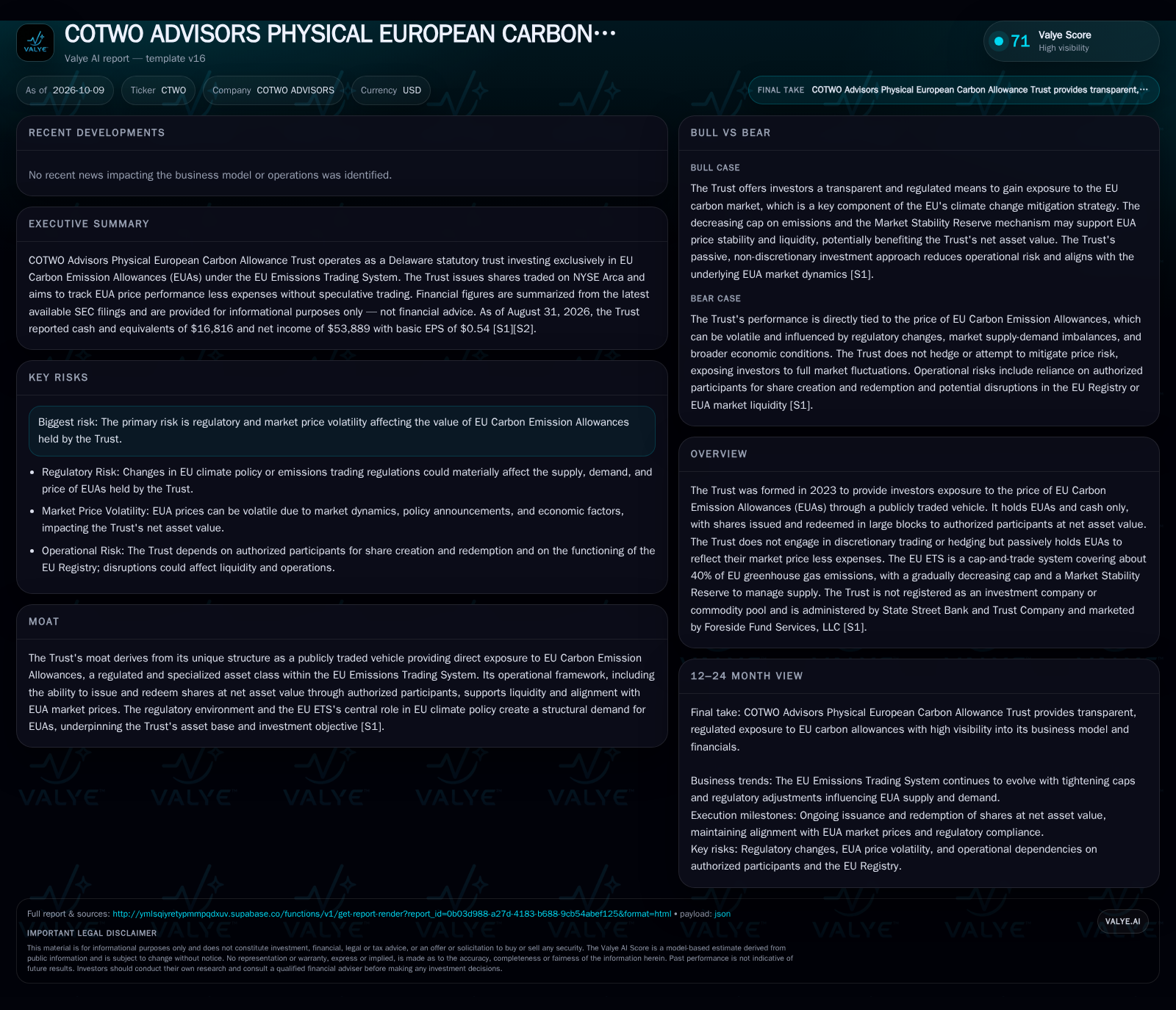
COTWO Advisors Physical European Carbon Allowance Trust (CTWO) gives investors a vehicle for passively tracking the price of EU Carbon Emission Allowances (EUAs) through a transparent, exchange-listed trust. Its structure supports liquidity and price alignment, but leaves investors fully exposed to regulatory shifts and EUA price volatility. As of August 2026, the Trust reported $16,816 in cash and net income of $53,889 for the period, reflecting minimal operational overheads and direct EUA exposure [S2].
COTWO Advisors Physical European Carbon Allowance Trust (CTWO) is a specialized investment vehicle designed to give investors exposure to the price movements of EU carbon allowances without the complexity of direct participation in the European Union Emissions Trading System (EU ETS). Structured as a Delaware statutory trust and trading on NYSE Arca, CTWO’s shares represent fractional interests in a pool of EUAs and cash, with strict passivity and NAV-based creation/redemption mechanics. This structure offers transparency and close tracking of EUA prices, but also subjects investors to the full force of regulatory adjustments and EUA market volatility—core characteristics of the evolving European carbon landscape.
Recent Financials and Structural Mechanics Define CTWO’s Operating Profile
As of August 31, 2026, COTWO Advisors Physical European Carbon Allowance Trust reported cash and equivalents of $16,816 and net income of $53,889 for the period, with basic EPS of $0.54 [S2]. The Trust’s assets consist solely of EU Carbon Emission Allowances (EUAs) and cash, with shares issued and redeemed in blocks of 50,000 at net asset value to authorized participants [S1]. This mechanism ensures that the Trust’s share price closely tracks the underlying EUA market price, rather than introducing tracking error or speculative performance. Importantly, the Trust does not engage in discretionary trading, hedging, or leverage, providing investors with a pure, passively managed exposure to the price of EUAs.
These structural and financial characteristics mean CTWO’s operational overhead is minimal and its reported net income largely reflects the impact of management fees and expenses against the passive appreciation or depreciation of the EUA holdings. The Trust’s model is thus highly transparent, but it also leaves investors fully exposed to the inherent volatility and regulatory risk of the EU carbon market.
Understanding the Economics of a Passively Managed Carbon Allowance Trust
CTWO earns no revenue in the traditional sense; its economics are fundamentally tied to the value appreciation (or depreciation) of the EUAs it passively holds. Expenses are predictable and primarily consist of management and administrative fees. The Trust does not attempt to generate alpha through active trading or market timing, nor does it hedge exposure, so its share price is intended to reflect the spot market price of EUAs less operational costs.
From an investor’s perspective, the most important driver of returns is the trajectory of EUA prices, which are set by the supply-demand balance in the EU ETS. This balance is shaped by the progressively tightening emissions cap, periodic regulatory interventions (such as the Market Stability Reserve), and broader macroeconomic factors that influence industrial emissions and compliance demand. Because the Trust issues and redeems shares at NAV in large blocks, arbitrage by authorized participants helps keep the share price closely aligned with the underlying EUA value, minimizing persistent premiums or discounts. The fixed-cost structure means that as the Trust scales, expense ratios could fall, offering potential operating leverage if asset growth outpaces fixed administrative costs.
Positioning Against Other Carbon Market Vehicles and Substitute Exposures
CTWO’s primary edge lies in its simplicity and regulatory clarity: it offers direct, passive exposure to a major environmental commodity without the operational complexity, leverage, or counterparty risks associated with derivatives or more complex funds. Alternative vehicles for carbon exposure include futures-based ETFs, active commodity pools, or direct EUA registry accounts—each with their own risk, liquidity, and fee profiles. Futures-based products may introduce roll costs, tracking error, and additional regulatory burdens, while direct EUA holding is typically inaccessible to most individual investors due to compliance and registry barriers.
However, the Trust’s lack of active management means it cannot take advantage of short-term market dislocations or volatility, nor can it mitigate drawdowns through hedging. Its competitive position is strongest for investors seeking a pure, transparent, and liquid proxy for EUA prices. Over time, competition could increase if more issuers launch similar products or if regulatory changes alter barriers to entry or the structure of the EU ETS. Substitute exposures could also emerge if voluntary carbon markets or non-EU compliance schemes gain investor traction, but these are not perfect economic substitutes for EUAs.
How Structural Tightening of the EU ETS Could Drive Significant Asset Appreciation
The most favorable scenario for CTWO is a sustained increase in EUA prices driven by a combination of a tightening emissions cap, robust compliance demand, and effective supply management through the Market Stability Reserve. If the European Commission continues to ratchet down emissions allowances and expands the scope of the EU ETS (for example, by including new sectors or accelerating the cap reduction), structural scarcity could emerge, driving EUA prices materially higher.
Confirmation of this scenario would include a visible uptrend in EUA prices, increasing net asset value per share, and growing Trust assets as investors allocate more capital. Additional evidence would be regulatory announcements that signal future tightening, or data showing strong compliance demand exceeding annual allowance supply. Falsification would occur if the EU relaxes caps, introduces alternative compliance mechanisms that dilute EUA demand, or if macroeconomic weakness undercuts emissions and compliance activity, leading to EUA oversupply and price declines.
Passive Price Tracking Amid Regulatory and Market Fluctuations
The most plausible path is that CTWO continues to function as a transparent, liquid, passively managed tracker of EUA prices, with net asset value fluctuating in line with the underlying market. The EU ETS is likely to persist as the central mechanism for EU climate policy, but periodic volatility in EUA prices is probable due to policy adjustments, economic cycles, and market sentiment shifts.
In this scenario, investor returns are a direct function of EUA price appreciation net of expenses. Operational execution remains straightforward, with ongoing share creation and redemption at NAV, and minimal tracking error. Evidence supporting this outcome would be stable or gradually rising EUA prices, regular in-kind share issuance/redemption activity, and steady Trust operations. Disconfirmation would come from major regulatory shocks, structural failures in the EU ETS, or operational breakdowns affecting the Trust’s ability to issue/redeem at NAV.
Regulatory Shocks or Market Oversupply Could Undermine Asset Value
The primary adverse scenario is that EU policymakers intervene to relax emissions caps, increase allowance supply, or otherwise depress EUA prices—whether due to economic pressures, energy crises, or political shifts. Alternatively, a sharp economic downturn could reduce industrial emissions, causing EUA surpluses and price declines. Because CTWO does not hedge or diversify, its NAV would fall in lockstep with EUA prices, directly impacting investor value.
Evidence for this scenario would be a material drop in EUA prices, reduced compliance demand, or new regulatory announcements expanding allowance supply or introducing alternative compliance paths. Operationally, a breakdown in the functioning of the EU Registry or disruptions among authorized participants could also impair liquidity or the Trust’s ability to track NAV. These risks are amplified by the Trust’s structural inability to respond actively to adverse market or regulatory developments.
Concrete Markers for Testing the CTWO Thesis in a Dynamic Carbon Market
Net asset value per share versus spot EUA price: Persistent tracking error would challenge the Trust’s pass-through mechanics.
Volume and frequency of share creations/redemptions: High activity suggests reported liquidity position and effective arbitrage; illiquidity would be a red flag.
Regulatory changes to the EU ETS cap, sector coverage, or Market Stability Reserve: Any significant adjustment could materially alter EUA supply/demand dynamics.
Announcement of new competing EUA-tracking products: Increased competition could affect fee structure or market share.
Operational integrity of the EU Registry and Trust’s authorized participants: Disruptions could impact liquidity or NAV tracking.
Expense ratio trends as asset scale changes: Declining fees with scale would enhance net returns; rising costs could erode the passive value proposition.
If disclosed, aggregate Trust asset growth or contraction: Flows into or out of the Trust may signal investor sentiment and confidence in the EUA market.
Disclaimer: This is research-only, informational analysis and not investment advice. It may include AI-generated interpretation and general industry context. Always verify important details using primary sources.

Comments