
Worthington Enterprises: Strategic Expansion and the Challenge of Margin Stability in Cyclical Markets
Worthington Enterprises' recent acquisition and segment focus position it to capture growth across building products and sustainable energy, but exposure to macro cycles and integration execution will test its ability to sustain earnings momentum.
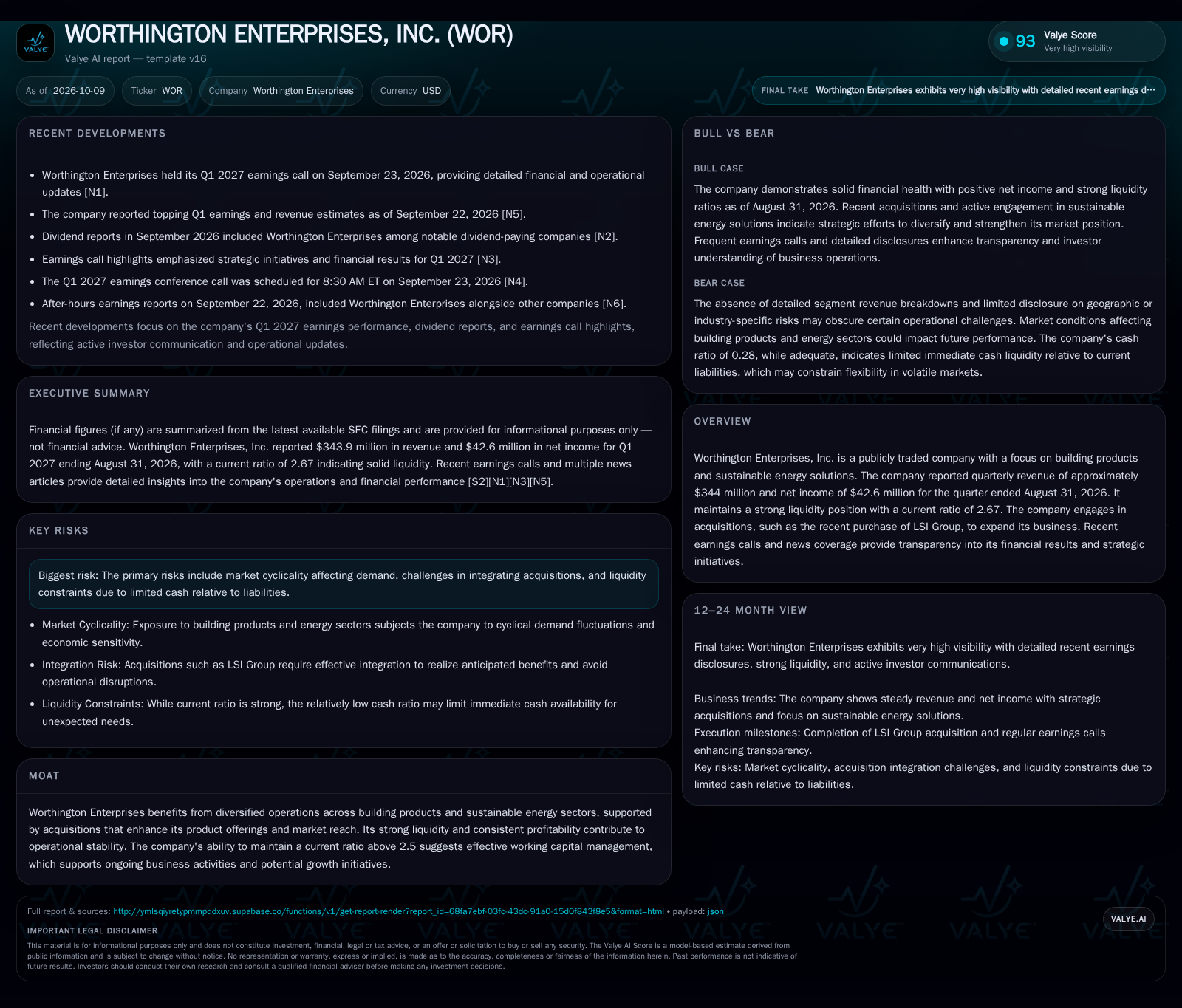
Worthington Enterprises reported $343.9 million in revenue and $42.6 million in net income for the quarter ended August 31, 2026, maintaining a current ratio of 2.67. The January 2026 acquisition of LSI Group reflects ongoing expansion in building products and sustainable energy. However, limited immediate cash liquidity and significant customer concentration in Trade & Specialty Solutions highlight the importance of disciplined capital management and successful integration [S2].
Worthington Enterprises, Inc. continues to execute on its growth and diversification strategy, with recent financials reflecting both resilience and persistent challenges typical of its end markets.
Recent Results Highlight Growth, Liquidity, and Integration Milestones
Worthington Enterprises reported $343.9 million in revenue and $42.6 million in net income for the quarter ended August 31, 2026, with cash and cash equivalents of $55.1 million and a current ratio of 2.67 [S2]. The company’s January 2026 acquisition of LSI Group marks a meaningful expansion into adjacent markets, with potential to deepen capabilities in building products and sustainable energy [S1]. [S2]
How Worthington’s Portfolio Could Drive Margins and Returns
Worthington’s business model centers on manufacturing engineered products for building performance and specialty trade applications, serving OEMs, distributors, and tradespeople. Revenue is driven by both volume and value-added product mix, with potential for premium pricing in specialized HVAC, containment, and specialty tool categories. However, the company’s end markets—particularly construction and energy—are highly cyclical, so demand and pricing power can fluctuate materially with macroeconomic conditions.
Operating leverage is significant: fixed costs in manufacturing and supply chain optimization mean that incremental sales, when capacity is utilized, can contribute disproportionately to profit. Conversely, a drop in volume can quickly pressure margins. The LSI Group acquisition introduces integration costs and may require additional capital outlays to harmonize operations or realize synergies, which could temporarily dampen margins.
Worthington’s margin profile is also influenced by its supply chain dynamics, where raw material cost volatility can materially affect input prices. The company's ability to negotiate long-term contracts or leverage scale economies in procurement can provide a buffer against commodity price swings. However, if input costs rise faster than the company can pass through to customers, margin compression may occur. Additionally, the capital intensity of manufacturing facilities means that capacity utilization rates are critical: underutilized capacity during demand troughs can disproportionately increase per-unit fixed costs, pressuring profitability. Conversely, efficient capacity ramp-up during demand upswings can amplify operating leverage benefits.
Another dimension to consider is the product lifecycle and innovation cadence within Worthington’s portfolio. The ability to continuously develop differentiated, higher-margin products—particularly in engineered HVAC components or energy-efficient solutions—can help mitigate commoditization risks and sustain pricing power. However, innovation cycles require investment in R&D and carry execution risk; delayed product introductions or technical setbacks could limit the company’s competitive positioning. Moreover, the pace of customer adoption for new technologies, especially in sustainable energy segments, will influence the timing and magnitude of margin enhancements.
Positioning in Fragmented Markets and the Challenge from Larger Integrated Players
Worthington competes in highly fragmented sectors for building products and specialty tools, facing both large diversified manufacturers and smaller niche providers. Scale offers advantages in procurement, manufacturing efficiency, and distribution reach, but also exposes the company to price competition and the risk of commoditization in core product lines.
The acquisition of LSI Group could strengthen Worthington’s portfolio and differentiation, enabling cross-selling and access to new customer segments. However, integration risk is nontrivial: realizing cost and revenue synergies depends on aligning product development, sales channels, and supply chain processes.
Switching costs for OEM and distributor customers may be moderate—particularly if Worthington can bundle solutions or provide superior service—but in many categories, price sensitivity remains high. The company’s exposure to a customer representing more than 10% of Trade & Specialty Solutions sales increases vulnerability to renegotiation or customer loss, which could impact revenue stability.
Sustainable energy solutions could provide longer-term growth if regulatory drivers and customer adoption increase, but competition from larger industrial conglomerates and specialized energy technology firms is likely to intensify as the market evolves.
Synergy Capture and Demand Recovery Could Accelerate Earnings Growth
If post-acquisition integration of LSI Group proceeds smoothly, Worthington could unlock operating synergies—lowering costs through consolidated procurement, streamlined manufacturing, and expanded distribution. Effective cross-selling between building products and specialty solutions could increase wallet share with key accounts and help diversify customer concentration.
A cyclical upswing in construction and sustainable energy markets would bolster both volume and pricing power, enabling Worthington to leverage its fixed cost base and expand margins. Successful innovation in engineered products—such as advanced HVAC components or energy-efficient containment solutions—could further differentiate offerings and could support premium pricing.
Evidence confirming this scenario would include: rising segment operating margins, improved cash conversion from operations, sequential revenue growth in both legacy and acquired businesses, and visible progress on integration milestones (such as cost savings or new product launches attributed to the combined entity).
Disciplined Execution Maintains Stability Amid Mixed Macro Backdrop
The most plausible trajectory is that Worthington continues to generate steady, if unspectacular, earnings growth, with periodic volatility tied to end-market cycles. Management’s focus on working capital discipline and operational efficiency helps preserve margins, while the LSI Group integration progresses incrementally—delivering some, but not all, anticipated synergies within the first 12-18 months.
Customer concentration in Trade & Specialty Solutions remains a watchpoint, but is partially offset by efforts to broaden the customer base.
This scenario would be confirmed by stable gross and operating margins, moderate revenue growth in line with construction and energy sector trends, and limited one-time charges or disruptions related to integration.
Cyclical Downturn or Integration Missteps Expose Margin and Liquidity Risks
A pronounced downturn in construction or energy end markets could drive down volumes and compress pricing, eroding Worthington’s operating leverage and straining profitability. If integration of LSI Group falters—due to cultural mismatch, delayed cost savings, or customer attrition—the company could incur higher-than-expected expenses and lose strategic focus.
Warning signs for this scenario would include: declining segment margins, negative operating cash flow, missed synergy targets, rising short-term debt, or material one-off charges tied to acquisition integration.
Performance Drivers That Will Shape Worthington’s Value Creation Trajectory
Quarterly segment operating margins, if disclosed, to track the impact of integration and cost management.
Revenue growth rates for both Building Performance Solutions and Trade & Specialty Solutions segments, to gauge underlying demand and portfolio expansion.
Progress on LSI Group integration—such as realized cost savings, new product launches, or cross-segment customer wins—would help test the upside scenario.
Working capital turnover metrics (inventory and receivables days), if disclosed, to assess liquidity management and resilience.
Customer concentration trends in Trade & Specialty Solutions: monitoring whether the >10% customer share shrinks or grows.
Operating cash flow generation relative to net income, as a signal of underlying business health and cash conversion.
Frequency and magnitude of one-time charges or integration-related expenses, to evaluate execution risk.
Disclaimer: This is research-only, informational analysis and not investment advice. It may include AI-generated interpretation and general industry context. Always verify important details using primary sources.

Comments