
WEWARDS, INC.: Navigating Zero Revenue, Liquidity Strain, and Strategic Uncertainty
WEWARDS, INC. With SEC compliance and commodity market context as the only visible anchors, the company’s commercial pathway and survival prospects remain opaque.
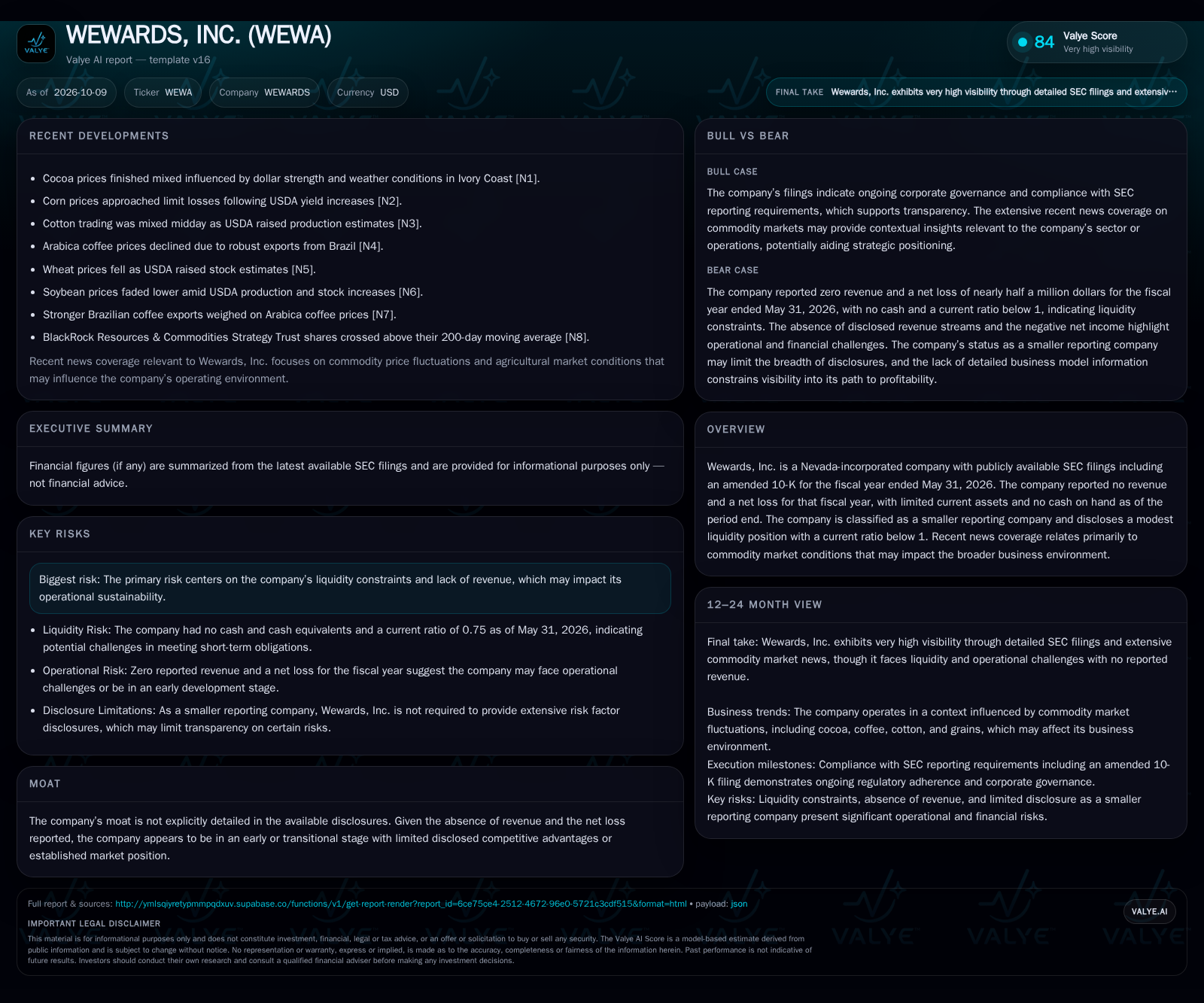
WEWARDS, INC. has reported zero revenue and a net loss of $497,512 for the fiscal year ended May 31, 2026, with no cash on hand and a current ratio of 0.75. Its only apparent strengths are regulatory compliance and transparency, while its business model and path to sustainability are not disclosed. [S1]
WEWARDS, INC. stands at a crossroads with no revenue generation, minimal assets, and a negative income statement for fiscal 2026. While regulatory adherence is evident, the absence of a defined business model or disclosed operations leaves the company’s strategic direction and survival prospects in question. The coming months will test whether WEWARDS can secure funding, articulate a viable strategy, or transition beyond its current stasis.
Zero Revenue, Negative Net Income, and No Cash: The Immediate Financial Backdrop
WEWARDS, INC. reported zero revenue and a net loss of $497,512 for the fiscal year ended May 31, 2026. The company’s balance sheet was stark: zero cash and cash equivalents, current assets of just $300, and current liabilities totaling $400, resulting in a current ratio of 0.75 and a cash ratio of zero. The company reported cash and liquidity metrics for the period; these figures do not by themselves establish operating runway, investment capacity, financial flexibility, or financing capacity. The aggregate market value of non-affiliate shares was $12.9 million as of November 30, 2025, but this market value does not reflect operational sustainability. In sum, WEWARDS is in a critical financial position, with no visible revenue, no reported cash balance, and a net loss that raises existential questions. [S1]
While market capitalization may appear superficially supportive, such valuation metrics for a non-revenue entity often reflect speculative sentiment rather than fundamental value. Consequently, the financial backdrop underscores the necessity for a clear path to cash generation or capital raising to avert insolvency or forced restructuring.
Revenue Model Unclear and Cost Structure Unviable: What Would Need to Change
With no disclosed revenue, product lines, or services, WEWARDS currently generates no operating income and incurs costs that result in negative net income. The lack of cash and negligible assets means the company cannot cover even basic liabilities without external funding. In the absence of a commercial model, plausible economic pathways would require the introduction of a viable product or service, clear monetization mechanics, or a capital-raising event. If the company were to launch operations, fixed costs (such as compliance and reporting) are likely dominant, with no evidence of scalable variable cost structure or operating leverage. Any attempt to scale would likely require significant upfront capital, as there is no evidence of recurring revenue, asset-light operations, or cash-generative activities. The current economics are unsustainable, and unless the company pivots or secures new funding, it faces a structural dead end.
For WEWARDS to transition from a non-revenue entity to a viable business, a fundamental pivot in its cost structure and revenue generation is essential. The introduction of a monetizable product or service would need to be accompanied by a scalable cost base, ideally with variable expenses that grow in line with revenue rather than fixed overheads that exacerbate losses. Additionally, the company would benefit from establishing recurring revenue streams, which provide predictability and improve financing prospects. Without these elements, any capital raised risks rapid depletion. A detailed breakdown of cost drivers, if disclosed, would help assess the company’s ability to achieve operating leverage and sustainable margins over time.
No Evident Market Position or Moat in a Crowded Landscape
There is no evidence that WEWARDS has established a competitive advantage, defined market niche, or differentiated product. The company’s filings do not disclose any commercial activity, intellectual property, or customer base. In the absence of operating data, it is unclear which competitor category—be it commodity trading, services, or fintech—the company aspires to enter. The only visible marker of differentiation is regulatory compliance, which, while necessary, is not sufficient for competitive success. If the company were to enter the commodity or financial services sector, it would face established players with significant scale, technology, and entrenched customer relationships. Barriers to entry in these sectors are typically high, requiring robust capital, regulatory expertise, and credible go-to-market execution—none of which are presently evident for WEWARDS.
The absence of a defined market position or intellectual property raises questions about the company's ability to differentiate itself in sectors characterized by high entry barriers and intense competition. In industries such as commodities or fintech, incumbents typically possess significant technological infrastructure, regulatory licenses, and customer trust, which act as formidable moats. For WEWARDS to carve out a niche, it would need to demonstrate unique value propositions, such as proprietary technology, innovative business models, or strategic partnerships that mitigate these barriers. Without such differentiation, the company risks commoditization and pricing pressures that could further undermine financial viability.
A Plausible Turnaround: Capital Infusion and Business Model Revelation
The most favorable scenario for WEWARDS would involve a successful capital raise or strategic investment that provides the liquidity needed to launch or relaunch operations. This could coincide with the disclosure of a compelling business model—potentially in a niche commodity, fintech, or digital services space—leveraging recent commodity market volatility as an entry point. Confirmation of this trajectory would require evidence of new financing (such as a private placement or public offering), the announcement of a concrete product or service, and the hiring of operational leadership with sector expertise. Early customer wins, a published go-to-market strategy, or the securing of strategic partnerships would further validate an operational pivot. Falsification of the upside would occur if no funding is secured, commercial plans remain undisclosed, or the company fails to attract credible management or partners within the next reporting cycle.
Prolonged Inactivity and Incremental Disclosure: Survival Without Progress
The most plausible path is continued operational stasis marked by regulatory filings, minimal compliance expenditures, and no substantive business activity. As a smaller reporting company, WEWARDS may continue to file SEC reports to maintain its public company status while seeking, but not necessarily securing, new capital or business opportunities. This scenario would be confirmed by subsequent SEC filings that show no change in revenue, cash, or business description, and the absence of new product or partnership announcements. A modest uptick in administrative expenses or the appearance of a small funding round could signal attempts to keep the corporate shell active, but without a disclosed operational plan, the company would remain in limbo. Falsification would require evidence of business launch, significant capital inflow, or a shift in strategic direction.
Liquidity Exhaustion and Regulatory Risk: Path to Delisting or Dissolution
In the adverse scenario, WEWARDS fails to secure new funding and exhausts its ability to meet regulatory or administrative obligations. With zero cash and negative working capital, the company could be forced to cease filings, lose its public company status, or enter dissolution or bankruptcy proceedings. This outcome would be confirmed by missed SEC filings, regulatory notices, or explicit disclosures indicating intent to wind down or liquidate. External factors such as changes in regulatory requirements for public shells or increased compliance costs could accelerate this path. Conversely, any sign of a last-minute capital injection or regulatory relief could delay, but not necessarily prevent, structural decline.
Milestones That Will Define Whether WEWARDS Can Move Beyond Stasis
Disclosure of any capital-raising transaction, such as a private placement, rights offering, or convertible debt issuance, would be a primary test of the company’s viability.
Announcement or launch of a tangible product, service, or technology platform would clarify the company’s business model and sector focus.
Hiring or appointment of experienced operational or sector-specific management would signal a shift from compliance-only mode to active business development.
Material changes in the balance sheet, particularly the appearance of cash or significant new assets, would provide evidence of renewed operational capacity.
Filing of a comprehensive business plan or investor presentation would help validate the intent and credibility of any pivot.
Disclosure, if any, of early customer contracts, partnerships, or letters of intent would serve as leading indicators of commercial traction.
Any SEC filing indicating intent to deregister, liquidate, or enter bankruptcy would confirm the downside scenario.
Disclaimer: This is research-only, informational analysis and not investment advice. It may include AI-generated interpretation and general industry context. Always verify important details using primary sources.

Comments