
Cryo-Cell International: Core Banking Stability, Strategic Uncertainty, and the Limits of Expansion Beyond Cord Blood
Cryo-Cell International’s established cord blood banking business remains operationally robust, but the breakdown of its Duke University partnership has stalled expansion into cellular therapies—leaving the company reliant on legacy services amid competitive and financial pressures.
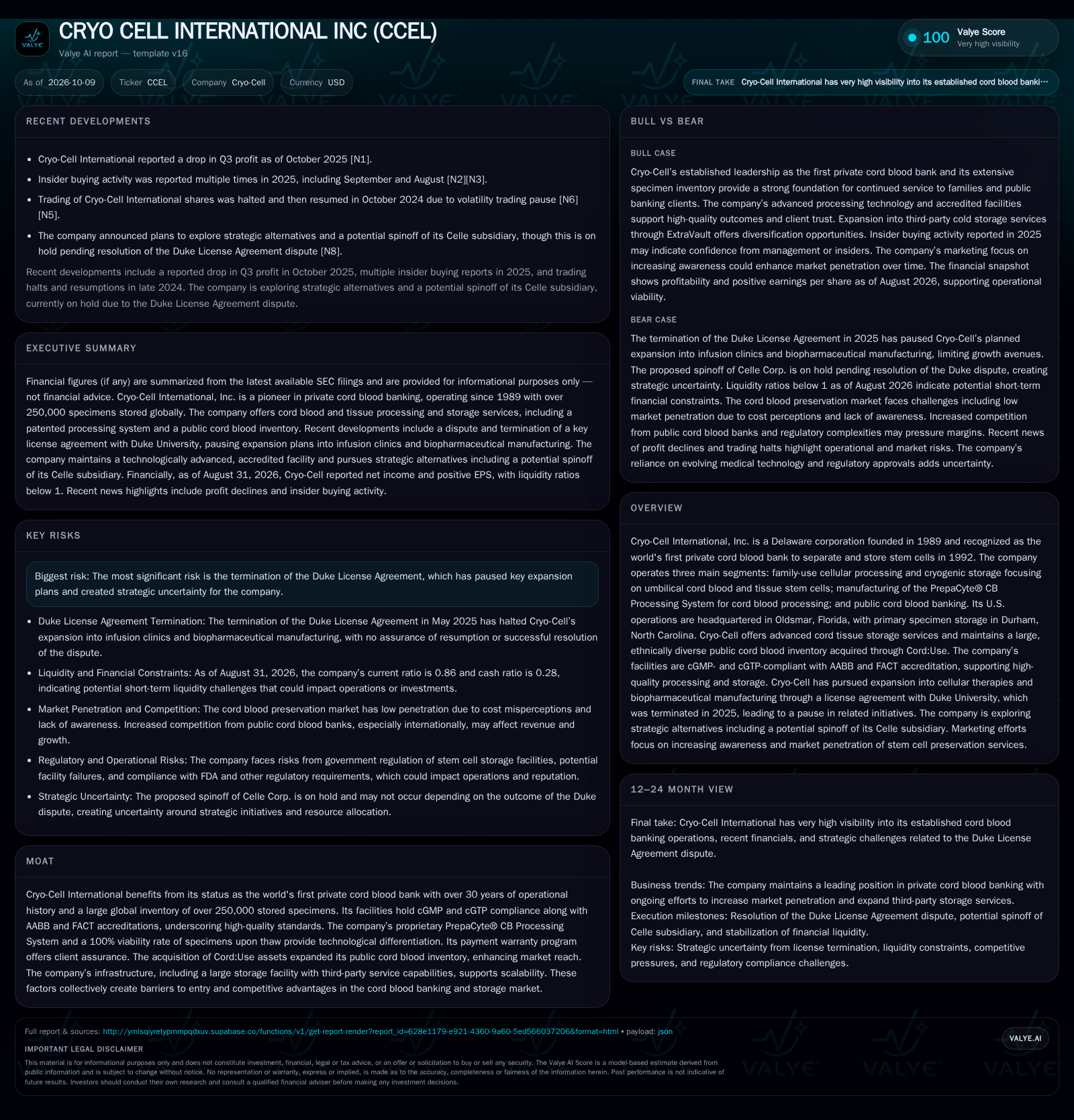
Cryo-Cell International continues to operate a leading private and public cord blood banking platform, with more than 250,000 specimens stored and a legacy of high-quality processing. However, the 2025 termination of its Duke University license agreement has frozen planned moves into infusion clinics and biomanufacturing, while strategic options such as a Celle subsidiary spinoff are on hold pending dispute resolution. The core thesis now hinges on Cryo-Cell’s ability to defend and grow its core franchise, restore expansion optionality, and manage near-term financial risks.
Cryo-Cell International stands at a crossroads: its long-standing leadership in private and public cord blood banking remains intact, backed by advanced processing capabilities, a sizable and diverse specimen inventory, and regulatory accreditations. However, the high-profile termination of its Duke University license agreement in 2025 has abruptly halted ambitions to diversify into cellular therapies and biomanufacturing, freezing new business initiatives and putting strategic moves like the Celle subsidiary spinoff on ice.
Terminated Expansion Plans and Financial Constraints Define Today’s Starting Point
Cryo-Cell International’s most consequential recent event is the May 2025 termination of its Patent and Technology License Agreement with Duke University, which led to a pause in all related investments and halted the planned Cryo-Cell Institute for Cellular Therapies [S1]. This has removed the company’s most visible near-term pathway to diversify beyond its core cord blood and tissue banking business.
Financially, as of August 31, 2026, Cryo-Cell reported $1.43 million in cash and equivalents, $2.8 million in short-term investments, current assets of $13.17 million, and current liabilities of $15.33 million, resulting in a current ratio of 0.86 and a cash ratio of 0.28 [S2]. The company reported cash and liquidity metrics for the period; these figures do not by themselves establish operating runway, investment capacity, financial flexibility, or financing capacity.
The company’s Celle subsidiary spinoff is on hold pending a resolution to the Duke dispute, compounding strategic uncertainty [N8] [S1]. Meanwhile, Cryo-Cell continues to operate its core business, storing over 250,000 specimens and offering both private and public banking services [S1].
Cord Blood Banking Economics: Recurring Revenue, Fixed Assets, and the Limits of Diversification
Cryo-Cell’s principal revenue streams are (1) upfront processing and long-term storage fees for private cord blood and tissue banking, (2) sales of its proprietary PrepaCyte® CB Processing System, and (3) sales of public cord blood units to the National Marrow Donor Program [S1]. The family-use business model is characterized by an initial collection and processing fee, followed by annual storage fees—creating a recurring-revenue base but also exposing the company to attrition risk if customers default or choose not to renew.
The economics of private cord blood banking are capital-intensive: high fixed costs for facility operation, regulatory compliance (cGMP, cGTP, AABB, FACT accreditations), and specimen storage infrastructure. Margins can be attractive if fixed costs are spread over a growing customer base, but low market penetration and price sensitivity can compress profitability. The public banking segment, while enhancing utilization and diversifying revenue, may have lower margins due to regulatory and contractual pricing constraints.
The company’s attempt to expand into cellular therapies and biomanufacturing via the Duke partnership represented a bid to access higher-value, less commoditized revenue streams. With this pathway now closed, Cryo-Cell is left with its legacy economics—reliant on banking volume, retention, and incremental expansion into third-party cold storage (ExtraVault)—without a proven new engine for growth. The company’s warranty program (up to $100,000 for failed engraftment) is a differentiator but also a contingent liability.
Operating leverage is inherent: incremental specimens generate high-margin storage revenue, but a decline in new enrollments or rising churn would quickly expose the fixed-cost base. Capital needs are moderate in the absence of new initiatives, but liquidity stress could constrain marketing, technology upgrades, or opportunistic acquisitions.
Defending Share in a Fragmented, Cost-Sensitive, and Regulated Market
Cryo-Cell’s legacy advantages include its status as the world’s first private cord blood bank, a 30+ year operational history, and a large, ethnically diverse inventory [S1]. Its cGMP/cGTP-compliant, AABB- and FACT-accredited facility, high reported specimen viability, and proprietary processing technology (PrepaCyte®) provide technical credibility and differentiation. The acquisition of Cord:Use expanded its public banking reach, and the ExtraVault cold storage offering opens a potential new customer segment.
However, private cord blood banking faces intensifying competition from public banks (which offer free storage for community benefit), international players with lower cost structures, and emerging alternative cell storage or regenerative medicine technologies. Customer acquisition is hampered by low awareness and cost sensitivity—most expectant parents do not elect storage, and price competition is common.
Switching costs for families are high once specimens are banked, but new customer acquisition is labor- and marketing-intensive. Regulatory compliance is a necessary but non-differentiating cost. While Cryo-Cell’s scale and accreditations create barriers to entry, the lack of a clear path to higher-value cell therapy applications or proprietary clinical offerings leaves the company vulnerable to commoditization and margin pressure.
Unlocking Value Through Strategic Resolution and Market Expansion
The most favorable scenario for Cryo-Cell would entail the successful resolution of the Duke University dispute, enabling the company to restart its push into cellular therapies, infusion clinics, or biomanufacturing. This could open new, higher-margin revenue streams, attract institutional partners, and reaccelerate growth beyond the slow-moving cord blood banking market.
Separately, if the company can execute a spinoff or monetization of the Celle subsidiary, this could unlock value, provide fresh capital, and sharpen the strategic focus of the core business [N8] [S1].
On the core banking front, increased marketing effectiveness—translating into higher enrollment and lower churn—could drive operating leverage, while successful expansion of ExtraVault’s third-party cold storage could diversify the revenue mix.
Evidence to confirm this scenario would include: the announcement of a settlement or new agreement with Duke or another cell therapy partner; resumption of paused investments; increased enrollment rates or storage volumes; and successful execution or monetization of the Celle spinoff.
Core Franchise Persists Amid Slow Growth and Ongoing Uncertainty
The most plausible near-term scenario is that Cryo-Cell continues to operate its core cord blood and tissue banking businesses with modest growth or flat revenue, as market penetration remains low and the company is unable to immediately resolve the Duke dispute or launch new lines of business. The ExtraVault cold storage service may contribute incremental revenue but is unlikely to become a major growth engine without significant commercial traction.
The legacy business model continues to generate recurring storage fees, but price competition, slow customer acquisition, and potential churn limit upside.
Liquidity remains tight but manageable if net income and cash flow remain positive; however, the company is vulnerable to any negative swing in enrollments, storage renewals, or unexpected expenses.
This scenario would be confirmed by continued quarterly profitability, stable or slowly increasing specimen counts, ongoing marketing campaigns focused on awareness, and no material change in the status of the Duke dispute or Celle spinoff.
Liquidity Pressure and Lack of Growth Catalysts Undermine Stability
A more adverse scenario would see Cryo-Cell unable to resolve the Duke dispute, foreclosing expansion into higher-margin cellular therapies and leaving the company exposed to the slow-growth, price-sensitive cord blood banking market. If new customer acquisition stalls or churn increases, the high fixed-cost base could quickly erode profitability.
Liquidity stress—already signaled by sub-1 current and cash ratios—could worsen if revenue or cash collections slip, potentially forcing the company to curtail operations, delay payments, or seek external financing on unfavorable terms [S2]. Strategic options such as the Celle spinoff might be delayed indefinitely or executed on less favorable terms, limiting the company’s ability to pivot or invest.
Competitive pressure from public banks, lower-cost international players, or technological substitutes (such as new cell therapies not requiring cord blood storage) could further compress margins or accelerate customer attrition.
This scenario would be confirmed by a drop in quarterly profitability or cash flow, rising customer attrition rates (if disclosed), failure to resolve the Duke dispute, and any announcement of cost-cutting, layoffs, or emergency financing.
Milestones and Metrics That Will Shape Cryo-Cell’s Strategic Trajectory
Resolution or further public disclosure regarding the Duke University license agreement dispute—any settlement, new partnership, or legal development.
Announcement or progress updates on the Celle subsidiary spinoff, including transaction structure, timing, and capital implications.
Quarterly trends in new customer enrollments and total specimens stored; a useful metric would be annualized storage churn, if disclosed.
Performance and customer uptake of the ExtraVault third-party cold storage service, including any major new contracts or commercial partnerships.
Sustained quarterly profitability and positive operating cash flow, as reported in SEC filings.
Any changes in regulatory status, accreditation, or facility compliance that could impact operations or reputation.
Incremental evidence of diversification beyond traditional cord blood banking—new products, clinical partnerships, or geographic expansion.
Disclosure of changes in pricing, discounting, or customer retention strategies that could impact revenue mix or margins.
Disclaimer: This is research-only, informational analysis and not investment advice. It may include AI-generated interpretation and general industry context. Always verify important details using primary sources.

Comments