
Quartzsea Acquisition Corp: Merger Execution Risk and the Road to Operating Viability
Quartzsea Acquisition Corp faces a decisive period as it seeks to consummate its merger with Eight Directions Technology Limited following the termination of its earlier Broadway Technology deal. With negligible liquidity and a looming deadline, the company's future hinges on its ability to transition from a shell to an operating entity.
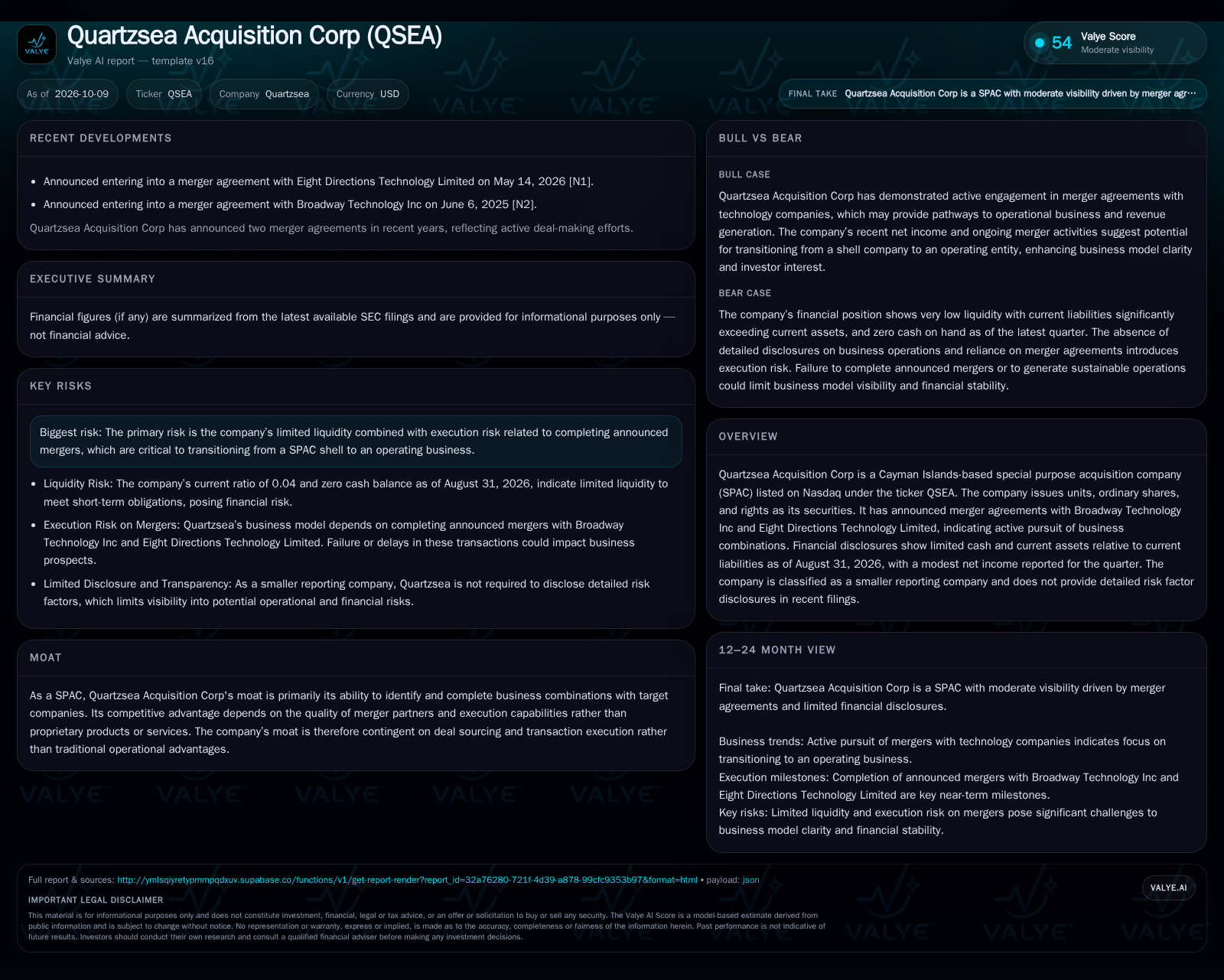
Quartzsea Acquisition Corp (QSEA), a Cayman Islands-based SPAC, terminated its merger with Broadway Technology in March 2026 but has since entered a new agreement with Eight Directions Technology Limited. The company’s liquidity is severely constrained, with zero cash and a current ratio of 0.04 as of August 31, 2026. Completion of the Eight Directions merger—valued at $515 million—is critical for Quartzsea’s transition to an operating business and for resolving its financial pressure. Execution risk remains high, as the business combination is subject to shareholder, SEC, and Nasdaq approvals, and the company's ability to cover obligations is limited without fresh capital or a completed merger.
Quartzsea Acquisition Corp exemplifies the high-wire act faced by many late-stage SPACs. Following the breakdown of its deal with Broadway Technology, Quartzsea now hinges its future on consummating a new merger with Eight Directions Technology Limited. The coming months will be a critical test of deal execution, regulatory navigation, and the fundamental SPAC business model.
Merger Termination, New Deal, and Severe Liquidity Constraints Define the Present
Quartzsea terminated its previously announced merger with Broadway Technology Inc on March 17, 2026, citing prolonged regulatory approval uncertainty in China. This left the company without a clear path to an operating business and reset the SPAC’s acquisition clock [S2].
On May 13, 2026, Quartzsea announced a new merger agreement with Eight Directions Technology Limited, with an implied equity value of $515 million to be paid in PubCo shares at $10 per share. The deal is subject to customary closing conditions, including shareholder, SEC, and Nasdaq approvals. Eight Directions is responsible for funding required monthly extension contributions until closing [S2].
As of August 31, 2026, Quartzsea reported zero cash, current assets of $68,655, and current liabilities of $1,872,732, resulting in a current ratio of 0.04 and a cash ratio of 0.32. The company continues to generate non-operating income but has not commenced any true operations [S2].
The next critical deadline is October 19, 2026, with possible monthly extensions, making the window for deal completion narrow and the stakes for execution extremely high [S2].
SPAC Financial Mechanics: Dilution, Fee Structure, and the Urgency of a Business Combination
Quartzsea’s economics are those of a typical SPAC: capital is raised via IPO and placed in trust, with the sponsor and public shareholders expecting a business combination within a prescribed timeframe. Until an acquisition is completed, the company earns minimal interest or dividend income from trust investments, but incurs expenses related to deal sourcing, legal, and compliance.
The company’s reported net income for the latest quarter ($458,897) is likely driven by investment income or accounting items, not operational activity [S2]. Without an operating business, Quartzsea cannot generate recurring revenue streams—making the completion of a merger existential.
SPACs typically face dilution risks from sponsor shares, rights, and warrants, as well as significant transaction costs. In Quartzsea’s case, the lack of liquidity heightens the risk that the sponsor or external parties will need to inject additional working capital or that the company will need to secure bridge financing to cover ongoing expenses if the merger is delayed.
If the Eight Directions transaction closes, Quartzsea’s economics will shift dramatically: the combined entity would inherit Eight Directions’ business model, revenue, and cost structure. Until then, the company remains a shell with the clock running down and its only path to value creation through deal closure.
Deal Sourcing as the Core Differentiator in a Crowded SPAC Landscape
Quartzsea’s only sustainable advantage as a SPAC is its ability to identify, negotiate, and close a value-creating merger ahead of competing SPACs. The market is crowded, with many SPACs chasing a finite pool of attractive targets—particularly in technology sectors.
SPACs compete not just with each other, but also with traditional IPOs, private equity, and direct listings. Target companies may prefer buyers with more liquidity, clearer regulatory pathways, or greater strategic alignment.
Quartzsea’s competitive position suffered a setback with the terminated Broadway Technology deal. The subsequent agreement with Eight Directions Technology Limited provides a new opportunity, but also comes with execution risk and potential for further delays—especially given the regulatory and shareholder approval hurdles.
The quality of deal execution, sponsor reputation, and ability to manage regulatory complexity are the most important factors determining whether Quartzsea can deliver value to shareholders and avoid liquidation.
If the Eight Directions Merger Closes Smoothly: Path to Operating Business and Value Realization
The most favorable scenario for Quartzsea is a timely and successful closing of the Eight Directions merger. This would transform Quartzsea from a cash-strapped shell into the public vehicle for a technology operating business with a pro forma equity value of $515 million [S2].
Successful completion would likely unlock new capital sources, allow for operational revenues, and potentially catalyze a re-rating of the combined entity’s shares. It could also establish a platform for future growth, additional M&A, or strategic partnerships.
Evidence confirming this scenario would include: SEC registration effectiveness, Nasdaq approval, definitive shareholder votes in favor of the transaction, and the timely funding of extension contributions by Eight Directions. Early post-merger financials showing real revenue and cash flow would further validate the business combination’s value.
Falsification would be signaled by regulatory setbacks, funding delays, shareholder rejection, or withdrawal by Eight Directions.
Extended Timeline, Rising Costs, and Persistent Execution Risk
The most probable near-term outcome is that Quartzsea continues to pursue the Eight Directions merger, requiring multiple deadline extensions and incurring additional expenses. The company’s liquidity remains precarious, so it is dependent on Eight Directions’ willingness and ability to fund further extension contributions as required by the merger agreement [S2].
Shareholder, SEC, and exchange approvals may take longer than anticipated, increasing the risk that costs will erode any remaining resources or that redemptions will reduce available capital for the deal.
This scenario would be confirmed by continued extension filings, ongoing regulatory submissions, and periodic disclosures of funding by Eight Directions. Any slippage in these milestones, or a failure to secure timely approvals, would increase the risk of deal collapse or forced liquidation.
Merger Failure or Delay Triggers Liquidation or Value Destruction
If the Eight Directions deal fails to close—due to regulatory, funding, or shareholder obstacles—Quartzsea faces few alternatives. With no cash and liabilities far exceeding assets, the company would likely be forced to liquidate and return any remaining trust proceeds to shareholders, with little or nothing left for other stakeholders [S2].
SPACs that fail to complete a business combination within the extension period must wind up operations, and the sponsor’s investment is typically wiped out. In this scenario, public shareholders may realize only a fraction of their initial investment, depending on the status of redemptions and trust balances.
Confirmation of this downside would be the withdrawal or failure of the Eight Directions merger, inability to fund further extensions, or a formal liquidation announcement.
What Will Determine Quartzsea’s Fate as a SPAC?
Completion of the SEC registration process and the effectiveness of the proxy/prospectus for the Eight Directions business combination.
Eight Directions’ continued funding of monthly extension contributions and disclosures of those payments, if reported.
Shareholder vote outcome on the Eight Directions merger at the extraordinary general meeting.
Nasdaq’s approval of the listing application for the combined entity.
Any regulatory or jurisdictional developments that could delay or block the transaction, especially involving PRC or cross-border reviews.
Disclosure (if any) of post-merger pro forma cash flows, revenues, and business model details from Eight Directions.
Redemption rates among public shareholders prior to merger closing, if disclosed—a high rate could imperil deal economics.
Updates on Quartzsea’s ability to cover ongoing expenses or secure bridge financing until the merger closes.
Disclaimer: This is research-only, informational analysis and not investment advice. It may include AI-generated interpretation and general industry context. Always verify important details using primary sources.

Comments