
Delta Air Lines: Margin Pressure, Regulatory Complexity, and the Strategic Levers for Resilience
Delta Air Lines faces intensifying cost headwinds—especially from fuel—amid a highly regulated operating environment, while leveraging entrenched route access, loyalty economics, and vertical integration. The company’s future cash flow stability and competitive position hinge on its ability to manage environmental compliance, labor dynamics, and the monetization of ancillary revenue streams.
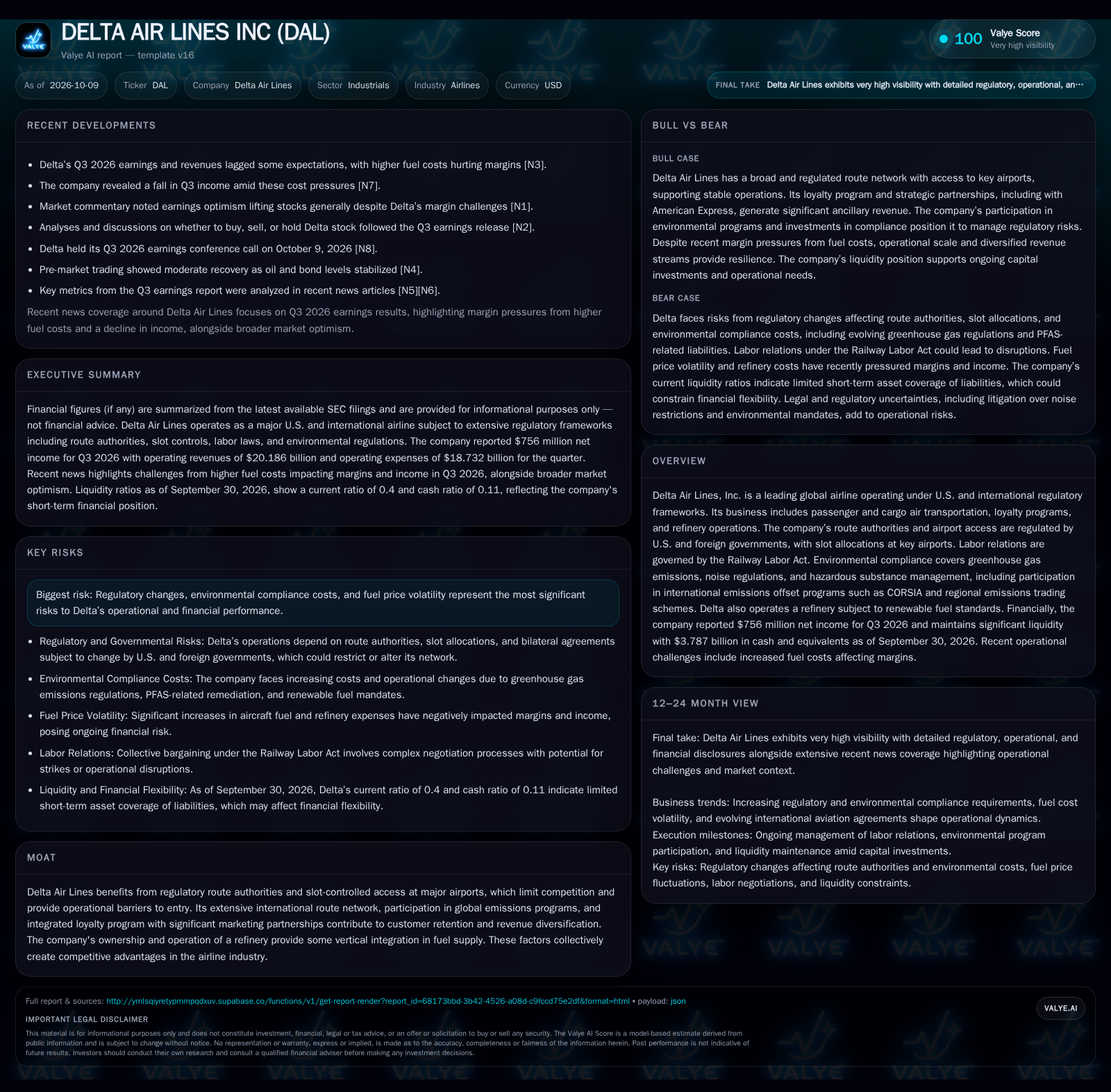
Delta Air Lines reported Q3 2026 net income of $756 million, but higher fuel costs drove margin compression and income declines. Near-term liquidity ratios are low, with a current ratio of 0.4. The company’s moat centers on restricted route and slot access, a large loyalty program, and vertical integration via its refinery. The key question is whether Delta can offset structural cost pressures through pricing power, ancillary revenue, and operational efficiency in a sector facing regulatory and environmental tightening. [S2] [N3] [N7]
Delta Air Lines enters the final quarter of 2026 contending with higher fuel costs that have eroded margins and undercut quarterly income, despite maintaining a dominant network position and robust ancillary revenue streams. The company’s short-term liquidity is tight, and its operating environment is shaped by a complex web of regulatory, environmental, and labor requirements. The central question is whether Delta can harness its structural advantages—route access, loyalty economics, and partial fuel integration—to offset sector-wide cost inflation and regulatory headwinds.
Margin Compression and Liquidity: The Latest Quarter’s Implications
Delta reported Q3 2026 net income of $756 million, with operating revenue of $20.186 billion and operating expenses of $18.732 billion, reflecting a period where higher aircraft fuel and refinery expenses drove a notable increase in costs relative to prior periods. This margin compression was a central theme in recent earnings coverage, with both net income and earnings per share coming in below some expectations. [S2] [N3] [N7]
As of September 30, 2026, Delta held $3.787 billion in cash and cash equivalents against current liabilities of $33.575 billion, resulting in a current ratio of 0.4 and a cash ratio of 0.11. [S2]
The company’s SkyMiles loyalty program and its partnership with American Express continue to generate meaningful ancillary revenue, providing some insulation against volatility in core ticket sales. However, the ability of these programs to offset structural cost inflation remains a central uncertainty. [S2]
How Delta’s Revenue Model Absorbs Cost Volatility
Delta’s core business model revolves around selling passenger and cargo air transportation, with ancillary revenue streams from its loyalty program, marketing partnerships (notably American Express), and, uniquely, partial vertical integration via its Monroe Trainer refinery. Revenue is a function of passenger volume, ticket pricing, and non-ticket monetization—each sensitive to macroeconomic cycles, competitive dynamics, and regulatory constraints.
Fuel represents one of the largest and most volatile components of Delta’s cost structure. While vertical integration via the refinery can provide some cost smoothing, the company remains exposed to global oil market swings and regulatory-driven fuel mandates (such as RIN obligations under the Renewable Fuel Standard). Operating leverage is high: small changes in capacity utilization or pricing can have outsized impacts on margins, but fixed costs (labor, aircraft leases/ownership, infrastructure) are substantial and difficult to flex quickly.
Capital needs in the airline sector are heavy and recurring, encompassing fleet renewal, regulatory compliance (including environmental retrofits), and ongoing slot/route investments. The loyalty program and co-brand partnerships provide relatively high-margin, recurring revenue, but their scale is ultimately tied to passenger volumes and airline brand strength.
Slot Controls, Loyalty, and Integration: Where Delta’s Moat Holds and Where It’s Vulnerable
Delta’s most defensible advantage lies in its entrenched access to high-value slots at capacity-constrained airports (e.g., JFK, LaGuardia, Reagan National), which are governed by regulatory allocation and present a high barrier to entry for new or expanding competitors. This regulatory moat is complemented by bilateral and multilateral route authorities, enabling a broad international network that is difficult to replicate quickly. [S1]
The SkyMiles loyalty program, amplified by the American Express partnership, creates switching frictions for frequent travelers and generates significant ancillary revenue. However, loyalty economics can be pressured if credit card partners renegotiate terms or if consumers shift travel behavior.
Delta’s ownership of a refinery provides some vertical integration, potentially mitigating fuel procurement risk and offering flexibility in sourcing. Still, the refinery itself is exposed to regulatory risks (environmental compliance, renewable fuel standards) and does not eliminate broader fuel price volatility.
Despite these advantages, Delta faces intense competition from other network carriers and low-cost airlines on price-sensitive routes. Technological substitution (e.g., videoconferencing) and evolving consumer preferences could further erode demand on certain business travel corridors.
Leveraging Loyalty and Network Advantages to Offset Structural Headwinds
The most favorable scenario for Delta involves a combination of moderate fuel cost stabilization, successful pricing power exerted on premium and business travel segments, and continued growth in high-margin loyalty and co-brand credit card revenues. If Delta can maintain or grow its share of lucrative airport slots while keeping labor relations stable and environmental compliance costs manageable, it could expand margins even amid persistent cost inflation.
Upside would be further supported if the company’s investments in operational efficiency (such as digitalization and fleet modernization) yield tangible cost savings and if the refinery’s vertical integration provides a relative cost advantage over peers. Confirmation would come from sequential margin expansion, rising loyalty revenue per passenger, and evidence of improved cost discipline despite regulatory and environmental complexity.
This scenario would be challenged or falsified if loyalty revenue growth stalls, if the company is forced into significant labor concessions, or if fuel and regulatory costs continue to outpace Delta’s ability to pass them on through fares or fees.
Managing Through Cost Pressures While Relying on Moat Characteristics
The most plausible outcome is that Delta continues to face elevated fuel and compliance costs, with modest ability to pass these on through ticket price increases in a competitive market. Operating margins may stabilize at a lower level than in prior cycles, with cash flow supported by the loyalty program and American Express partnership but constrained by ongoing capital and compliance needs.
Slot and route access, plus the scale of the loyalty program, help maintain a buffer against the worst effects of sectoral downturns.
This scenario would be confirmed by stable or modestly declining margins, steady loyalty revenue, and no major changes in regulatory or labor cost structure. It would be falsified by either a dramatic improvement (margin expansion, cost reductions) or a sharp deterioration (unexpected regulatory, labor, or liquidity shocks).
Escalating Regulatory, Fuel, and Labor Costs Erode Delta’s Defenses
In a less favorable scenario, Delta could be hit by a combination of persistently high fuel prices, escalating environmental compliance costs (including new emissions mandates or PFAS remediation), and labor unrest that drives up wage and benefit expenses or disrupts operations. In this case, the company’s structural advantages would be insufficient to prevent a significant squeeze on margins and cash flow.
Regulatory changes—such as the loss of key slots, new route restrictions, or more aggressive environmental mandates—could further erode Delta’s competitive position.
Confirmation of this scenario would come from a sequence of margin contractions, negative free cash flow, rising leverage, and signs of stress in labor or regulatory relationships. A reversal would require either a sharp drop in fuel or compliance costs, or a successful renegotiation of labor and regulatory burdens.
Milestones and Metrics That Will Determine Delta’s Ability to Withstand Sector Headwinds
Quarterly operating margin trends, particularly as they relate to changes in fuel and environmental compliance costs.
Growth rate and profitability of the SkyMiles loyalty program and the American Express co-brand partnership, if disclosed.
Slot and route retention at key constrained airports—any regulatory or competitive developments that threaten these moats.
Progress and cost of compliance with environmental mandates, including CORSIA, EU/UK emissions trading, and PFAS remediation.
Labor relations developments, including contract negotiations, wage/benefit trends, and potential for labor actions.
Liquidity and leverage metrics beyond the current ratio: net debt, interest coverage, and free cash flow generation.
Refinery performance and the extent to which vertical integration mitigates or exposes Delta to fuel price volatility.
Capacity discipline and fleet modernization initiatives—whether Delta can flex capacity or reduce costs without sacrificing network relevance.
Disclaimer: This is research-only, informational analysis and not investment advice. It may include AI-generated interpretation and general industry context. Always verify important details using primary sources.

Comments