
Jefferies Financial Group: Diversification, Liquidity, and the Next Phase of Private Credit Expansion
Jefferies Financial Group reported $3.23 billion in quarterly revenue and maintained a substantial $16.88 billion cash position as of August 31, 2026.
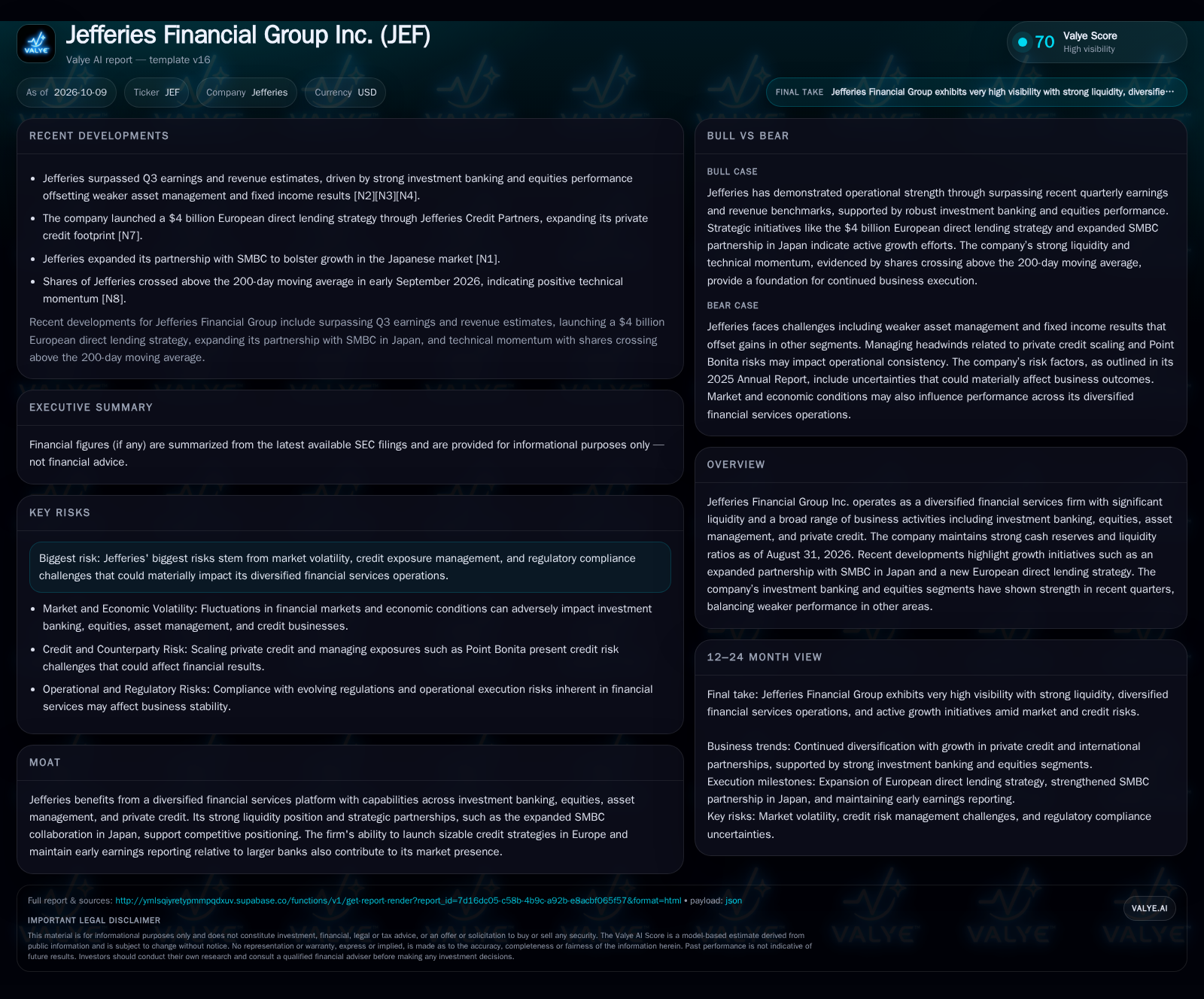
Jefferies Financial Group reported $3.23 billion in quarterly revenue and maintained a substantial $16.88 billion cash position as of August 31, 2026. The recent launch of a $4 billion European direct lending strategy and an expanded SMBC partnership underscore a drive to scale in private credit and international markets. While investment banking and equities delivered strong results in Q3 2026, asset management and fixed income remain relative weak spots. [S2] [N2] [N3] [N7] [N1]
The firm’s latest quarter showcased the resilience of its investment banking and equities franchises, which compensated for weaker asset management and fixed income results. With a $4 billion European direct lending initiative and deeper ties to SMBC in Japan, Jefferies is seeking growth beyond its traditional core. However, the balance between diversification, risk management, and execution in new arenas will determine whether this momentum translates into sustainable shareholder value.
Recent Performance and Strategic Initiatives Set the Stage
Jefferies reported quarterly revenue of $3.23 billion for the period ending August 31, 2026, with earnings per share of $0.72 (basic) and $0.70 (diluted). A $4 billion European direct lending strategy was launched, marking a significant expansion in private credit, while the partnership with SMBC was broadened to drive growth in Japan. Investment banking and equities outperformed in Q3 2026, helping offset softness in asset management and fixed income. [S2] [N2] [N3] [N7] [N1]
How Jefferies Monetizes Diversification and Scale
Jefferies’ business model centers on fee and spread income from investment banking, equities trading, asset management, and increasingly, private credit activities. Investment banking generates revenue through advisory and underwriting fees, which can be volatile and cyclical but offer high margins in strong deal environments. Equities and trading contribute through commissions and market-making spreads, benefiting from volume and volatility.
Asset management delivers recurring fee income but is sensitive to AUM trends and performance, with operating leverage depending on scale and investment returns. The move into private credit—particularly direct lending—introduces a different risk-return profile: revenues are driven by interest and origination fees, but credit quality and loss provisioning become critical. This segment typically requires less regulatory capital than traditional lending, but scaling it involves careful risk management and robust origination networks.
However, sustained profitability depends on balancing fixed costs (talent, technology, compliance) with variable deal flow and maintaining pricing discipline in competitive markets. Operating leverage can be significant in up markets but may reverse sharply if deal activity or asset valuations weaken.
The interplay between diversification benefits and operational complexity is a critical consideration in Jefferies’ business economics. While diversification across investment banking, equities, asset management, and private credit can smooth revenue volatility and enhance resilience, it also demands sophisticated risk management frameworks and cross-segment coordination. For example, capital allocation decisions must weigh the differing return profiles and regulatory capital requirements of each segment, balancing growth ambitions against potential concentration risks. Additionally, the firm’s ability to leverage technology and data analytics to optimize pricing, credit assessment, and client targeting can materially influence margins and scalability, especially as private credit expands into new geographies with distinct underwriting standards and competitive dynamics.
Jefferies’ Edge Amidst Bulge-Bracket Banks and Alternative Lenders
Jefferies competes with both global investment banks and a rising cohort of alternative asset managers in private credit. Its mid-sized, diversified platform allows for agility and early reporting, which can attract client attention and talent. The expanded SMBC partnership provides a foothold in Japan and access to cross-border opportunities, while the European direct lending strategy positions Jefferies against private credit giants and traditional banks retreating from middle-market lending.
However, the firm lacks the scale and balance sheet depth of the largest banks, making differentiation dependent on sector expertise, client relationships, and the ability to originate and syndicate complex transactions. In private credit, competition from established asset managers and funds is intense, and pricing can be pressured by capital inflows chasing yield. Jefferies’ flexibility and liquidity help, but maintaining a quality pipeline and managing credit risk will be central to defending margins.
Jefferies’ competitive positioning also hinges on its capacity to innovate within its product offerings and distribution channels. In private credit, differentiation may arise from structuring bespoke financing solutions tailored to middle-market borrowers underserved by larger banks, thereby commanding pricing premiums or exclusivity. Moreover, the firm’s agility enables it to respond more quickly to emerging market dislocations or regulatory shifts that can create arbitrage opportunities. However, sustaining this edge requires continuous investment in talent and infrastructure, as well as maintaining strong relationships with institutional investors to support syndication and capital recycling. The evolving competitive landscape, including the rise of fintech platforms and direct lending funds, underscores the importance of strategic partnerships and alliances to access deal flow and diversify funding sources.
Unlocking Value Through Successful Private Credit Expansion
If Jefferies can rapidly scale its European direct lending platform while maintaining tight credit standards, the firm could capture attractive risk-adjusted returns and establish a recurring, higher-margin earnings stream. The expanded SMBC partnership could drive incremental advisory and capital markets revenue, especially if cross-border M&A and financing activity increase in Japan.
Upside would be confirmed by sustained growth in private credit AUM, improved fee margins, and a visible shift in segment mix toward higher-return, less cyclical businesses. Evidence would include accelerating origination volumes in direct lending, robust credit performance (low impairments), and incremental revenue contributions from Japan-related deals. A narrowing of the performance gap in asset management and fixed income would further validate the model.
Balanced Growth With Persistent Segment Variability
The most plausible outlook is one of moderate growth, with investment banking and equities continuing to anchor profits, and private credit gradually contributing more as origination ramps up. Asset management and fixed income may remain under pressure due to competitive fee compression and market uncertainty, limiting overall margin expansion.
Confirmation would come from steady quarterly results, limited credit losses in new lending operations, and incremental but stable growth in international activities. If Jefferies maintains its liquidity and delivers consistent performance across segments, it can absorb volatility and position for opportunistic growth when market windows open.
Credit and Market Shocks Could Disrupt Expansion Plans
A sharp deterioration in credit quality—particularly in the new European direct lending book—could trigger losses, increased provisioning, and reputational damage, undermining the economics of private credit expansion. Weakness in asset management and fixed income could persist or deepen if markets turn risk-off or if competition forces further fee reductions.
Downside would be confirmed by rising non-performing loan ratios, negative marks in the lending portfolio, or material outflows from asset management. A failure to generate incremental revenue from SMBC partnership initiatives would also signal execution risk. In this scenario, fixed costs could outpace revenue growth, compressing margins and limiting strategic flexibility.
What Will Determine Jefferies’ Success in Private Credit and International Growth?
Quarterly origination volume, credit performance, and fee margins in the European direct lending strategy—if disclosed—would be critical to test scalability and risk management.
Growth in assets under management (AUM) and net flows for asset management, particularly as Jefferies seeks to offset segment weakness.
Incremental revenue and deal volume attributable to the expanded SMBC partnership, especially in cross-border M&A and capital markets.
Credit quality metrics, such as non-performing loan ratios or charge-offs, in the private credit book as risk ramps up.
Sustained investment banking and equities performance relative to peers, as these segments remain core profit drivers.
Cost discipline and operating leverage—tracking changes in compensation, technology, and compliance spend versus revenue growth.
Any material updates on Point Bonita or other identified credit exposures that could impact future results.
Disclosure and commentary on regulatory or macroeconomic headwinds affecting private credit and international operations.
Disclaimer: This is research-only, informational analysis and not investment advice. It may include AI-generated interpretation and general industry context. Always verify important details using primary sources.

Comments