
OZ Vision Inc.: Asset-Rich, Cash-Poor, and at a Strategic Crossroads Between Logistics and Combat Sports
OZ Vision Inc. remains a micro-scale logistics provider, but its recent acquisition of combat sports promotion assets creates a high-variance pivot opportunity—one that is currently constrained by severe liquidity issues, customer concentration, and the absence of operational infrastructure.
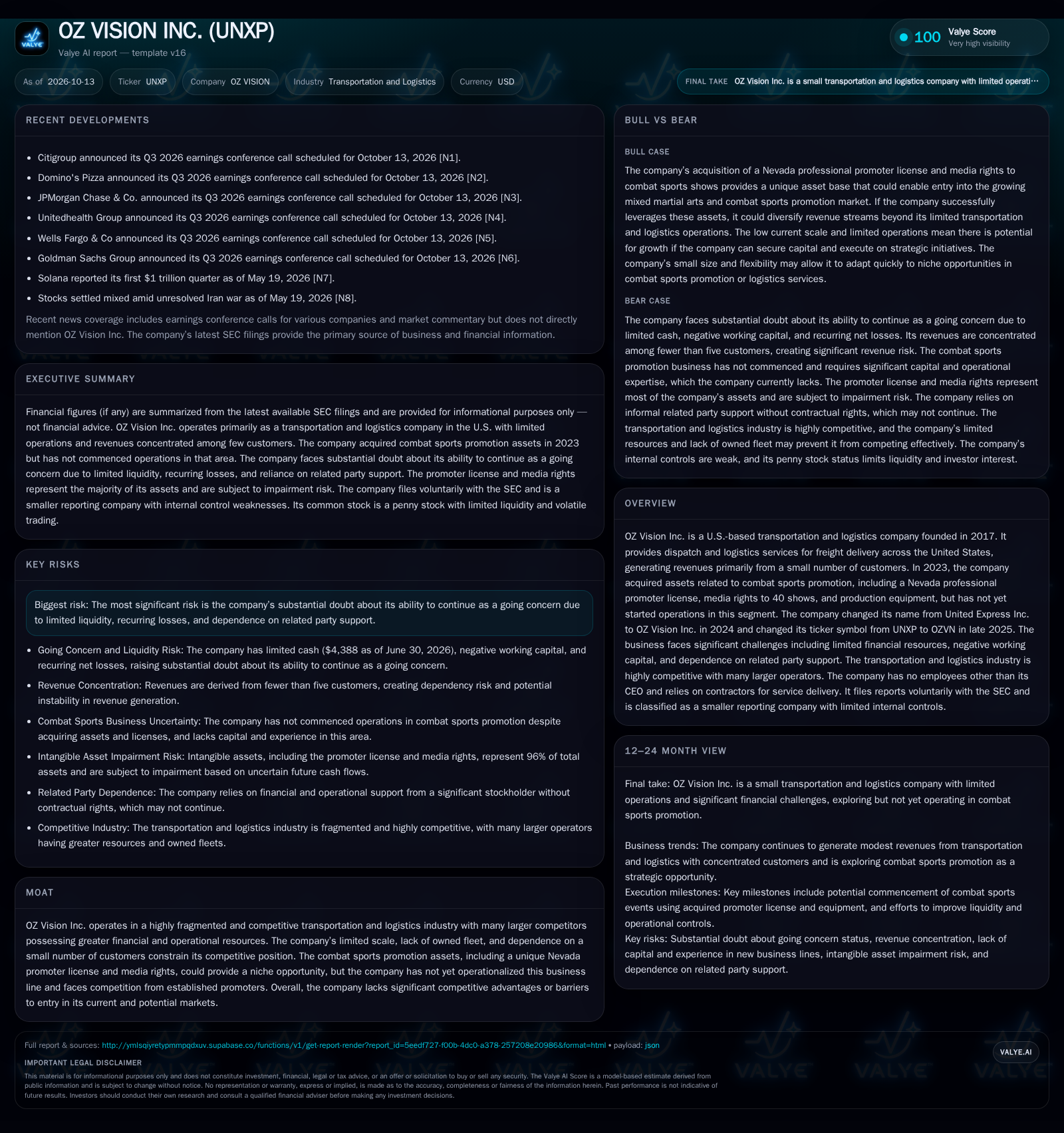
OZ Vision Inc. continues to operate as a tiny transportation and logistics provider with revenues concentrated among a handful of customers, while holding $13.1 million in intangible assets related to a dormant combat sports promotion venture. The company’s future hinges on either monetizing its combat sports assets or stabilizing its core logistics business, both of which require capital and operational scale that it currently lacks. [S1]
OZ Vision Inc. stands at a precarious inflection point. While its core transportation and logistics business delivers modest revenue from a handful of customers, the company’s recent foray into combat sports promotion—anchored by a Nevada promoter license and media rights—remains entirely unrealized. The business is capital-constrained, deeply reliant on related-party support, and exposed to operational risks that could quickly force impairment of its primary assets. The question for investors is whether OZ Vision can secure the resources and partnerships to activate its combat sports ambitions, or if it will remain a micro-cap logistics player with limited financial runway and persistent structural vulnerabilities.
Recent Developments: Asset Acquisition and Persistent Financial Strain
OZ Vision Inc.'s most material recent development is the acquisition of combat sports promotion assets, including a Nevada State Athletic Commission Professional Promoter license, media rights to 40 combat sports shows, and related production equipment. These intangible assets are valued at approximately $13.1 million and now represent about 96% of the company’s total assets. However, as of October 2026, the company has not commenced any operations utilizing these assets and has not generated any revenue or cash flow from them. [S1]
Financially, the company reported $46,930 in revenue for the fiscal year ended June 30, 2026, down from $54,232 the prior year. More concerning is its cash balance of $4,388 against current liabilities of $1,204,517, resulting in negative working capital and raising substantial doubt about its ability to continue as a going concern. The company remains dependent on informal, non-contractual support from a major shareholder, with $1,042,647 in related-party payables. [S1]
Customer concentration is acute: fewer than five customers account for all current logistics revenue, and the logistics segment is characterized by limited scale and declining topline. These facts underscore the urgency for OZ Vision to either stabilize its core business or successfully pivot to monetizing its newly acquired combat sports assets.
How Revenue Is (and Isn’t) Generated: Dispatch Margins and the Dormant Value of Intangibles
In its core logistics business, OZ Vision generates revenue by providing dispatch and logistics services, charging based on working time, distance, and margins between wholesale and retail pricing. However, the company’s lack of an owned fleet means it relies on third-party contractors, limiting operating leverage and compressing margins in a highly competitive, low-differentiation environment.
With a revenue base under $50,000 and only a single employee (the CEO), the company’s fixed costs are minimal, but so is its capacity for scale or operational investment. Public reporting costs alone ($40,000 to $70,000 annually) represent a significant share of gross revenue, further straining profitability. [S1]
The economics of the potential combat sports segment are fundamentally different. If operationalized, the promoter license could allow OZ Vision to produce live events and monetize media rights, pay-per-view, sponsorships, and ticketing. However, event production is capital-intensive, requires up-front outlays for venue, talent, marketing, and regulatory compliance, and exposes the company to execution risk and volatile returns. Without capital and industry relationships, the promoter license remains a dormant asset, and the $13.1 million intangible value is at risk of impairment if the business is not activated. [S1]
Competitive Realities: Fragmented Logistics, High Barriers in Combat Sports
OZ Vision operates in two distinct arenas—logistics and (potentially) combat sports promotion—each with formidable competitive dynamics. In transportation and logistics, the company faces an intensely fragmented market populated by larger operators with owned fleets, substantial customer bases, and established technology platforms. OZ Vision’s lack of scale, customer concentration, and reliance on third-party contractors leave it with no meaningful moat or pricing power.
In combat sports, the Nevada promoter license is a rare asset, but the market is dominated by well-capitalized incumbents with established brands, athlete rosters, and media partnerships. While OZ Vision’s media rights portfolio could, in theory, provide a foundation for syndication or digital streaming, actual monetization depends on executional capability, capital, and network effects that are currently absent. Barriers to entry in event production are high, with regulatory, operational, and reputational hurdles. The company’s lack of employees and operational infrastructure further weakens its competitive position in both segments.
Unlocking Value: What a Successful Pivot to Combat Sports Would Require
The bull case for OZ Vision hinges on successfully activating its combat sports assets. In this scenario, the company secures external capital—either through investment, partnership, or asset sale—that enables it to stage live events leveraging its Nevada promoter license and media library. Operationalizing the production equipment and launching branded events could open up multiple revenue streams: live gate, broadcast rights, digital pay-per-view, sponsorship, and merchandise.
Confirmation of this scenario would require announcements of capital raises, strategic partnerships with media or event operators, scheduling of actual fight cards, and ticket sales or broadcast agreements. Early evidence might also include operational hires, marketing campaigns, or the launch of digital platforms utilizing the company’s media rights. If OZ Vision can establish a recurring event schedule and demonstrate even modest event profitability, the $13.1 million intangible asset value could be validated, and the company could diversify away from its precarious logistics base.
Stagnation or Survival: Logistics Revenue Persists, Combat Sports Remains Aspirational
The most plausible near-term scenario is that OZ Vision continues to generate modest, declining revenues from its logistics segment, relying on a handful of customers and informal related-party support to cover minimal operating expenses. The combat sports assets remain unutilized, with no near-term events or monetization, and the intangible asset value becomes increasingly vulnerable to impairment.
Evidence supporting this scenario would be continued absence of event announcements, stagnant revenue, and ongoing negative working capital. The company may attempt to market its combat sports assets for partnership or sale, but without capital or operational muscle, it is likely to remain a penny stock with reported liquidity position and persistent going-concern risk. Confirmation would be a lack of new hires, no capital infusion, and continued reliance on the CEO as the sole employee.
Impairment and Contraction: When Assets Fail to Generate Cash Flow
The bear case is that OZ Vision is unable to monetize or operationalize its combat sports assets, leading to impairment of the $13.1 million in intangibles. If related-party support is withdrawn or customer concentration worsens, the company could face immediate liquidity crisis, default on obligations, or be forced into a distressed asset sale.
This scenario would be confirmed by impairment charges in future filings, further declines in logistics revenue, or disclosures of legal or creditor actions. If the company is unable to renew or maintain its promoter license, or if production equipment is lost, stolen, or sold for scrap, the company’s asset base would rapidly contract. In this case, shareholders would be left with a non-viable enterprise and little prospect of recovery.
Milestones That Will Determine Whether OZ Vision Can Monetize Its Assets or Remain Marginal
Evidence of a capital raise or strategic investment—either for the logistics business or to fund combat sports event production—would be a crucial near-term signal.
Announcements regarding the scheduling or promotion of live combat sports events using the Nevada promoter license would indicate progress toward operationalizing the new business line.
Material partnership agreements with broadcasters, streaming platforms, or sponsors for the company’s combat sports content would validate the monetization thesis.
Disclosure of new customer wins or meaningful revenue diversification in the logistics segment would reduce customer concentration risk.
Any impairment charges or write-downs of intangible assets in future SEC filings would be a red flag for the asset base.
Updates on the status and security of production and stage equipment, especially if disclosed, would help test the company’s operational readiness.
A useful metric would be the number of events produced or contracted, if disclosed, as this would directly test the combat sports pivot.
Continued or expanded reliance on related-party support, or the withdrawal of such support, would be a key determinant of the company’s short-term survival.
Disclaimer: This is research-only, informational analysis and not investment advice. It may include AI-generated interpretation and general industry context. Always verify important details using primary sources.

Comments