
Nurix Therapeutics: AI-Powered Drug Discovery and Clinical Advances Fueling Value Creation
A major licensing deal, a reported liquidity position, and multiple late-stage clinical trials have propelled Nurix Therapeutics into a new phase, but the company’s future will depend on the repeatability of its AI-enabled drug-discovery model, regulatory outcomes, and the ability to turn pipeline momentum into commercial traction.
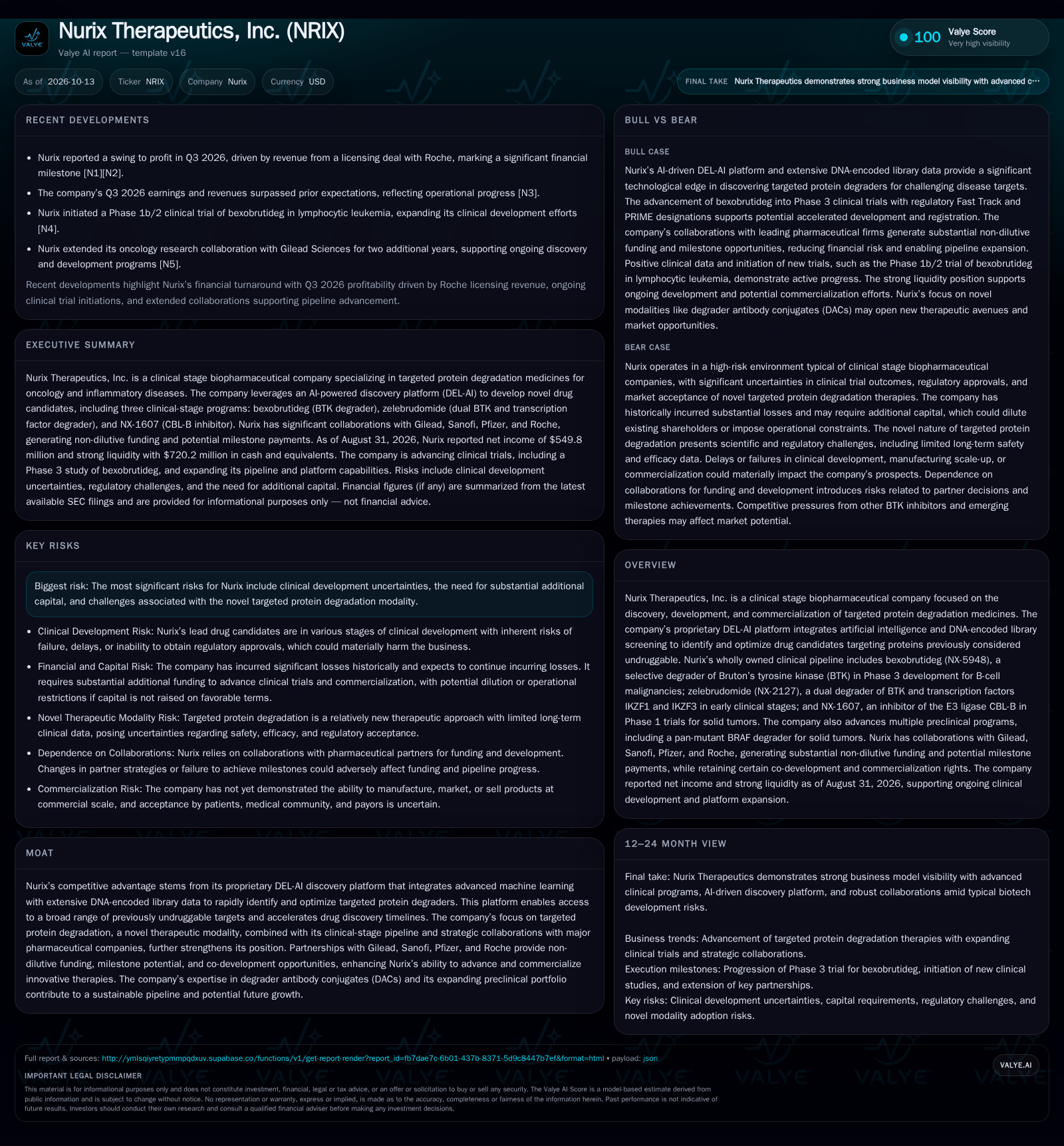
Nurix Therapeutics has shifted to profitability in Q3 2026 following a significant Roche licensing deal, while advancing its AI-driven pipeline of targeted protein degraders across multiple late-stage clinical trials. Risks include clinical uncertainty, capital intensity, and the challenge of commercializing a novel therapeutic modality in a competitive landscape. [N1] [N2] [S2]
Nurix Therapeutics, Inc. has reached a critical inflection point in late 2026: the company reported a quarterly profit for the first time, driven by a licensing surge from Roche, while its AI-enabled DEL-AI platform continues to fuel a pipeline of novel protein degraders in oncology and immunology. With Phase 3 clinical development underway for its lead asset and a robust reported cash balance, Nurix appears well-positioned to drive forward multiple programs and collaborations. However, the sustainability of this momentum will depend on the company’s ability to translate scientific innovation and pharma partnerships into repeatable clinical wins, regulatory approvals, and ultimately commercial products in a still-nascent therapeutic space.
Profitability Gains and Pipeline Growth Shape Nurix’s Present Landscape
Nurix’s swing to profitability in Q3 2026 was catalyzed by licensing revenue from a deal with Roche, reversing a long history of net losses and marking a tangible financial milestone for a clinical-stage biotech. The company reported cash and liquidity metrics for the period; these figures do not by themselves establish operating runway, investment capacity, financial flexibility, or financing capacity. [N1] [N2] [S2]
On the operational side, Nurix’s lead candidate bexobrutideg (NX-5948) has advanced into Phase 3 trials for relapsed or refractory chronic lymphocytic leukemia (CLL) and Waldenstrom’s macroglobulinemia (WM), with additional Phase 1b/2 studies underway. The company also extended its research collaboration with Gilead for two years, reinforcing its model of leveraging partnerships to fund discovery and development. [N4] [N5] [S2]
These developments matter because they collectively validate the company’s platform, provide near-term financial stability, and set up multiple clinical readouts that could fundamentally alter Nurix’s trajectory—if the results are positive and the partnership model proves repeatable.
Mechanisms for Translating Platform Innovation into Revenue Streams
Nurix’s economics are built on two primary engines: milestone and royalty income from pharma collaborations, and future direct product revenue from wholly owned pipeline assets. The Roche licensing windfall in 2026 demonstrates the upside of the partnership model, but such events are inherently episodic and dependent on external partner decisions. Ongoing collaborations with Gilead, Sanofi, and Pfizer offer additional non-dilutive funding and potential for downstream royalties, although the timing and magnitude of these payments are tied to clinical and regulatory progress, which can be unpredictable. [S2]
Direct product revenue will only materialize if Nurix’s lead clinical assets—particularly bexobrutideg—clear regulatory hurdles and achieve commercial uptake. The AI-integrated DEL-AI platform is intended to accelerate candidate identification and reduce R&D timelines, which could, in theory, increase the throughput of pipeline assets and lower unit R&D costs. However, the cost structure remains heavily weighted toward fixed R&D expenses, and commercialization would bring a new layer of variable costs (manufacturing, sales force buildout, pharmacovigilance). Operating leverage could be substantial if multiple assets succeed, but this is highly contingent on clinical outcomes and market acceptance.
Capital needs are likely to remain significant as Nurix advances late-stage trials and contemplates potential commercial launches, especially given the high bar for market entry in oncology and the need for robust safety and efficacy data. While the current reported liquidity position, the company’s own disclosures indicate an expectation of rising expenses as the pipeline advances. [S2]
Nurix’s Platform Strengths Amid Established and New Market Players
Nurix’s competitive position is rooted in its DEL-AI platform, which integrates large-scale DNA-encoded libraries with machine learning to identify and optimize targeted protein degraders—an approach designed to access previously undruggable targets and compress the drug discovery timeline. This is a significant technological differentiator, but the commercial value will ultimately depend on the platform’s ability to consistently deliver first-in-class or best-in-class molecules with clinically meaningful benefits.
The company faces competition from established BTK inhibitor franchises in hematology/oncology, as well as other protein degradation specialists (such as those developing PROTACs or molecular glues). Large pharma companies with deep pockets and established commercial infrastructure represent a formidable barrier, especially if Nurix’s assets are perceived as incremental rather than transformative. Emerging competitors are also leveraging AI and high-throughput screening, narrowing the window of technical advantage.
Switching frictions in oncology can be high for both physicians and payors, especially for patients who have cycled through multiple therapies. If Nurix’s degraders demonstrate efficacy in refractory populations or offer a differentiated safety profile, this could create an adoption wedge. However, rapid advances in targeted therapies, cell therapies, and immuno-oncology create a moving competitive target.
Potential Impact of Consistent Licensing Deals and Clinical Breakthroughs
In a favorable scenario, Nurix’s DEL-AI platform continues to deliver a steady stream of high-quality drug candidates, enabling the company to secure additional licensing deals or expand existing collaborations. Positive pivotal data for bexobrutideg in relapsed/refractory CLL could drive regulatory approval and the first commercial launch, validating the platform and opening the door to further pipeline advancement.
If the company can demonstrate that its AI-driven approach reliably accelerates the discovery of differentiated assets—leading to multiple late-stage programs and sustained pharma interest—Nurix could build a royalty and milestone annuity stream while retaining select commercial rights in the US. Confirmation of this scenario would come from additional lucrative deals, continued progress in clinical trials (including expansion of Phase 3 programs), and early signs of commercial traction in lead indications.
Evidence that would support this upside includes: rapid initiation of new clinical trials, additional extensions or expansions of existing partnerships, and disclosure of new licensing agreements with significant upfront or milestone payments. Early regulatory approvals or breakthrough designations would further reinforce the bull case.
Ongoing Clinical Challenges and Revenue Variability Define the Core Outlook
The most plausible near-term scenario is that Nurix continues to advance its lead programs (particularly bexobrutideg and zelebrudomide) through clinical development, with the DEL-AI platform generating a steady but not explosive pace of new candidates. Revenue remains lumpy, driven by milestone payments from existing collaborations rather than consistent product sales.
Clinical trial outcomes will be mixed, with some programs advancing and others stalling or failing to differentiate meaningfully. The company’s reported liquidity position allows it to weather setbacks and continue investing in the platform, but the bulk of value realization remains in the future, pending pivotal data and regulatory outcomes.
This scenario would be confirmed by incremental progress in pipeline updates, periodic collaboration renewals or modest new deals, and continued investment in platform capabilities. Falsification would come from a major clinical failure in the lead program, termination of key collaborations, or a rapid drawdown in cash without new sources of external funding.
Risks from Clinical Failures and Partnership Issues Threaten Financial Stability
A negative outcome would be triggered by clinical trial failures or significant safety concerns in late-stage programs, especially if bexobrutideg fails to demonstrate meaningful benefit in Phase 3 trials. Such events could cause pharma partners to curtail or terminate collaborations, drying up milestone and licensing revenue and forcing Nurix to rely more heavily on dilutive equity issuance or cost-cutting.
If the AI-integrated platform fails to deliver differentiated assets at scale, the company’s technological edge would erode, and it could fall behind competitors with more mature clinical pipelines or greater commercial resources. Cash burn would accelerate as fixed costs persist without offsetting milestone inflows, raising the risk of a return to net losses and capital scarcity.
Evidence to watch for this scenario includes adverse clinical data, regulatory setbacks (such as new clinical holds), partner exits or deal renegotiations, and a sharp decline in cash reserves or working capital. A failure to initiate new trials or advance preclinical candidates would also be a warning sign.
Upcoming Milestones That Could Cement Nurix’s Platform Trajectory
The outcome and timelines of the Phase 3 bexobrutideg trials in CLL and WM, including any regulatory feedback or interim data releases.
Disclosure of new or expanded licensing deals, particularly those with large upfront payments or expanded co-development rights.
Progression and enrollment status of early-stage clinical programs, especially NX-1607 and zelebrudomide, including movement into later-stage trials.
Updates on the DEL-AI platform’s productivity: number of new candidates advancing to IND-enabling studies or clinical entry (if disclosed).
Changes in collaboration structure with major partners (Gilead, Roche, Pfizer, Sanofi), including any terminations, extensions, or new deal terms.
Cash runway estimates and any new equity or debt financings, particularly if cash burn accelerates or milestone revenue becomes less predictable.
Any regulatory designations (e.g., Fast Track, PRIME, Innovation Passport) granted to new pipeline assets, as these can materially impact timelines and market potential.
Manufacturing or commercialization partnerships and disclosed plans for building out a targeted sales force or distribution infrastructure.
Disclaimer: This is research-only, informational analysis and not investment advice. It may include AI-generated interpretation and general industry context. Always verify important details using primary sources.

Comments