
Zhanling International Ltd: Shell Status, Liquidity Strain, and the Strategic Uncertainty of a China-Facing Corporate Vehicle
Its future hinges on the identification and successful execution of a viable business combination—a process complicated by both financial and geopolitical constraints.
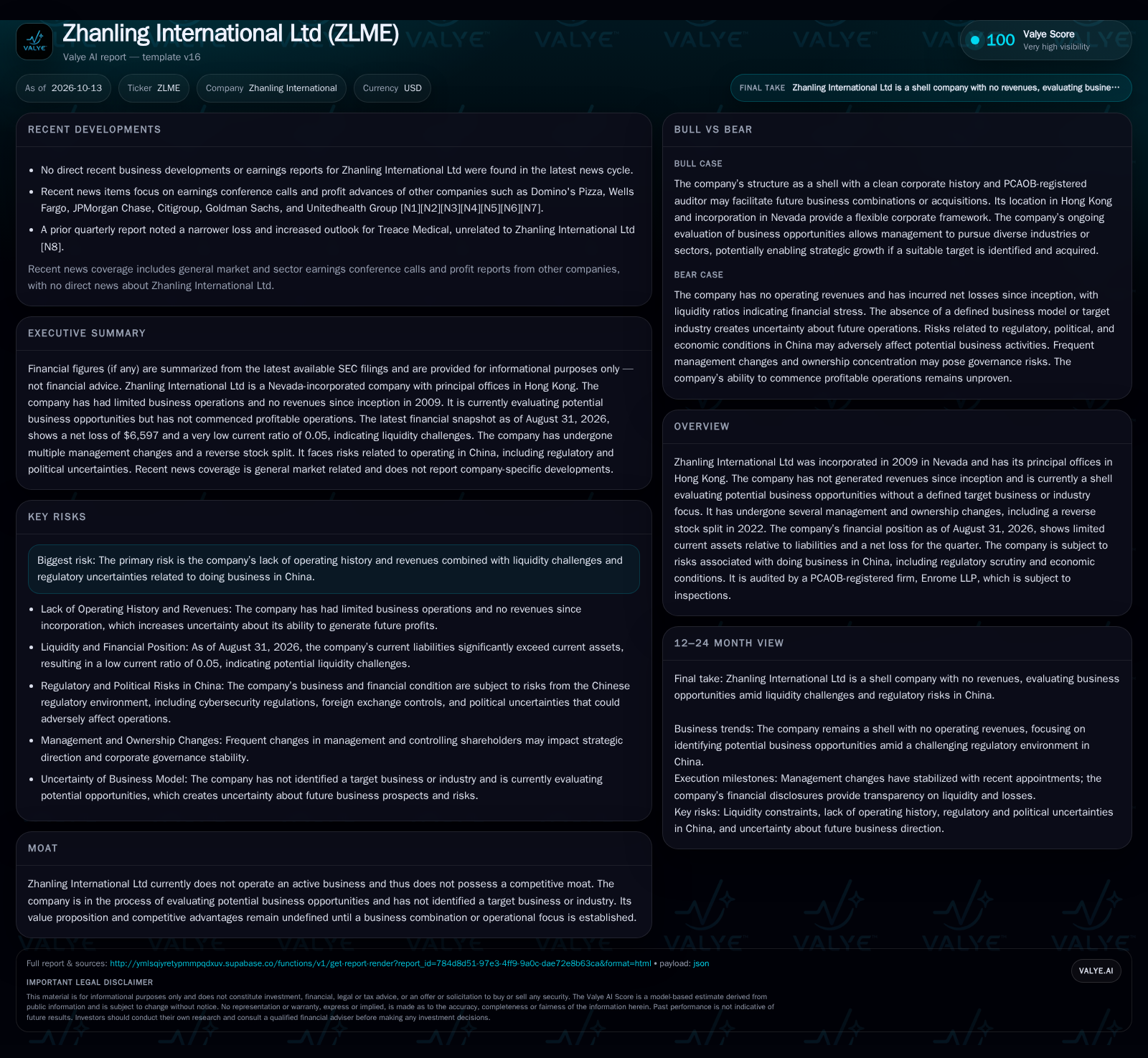
Zhanling International Ltd has not generated any revenues since its 2009 incorporation and remains a shell, currently evaluating but not committed to any business opportunity. The company’s latest financials show minimal assets against substantial liabilities, resulting in a current ratio of 0.05 and a net loss for the most recent quarter. With principal offices in Hong Kong and a Nevada incorporation, Zhanling faces heightened regulatory risks tied to China, frequent management turnover, and a lack of operating history, all of which compound the uncertainty around its future direction and viability. [S2]
Zhanling International Ltd stands as a prototypical shell company—Nevada-incorporated, Hong Kong-based, and devoid of active business operations or revenue since its founding in 2009. Despite a clean corporate structure and PCAOB-registered auditor, Zhanling’s financial position is precarious, with liabilities vastly exceeding assets and no clear business direction. The company’s exposure to Chinese regulatory risk, combined with frequent leadership changes, means its future rests on the uncertain prospect of securing and executing a business combination in a complex cross-border environment. Investors are left to weigh the potential for a strategic transaction against persistent doubts about liquidity, governance, and regulatory headwinds. [S2]
Material Facts: Shell Status, Balance Sheet Weakness, and Regulatory Exposure
Zhanling International Ltd has operated as a shell company since its 2009 incorporation and has not generated any revenues from business operations through August 31, 2026. The company’s latest financials show current assets of $3,404 and current liabilities of $63,040, leading to a current ratio of 0.05 and a reported net loss of $6,597 for the most recent quarter. [S2]
Frequent management and controlling shareholder changes have punctuated Zhanling’s history, with the most recent CEO appointed in March 2024 and CFO in August 2025. The company’s principal offices are in Hong Kong, and its controlling shareholder holds approximately 72.5% of voting rights as of April 2023. [S2]
Zhanling faces material risks related to operating in or with China, including regulatory uncertainty over cybersecurity, foreign exchange, and political volatility. The company’s auditor is PCAOB-registered, providing some regulatory transparency, but this does not mitigate the fundamental business and liquidity risks. [S1] [S2]
How Value Might Be Created: Shell Economics and the Mechanics of a Prospective Combination
As a shell, Zhanling International Ltd currently generates no revenue or operating cash flow and incurs ongoing administrative costs. Its economic model, if one emerges, depends entirely on the successful identification and acquisition of a target business. In such scenarios, the shell’s value lies in providing a public listing vehicle and potentially facilitating cross-border access to U.S. capital markets—especially for private companies in Greater China seeking foreign listings.
Typically, a shell like Zhanling could monetize its status through a reverse merger or business combination. The economics of such a transaction would depend on (1) the attractiveness of the shell to potential targets (often a function of its clean corporate history, regulatory compliance, and capital structure), (2) the terms of the transaction (e.g., equity swap versus cash consideration), and (3) the post-merger operating economics of the combined entity.
However, Zhanling’s severely constrained liquidity—current assets of $3,404 versus liabilities of $63,040—suggests limited ability to fund due diligence, deal expenses, or provide working capital for a new operating subsidiary. Without an external capital infusion or a pre-funded deal partner, the shell’s economics remain negative, with recurring losses and no path to positive cash flow absent a transaction. [S2]
Evaluating Competitive Position: Shell Attractiveness, Risks, and the China Factor
In the universe of shell companies, Zhanling’s competitive position is mixed. On one hand, its Nevada incorporation, principal office in Hong Kong, and PCAOB-registered auditor may appeal to certain target companies seeking a public vehicle with regulatory transparency. On the other, its lack of cash, limited market profile, and unstable management history may deter higher-quality targets.
The China exposure is a double-edged sword: while Zhanling could theoretically facilitate a U.S. listing for a Chinese or Hong Kong-based business, the evolving regulatory climate—especially around cybersecurity, foreign exchange, and cross-border listings—poses substantial uncertainty. Recent regulatory tightening has made U.S. listings more complex for China-based companies, and shells with perceived links to sensitive sectors or data could face additional scrutiny or be excluded from high-value deals.
Zhanling competes against other U.S.-listed shells (including SPACs and blank-check companies), many of which have stronger balance sheets, established sponsor reputations, or sector focus. The company’s lack of operating history, cash constraints, and management turnover likely place it at a disadvantage versus peers targeting premium business combinations.
What Success Would Require: Securing a Strategic, Compliant Business Combination
The most favorable scenario for Zhanling International Ltd is the identification and closing of a business combination with a viable, growth-oriented private company—ideally one with a clean regulatory profile and a compelling reason to access U.S. capital markets through a shell structure. This could unlock value by transforming Zhanling from a cost center into an operating entity, potentially generating revenue, cash flow, and market interest.
To realize this scenario, Zhanling would likely need to attract a target that values its public listing status, regulatory compliance, and corporate structure, while securing external funding to address immediate liquidity needs and transaction costs. Success would be confirmed by the announcement of a definitive merger agreement, regulatory filings describing the target and deal terms, and subsequent capital infusions or financing arrangements.
Falsification of this scenario would be evidenced by continued failure to identify a target, inability to secure deal financing, or regulatory developments that further curtail the pool of eligible Chinese or Hong Kong-based businesses seeking U.S. listings.
Most Likely Outcome: Prolonged Shell Status and Liquidity Erosion
The most plausible near-term trajectory for Zhanling International Ltd is continued existence as a shell company with ongoing operating losses and mounting liquidity strain.
This scenario would be confirmed by future filings showing no revenue, persistent net losses, and negative working capital, accompanied by generic language about evaluating business opportunities but no concrete deal announcements. Further management turnover or auditor resignations would reinforce the sense of strategic drift.
Falsifying this scenario would require evidence of a signed business combination agreement, material new capital injection, or regulatory clarity that expands the addressable pool of potential targets for a U.S.-listed shell with Chinese ties.
Acute Risks: Dissolution, Trading Suspension, or Regulatory Intervention
The adverse scenario for Zhanling involves a combination of persistent financial distress and regulatory or market intervention. With liabilities far outstripping assets and no income, the company risks defaulting on obligations, facing forced dissolution, or being delisted or suspended from trading due to non-compliance or inactivity.
External shocks—such as further tightening of U.S. or Chinese rules on cross-border listings, cybersecurity, or foreign exchange—could also render the shell structure unviable, eliminating any potential for a business combination. Regulatory actions or adverse audit findings could accelerate this outcome.
Confirmation of this scenario would include auditor resignation, SEC trading suspensions, formal dissolution proceedings, or explicit disclosures of an inability to continue as a going concern. Conversely, a reprieve would require unexpected capital support, regulatory relief, or a last-minute strategic transaction.
Milestones That Would Clarify Zhanling’s Future as a Shell or Operating Company
Any definitive announcement of a business combination, reverse merger, or acquisition target—accompanied by SEC filings describing the counterparty, deal structure, and financing—would signal a critical thesis inflection.
Auditor continuity: Retention or resignation of the PCAOB-registered auditor (Enrome LLP) would impact regulatory risk perception and market credibility.
Further changes in management or controlling shareholder composition—especially if accompanied by shifts in strategy or governance disclosures—would provide insight into internal stability.
Updates on regulatory developments affecting U.S. listings of China- or Hong Kong-based companies, particularly regarding cybersecurity, foreign exchange, or variable interest entity structures, would directly impact Zhanling’s pool of potential targets.
If disclosed, metrics on deal pipeline activity (e.g., number of targets under consideration, status of negotiations) would help gauge real progress beyond generic statements.
Material changes in the balance sheet, such as asset sales or settlements of outstanding liabilities, could foreshadow strategic shifts or distress resolution.
Any trading suspensions, delisting notices, or formal going-concern warnings in future filings would confirm acute downside risk.
Disclaimer: This is research-only, informational analysis and not investment advice. It may include AI-generated interpretation and general industry context. Always verify important details using primary sources.

Comments