
Domino’s Pizza: Franchising Scale, Supply Chain Leverage, and the Battle for QSR Share
With over 22,100 locations worldwide and a 23.3% U.S. pizza market share, Domino’s Pizza continues to rely on its asset-light franchise model, robust supply chain, and brand leadership.
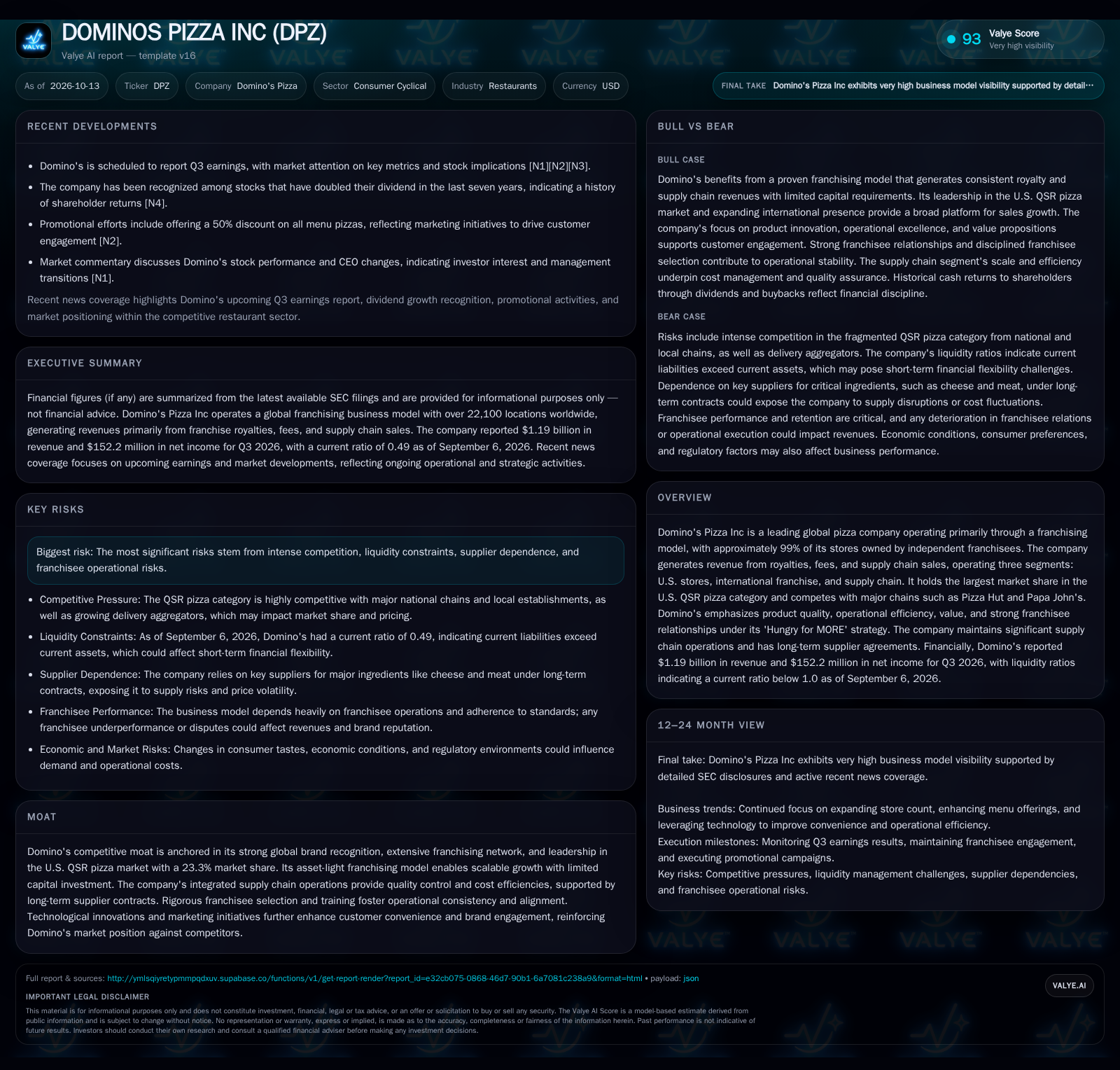
Domino’s Pizza remains the global leader in QSR pizza by store count and U.S. market share, executing an asset-light, franchise-driven model that delivers consistent royalty and supply chain revenues. The strategic focus is on expanding store count, deepening franchisee relationships, and leveraging supply chain scale, with execution and potential financial flexibility as critical watchpoints for sustaining growth and defending margins. [S2]
Domino’s Pizza Inc, the world’s largest pizza chain by locations, has built a resilient business around an asset-light, franchise-first model and a tightly integrated supply chain. As of late 2025, it holds a commanding lead in the U.S. QSR pizza category and continues to expand internationally, with nearly all stores operated by independent franchisees. The coming quarters will test whether the company’s scale, brand, and operational discipline can keep it ahead in a rapidly evolving market. [S2]
Recent Performance and Strategic Focus: What the Numbers and Initiatives Reveal
Domino's Pizza reported $1.19 billion in revenue and $152.2 million in net income for the quarter ended September 6, 2026, reinforcing the ongoing profitability of its global franchise and supply chain-driven model. The company operates more than 22,100 stores across over 90 markets, with 99% of locations franchised, and holds a 23.3% market share in the U.S. QSR pizza segment as of December 2025. [S2]
This highlights a potential constraint on short-term potential financial flexibility, especially in the face of economic or operational shocks. [S2]
Domino’s is advancing its 'Hungry for MORE' strategy, targeting growth in sales, store count, and profitability through product innovation, operational excellence, and franchisee support. With Q3 earnings drawing investor and analyst scrutiny, the focus is squarely on execution and the ability to translate strategic priorities into sustained performance. [N1] [N3]
How Domino’s Makes Money: The Franchise Royalty and Supply Chain Engine
Domino’s business model is fundamentally asset-light and highly scalable. The company earns the bulk of its income through two primary streams: royalties and fees from franchisees, and revenue from its supply chain operations. Franchisees pay a 5.5% royalty on sales plus technology fees under standard 10-year agreements, with a reported 99% renewal rate in 2025. These high renewal rates suggest strong alignment and satisfaction among franchisees, underpinning revenue stability. [S2]
The supply chain segment, which accounted for 60.5% of consolidated revenues in 2025, is a core economic driver. Domino’s supplies franchisees with dough, ingredients, and other products, capturing additional margin while ensuring product consistency and cost control. This vertical integration provides both operational leverage and a degree of insulation from third-party supply risk, though the company remains exposed to commodity price swings through its key ingredient contracts.
Fixed costs are relatively low at the corporate level due to the franchising structure, though the supply chain operations necessitate ongoing investment in logistics, manufacturing, and inventory. Variable costs are borne primarily by franchisees, who manage labor, rent, and in-store operations. This structure supports strong cash generation and enables Domino’s to return capital to shareholders, but the company’s own working capital management is crucial given its current ratio below 1.0.
Defending Share in a Crowded Market: Domino’s Moat, Rivals, and Substitutes
Domino’s competitive moat is built on global brand recognition, an extensive and loyal franchisee network, and operational excellence in both delivery and digital ordering. Its 23.3% U.S. QSR pizza market share reflects not only its scale but also its ability to consistently deliver on value, speed, and convenience. The integrated supply chain further reinforces product quality and cost efficiency, while long-term supplier contracts provide some input cost predictability. [S2]
Major competitors include other global QSR pizza chains such as Pizza Hut and Papa John’s, as well as regional chains and local independents. Increasingly, Domino’s faces indirect competition from delivery aggregators and non-pizza QSRs, which erode category boundaries and intensify the fight for delivery occasions.
Technology and digital ordering platforms are both a strength and a vulnerability: Domino’s leads in digital penetration, but competitors and aggregators are rapidly narrowing the gap. Menu innovation and regional tailoring can help defend share, but price competition and promotional intensity remain persistent threats.
What Could Drive Domino’s Outperformance: Store Growth, Digital Leverage, and Supply Chain Margin Expansion
A favorable outcome for Domino’s would see it accelerate store openings, particularly in international markets with fragmented competition and lower QSR pizza penetration. If franchisees continue to renew at high rates and new operators are attracted by robust unit economics, Domino’s could further entrench its global leadership.
Digital innovation—such as AI-driven ordering, loyalty personalization, or operational automation—could reduce labor costs, improve customer retention, and drive higher order frequency. If Domino’s leverages its supply chain scale to secure better input pricing or unlock new margin opportunities (e.g., supplying third parties or expanding menu offerings), consolidated profitability could rise.
Evidence confirming this scenario would include sustained high same-store sales growth, acceleration in net new store count, improved supply chain margins, and continued high franchisee renewal rates. Disclosures of new technology rollouts or successful international market entries would further validate the upside.
Sustained Leadership with Margin Pressures: The Most Likely Trajectory
The most plausible outcome is that Domino’s maintains its top-tier U.S. market share and continues measured international expansion, but faces ongoing margin pressure from competition, labor costs, and input volatility. The core franchise and supply chain model should support stable, recurring revenues, with modest growth driven by incremental store openings and menu innovation.
Operational leverage will remain a function of supply chain efficiency and franchisee health; any major disruption in franchisee economics or supply chain performance could dent profitability.
Confirmation of this scenario would be steady (but not accelerating) same-store sales, incremental store growth, stable (but not expanding) supply chain margins, and continued but cautious capital returns to shareholders.
Where Domino’s Could Stumble: Franchisee Weakness, Supply Shocks, or Digital Disruption
A negative outcome could unfold if competitive intensity escalates—especially from aggregators or new digital-first entrants—leading to market share erosion and heavier promotional spending. If franchisee unit economics deteriorate, renewal and expansion rates could slump, undermining royalty streams and threatening system-wide health.
Supply chain disruptions—whether from ingredient shortages, cost spikes, or contract disputes—could compress margins, particularly given Domino’s exposure to cheese and meat cost volatility. A liquidity squeeze, triggered by adverse macro shocks or operational missteps, could force the company to curtail investments or renegotiate supplier and franchisee terms under less favorable conditions.
Evidence of this scenario would include declining same-store sales, rising franchisee closures or non-renewals, margin compression in supply chain operations, and negative working capital trends. Public disputes with franchisees or suppliers, or a sudden spike in short-term borrowing, would further validate downside risk.
Milestones That Will Shape Domino’s Competitive Trajectory
Sustained global same-store sales growth rates—especially in the U.S. and key international markets—would help gauge ongoing customer demand and competitive positioning.
Net new store openings and franchisee renewal rates, if disclosed, are critical for testing the health of the system and future royalty potential.
Supply chain segment margins and input cost trends, particularly for cheese and meats, will indicate Domino’s ability to manage commodity risk and operational leverage.
Liquidity and working capital evolution—monitoring the current and cash ratios for signs of improvement or strain—will be important in assessing potential financial flexibility.
The pace and impact of technology and digital ordering innovations, such as new AI-driven features or delivery automation, could affect both cost structure and customer experience.
Promotional intensity and discounting activity, if disclosed, would signal competitive pressure and potential margin trade-offs.
Franchisee health indicators, such as unit-level profitability or closure rates (if disclosed), would inform the resilience of the broader Domino’s system.
Any significant changes in long-term supplier contracts or unforeseen supply chain disruptions should be closely watched for potential margin and operational impacts.
Disclaimer: This is research-only, informational analysis and not investment advice. It may include AI-generated interpretation and general industry context. Always verify important details using primary sources.

Comments