
US Nuclear Corp.: Niche Leadership in Radiation Detection Confronts Capital Constraints and Global Shifts
US Nuclear Corp. leverages proprietary technology and deep specialization in tritium and radiation water monitoring to serve critical infrastructure and security markets.
US Nuclear Corp. stands out for its proprietary, high-barrier technology in radiation detection, especially tritium monitoring, with a customer base spanning government, defense, and industrial sectors. However, financial stress is acute: as of March 2026, current liabilities far exceed current assets, and the company projects a need for $5 million in new capital to fund its next phase. The company's growth ambitions ride on international nuclear buildouts, but execution depends on both capital access and maintaining its technical edge in a rapidly evolving, high-stakes market. [S1] [S2]
US Nuclear Corp. occupies a specialized niche in the global nuclear value chain, providing critical radiation and tritium monitoring equipment to power plants, government agencies, and defense installations. Its defensible technology and customer relationships have supported a leading position in technically demanding markets. Yet the company’s future hinges on its ability to secure substantial additional capital, manage acute liquidity pressures, and capture growth in international nuclear markets while defending its technological edge. The interplay of these factors will determine whether US Nuclear can translate its niche leadership into sustainable value.
Liquidity Pressure, Concentration, and International Ambitions Shape Near-Term Reality
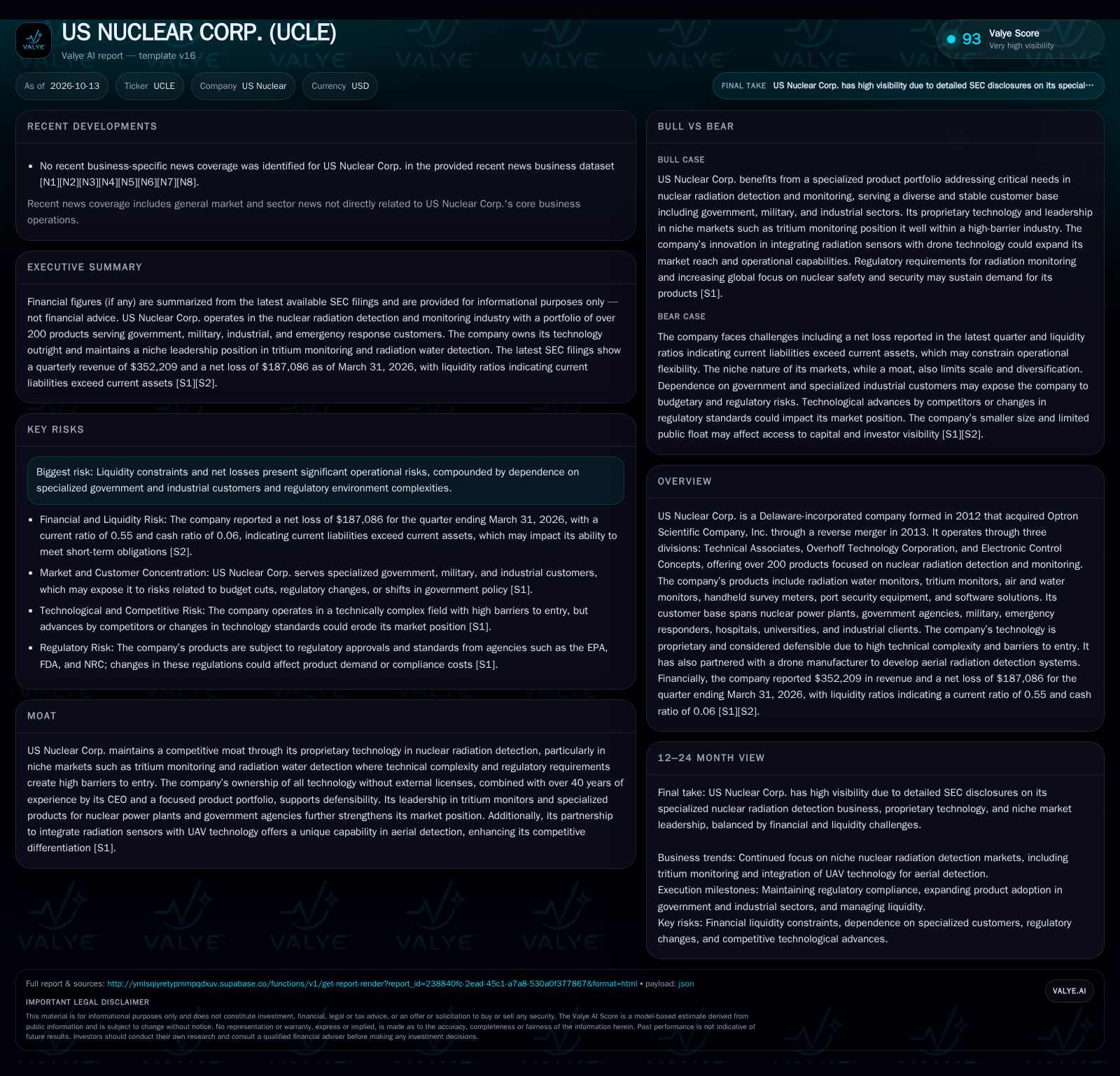
As of March 31, 2026, US Nuclear Corp. reported $352,209 in quarterly revenue with a net loss of $187,086. The company’s balance sheet is under significant strain: current liabilities of $2,186,126 surpass current assets of $1,194,749, resulting in a current ratio of 0.55 and a cash ratio of just 0.06. Management projects a need for approximately $5 million in new capital over the next twelve months to fund planned operations and growth initiatives. Overhoff Technology, the tritium monitoring division, contributed 61% of revenue for the quarter, highlighting significant product concentration risk. International sales comprised 42% of revenue, and management anticipates further growth in Asian markets as nuclear energy deployment accelerates. [S2]
How US Nuclear’s Niche Focus Drives Revenue—and Exposes Margin and Funding Challenges
US Nuclear’s business model centers on designing, manufacturing, and selling highly specialized radiation detection and monitoring equipment for nuclear, security, and industrial applications. The company owns all its technology, avoiding royalty or licensing costs, which supports gross margins in defensible product categories. Most revenue appears to be generated from discrete equipment sales and systems integration, with some potential for recurring revenue from maintenance, calibration, and software—though recurring contract structure is not established in the current disclosures.
Operating leverage is plausible given the technical complexity and regulatory hurdles for competitors, but scale is inherently limited by the niche size of critical nuclear monitoring markets. The company’s fixed cost base, including engineering, compliance, and manufacturing overhead, likely drives significant operating leverage when orders are robust. However, the current net loss and negative liquidity position suggest that recent sales volumes are insufficient to cover fixed costs, possibly due to the lumpy, project-driven nature of customer procurement.
Capital intensity is moderate to high: the company must maintain R&D to keep pace with evolving nuclear standards and customer requirements, and upfront working capital is needed to fulfill large project orders. With a projected $5 million capital need for the next year, US Nuclear’s ability to invest in growth or weather order delays is tightly constrained by its funding environment. [S2]
Technical Complexity and Regulatory Barriers Defend Core Markets, But Customer and Product Concentration Heighten Vulnerability
US Nuclear benefits from deeply entrenched technical and regulatory barriers, especially in tritium monitoring and radiation water detection. These products require years of development, rigorous accuracy, and compliance with nuclear safety standards, making market entry difficult for newcomers. The company’s ownership of all its technology further protects its position and supports product customization for demanding clients.
However, the company’s high reliance on the Overhoff Technology division (61% of revenue) and a customer base dominated by government, defense, and nuclear operators create concentration risk. Budget shifts, regulatory changes, or a lost bid in a key market could have outsized impact. Additionally, the company faces competition from larger multinational instrumentation firms and specialized nuclear detection providers. While few direct competitors match US Nuclear’s tritium monitoring focus, broader radiation detection and environmental safety markets remain intensely competitive.
Substitutes are limited for customers with strict regulatory mandates, but advances in sensor miniaturization, software analytics, or integration with broader security platforms could allow larger players or new entrants to encroach on US Nuclear’s niches—especially if the company is unable to sustain R&D investment.
If International Nuclear Buildout and Technical Edge Drive Accelerated Growth
The most constructive scenario for US Nuclear involves successful capital raising that stabilizes operations and funds targeted expansion, particularly in Asia where next-generation nuclear reactors (Molten Salt, LFTR, CANDU) are being deployed. If the company can secure major contracts with new or expanding nuclear facilities in South Korea, China, or other rapidly developing markets, revenue scale could improve, enhancing operating leverage. Continued leadership in tritium monitoring—where competitors are few and regulatory requirements are stringent—could enable premium pricing and repeat orders.
Integration of proprietary sensors with UAV platforms (as in the FlyCam partnership) could open new security and environmental monitoring markets, diversifying revenue streams and reducing reliance on traditional nuclear infrastructure customers.
Confirmation would come from announcements of large international orders, new capital secured at sustainable terms, and evidence of rising gross margins or recurring revenue. Falsification would be indicated by continued capital scarcity, lack of international traction, or material erosion of market share in core detection products.
Current Operations Continue Under Tight Constraints, With Incremental International Gains and Ongoing Financial Stress
The most plausible trajectory is a continuation of current trends: US Nuclear manages to maintain its niche leadership and customer relationships, but growth is incremental and uneven. Domestic market demand remains steady but not transformative, while international expansion produces modest gains amid fierce competition and long sales cycles.
Liquidity remains a persistent constraint, limiting the company’s ability to invest in R&D, sales, and product development. The company may secure some new capital, but likely on dilutive or expensive terms, constraining strategic flexibility. Overhoff Technology continues to dominate the revenue mix, and the company’s exposure to lumpy government and nuclear procurement cycles persists.
This scenario would be confirmed by stable or slightly rising revenues, continued dependence on a narrow set of products and customers, and ongoing net losses with only incremental improvement in liquidity. Falsification would require either a major strategic shift—such as a large acquisition, new recurring revenue model, or breakthrough in international sales—or further deterioration in liquidity leading to restructuring.
Acute Capital Shortfall, Missed Orders, or Regulatory Shifts Trigger a Crisis
The adverse scenario sees US Nuclear unable to raise the $5 million needed to fund ongoing operations, forcing severe cost cuts, layoffs, or a strategic sale. A missed major order—especially from a government or large international customer—could drive a precipitous drop in revenue, with fixed costs and negative working capital compounding the impact.
A regulatory shift (such as a change in nuclear monitoring standards or reduced government procurement) or new competitive technology could displace the company’s core products, rapidly eroding its market position. In a worst-case, the company could face insolvency or be forced to sell core assets at distressed valuations.
Confirmation of this scenario would come from failure to secure new financing, rapid declines in order backlog, deteriorating customer relationships, or regulatory actions that render key products obsolete. Conversely, even a modest capital infusion or new order win could delay or soften this outcome.
Milestones and Metrics That Will Determine US Nuclear’s Competitive Trajectory
Progress toward raising the projected $5 million in new capital—timing, terms, and sources will directly impact operational runway and ability to execute growth plans.
Large international contract wins, particularly in Asia (South Korea, China) or with next-generation nuclear reactor projects; order size and customer diversification would help test the thesis.
Revenue mix evolution: whether Overhoff Technology’s share declines as other divisions or new products contribute more meaningfully to sales (if disclosed).
Changes in gross margin and operating leverage, especially if new orders drive improved scale or if recurring revenue contracts are established (if disclosed).
Evidence of adoption or commercial traction for drone-integrated sensor solutions, including new partnerships or pilot deployments.
Customer concentration metrics—whether the company reduces reliance on a handful of government or nuclear clients (if disclosed).
Disclosure of backlog, order pipeline, or renewal rates, which would clarify revenue visibility and near-term risk.
Regulatory developments affecting nuclear detection standards or procurement budgets in key markets.
Disclaimer: This is research-only, informational analysis and not investment advice. It may include AI-generated interpretation and general industry context. Always verify important details using primary sources.

Comments