
MADE IN USA INC.: Reshoring Ambitions, Certification Tech, and the Challenge of Going Concern
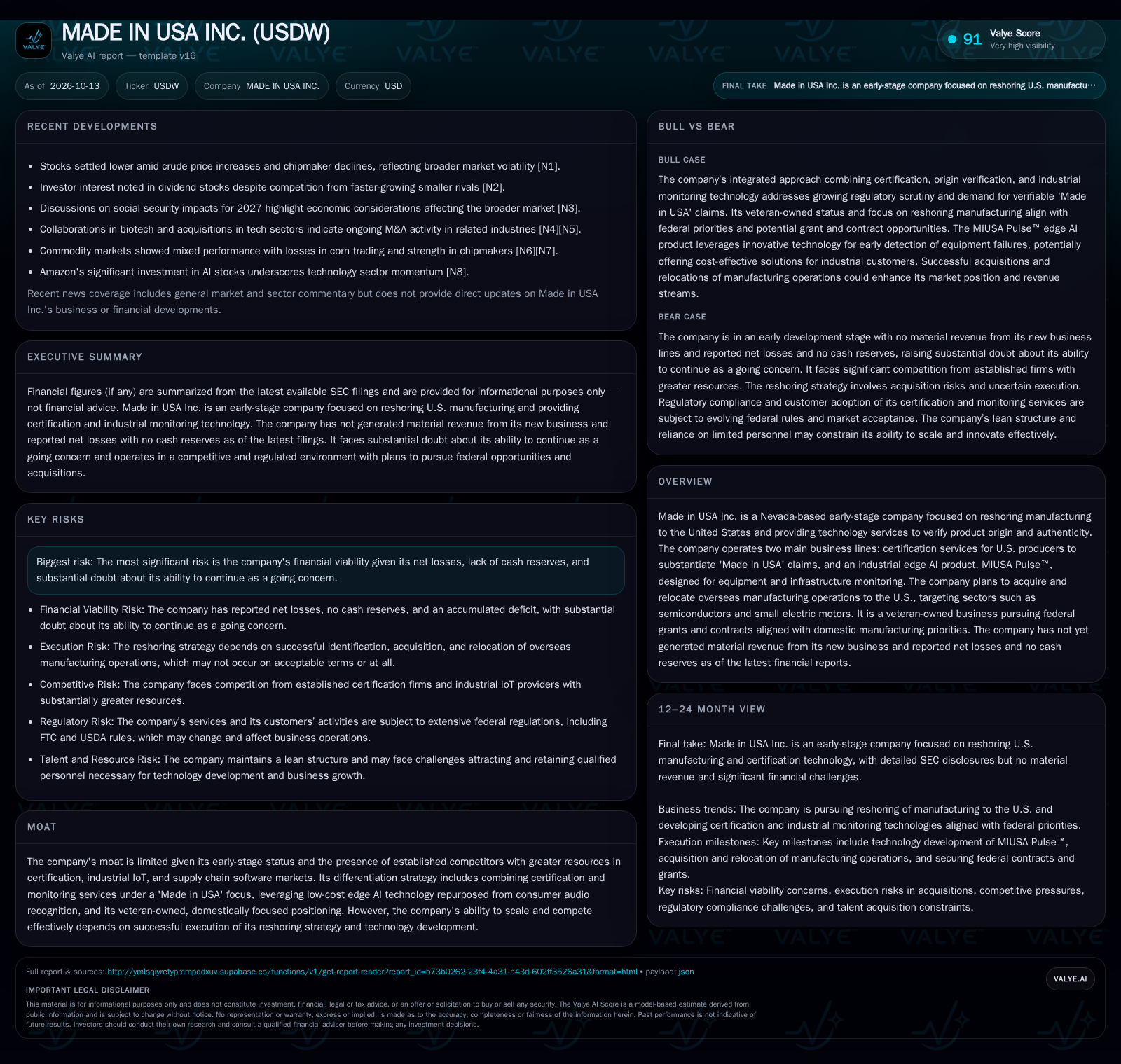
MADE IN USA INC. aims to capture the momentum behind U.S. manufacturing reshoring and origin verification with a dual focus on certification and edge AI monitoring technology. However, minimal revenue, no cash reserves, and ongoing net losses underscore the urgent need for capital, execution, and customer traction in a competitive and regulated landscape.
MADE IN USA INC. has repositioned itself to support U.S. manufacturing through certification services and industrial AI monitoring, hoping to capitalize on regulatory and federal tailwinds. Yet, with zero cash, minimal revenue, and ongoing losses, the company’s execution risk and financial viability are front and center.
MADE IN USA INC. is attempting to ride the crest of renewed U.S. industrial policy, offering certification and industrial AI monitoring services aimed at producers needing to validate 'Made in USA' claims. Its dual strategy—combining regulatory compliance services with early-stage edge AI for equipment monitoring—caters to both policy trends and operational needs. Yet, as of its most recent filings, the company stands at the threshold of existential risk, with no cash, negligible revenue, and a going-concern warning. The central question now is whether MADE IN USA INC. can secure the capital, execution, and customer traction needed to transform its ambitions into a sustainable business.
Pivot to Reshoring and Technology—But No Cash, Minimal Revenue
MADE IN USA INC. underwent a significant change in control in August 2025, shifting its business model to support U.S. manufacturing through product origin certification and industrial edge AI monitoring. The company now operates two main business lines: a certification service for substantiating 'Made in USA' claims, and MIUSA Pulse™, an edge AI solution for detecting early signs of equipment failure in industrial settings [S1] [S2].
Despite this strategic repositioning, the company’s financials remain stark. For the quarter ended August 31, 2026, MADE IN USA INC. reported zero revenue, zero cash or equivalents, and a net loss of $1,737. Total current assets stood at zero, with $622 in current liabilities, resulting in a current ratio and cash ratio of zero. There is substantial doubt about the company's ability to continue as a going concern [S2].
These facts matter because they frame the company's near-term survival as a gating issue. Execution of its new business lines and pursuit of federal opportunities will require not only strategic clarity but also urgent access to capital and commercial traction.
How MADE IN USA INC. Could Make Money: Certification Fees, Subscriptions, and Industrial AI
The company’s two business lines are designed to capture value from regulatory and operational needs. Certification services generate revenue through one-time fees and monthly subscriptions, targeting U.S. producers that must comply with FTC and USDA/FSIS documentation rules. Success in this segment depends on the company's ability to efficiently acquire and retain customers, likely through referral and affiliate networks rather than a costly direct sales force.
MIUSA Pulse™, the edge AI monitoring product, is intended for industrial customers seeking early detection of equipment failure—potentially reducing downtime and maintenance costs. The economics here could be attractive if the product proves reliable and scalable, with pricing models plausibly ranging from hardware/software bundles to SaaS-like recurring fees per monitored asset.
Both segments offer potential for high-margin, recurring revenue if adoption is achieved. However, the early-stage status means that fixed costs—such as technology development, certification processes, and regulatory compliance—likely outweigh the minimal variable costs at current scale. Operating leverage would only emerge with real customer traction and volume.
Capital needs are acute. Pursuing acquisitions of overseas manufacturing operations and relocating them to the U.S. will require significant upfront investment, due diligence, and integration resources. The company’s lean structure keeps costs low but may hinder the pace of development and customer acquisition without additional funding.
Facing Deep-Pocketed Incumbents and Regulatory Complexity
MADE IN USA INC. operates at the intersection of several crowded markets: certification and verification (competing with established certification firms), industrial IoT (where large technology and automation vendors dominate), and supply chain traceability software. These categories are marked by entrenched players with greater resources, established customer relationships, and proven technology platforms.
The company’s differentiation rests on three pillars: combining certification with edge AI monitoring, focusing exclusively on U.S.-origin claims, and leveraging its veteran-owned status to compete for federal contracts and grants. Theoretically, this positioning could appeal to customers seeking a one-stop solution for regulatory compliance and operational monitoring, especially in sectors where federal procurement preferences apply.
Counterforces are formidable. Incumbents may bundle similar services, undercut pricing, or leverage broader product ecosystems to retain customers. The regulatory environment is also dynamic—changes in FTC or USDA requirements could either expand or constrain the addressable market. As a newcomer, MADE IN USA INC. must overcome both switching frictions and credibility gaps to win meaningful business.
Unlocking Federal Contracts and Manufacturing Relocation: The Path to Scale
A favorable scenario would see MADE IN USA INC. securing federal grants or contracts—leveraging its veteran-owned status and compliance-focused solutions to win business under CHIPS Act, USDA, or Department of Defense programs. This could provide both non-dilutive capital and a reference base for commercial customers.
At the same time, successful acquisition and relocation of overseas operations in priority sectors (semiconductors, LEDs, small motors) would validate the company’s reshoring thesis and potentially generate manufacturing revenue alongside technology and certification fees.
Confirmation of this scenario would require announcements of federal contract wins, signed agreements for manufacturing relocations, and meaningful growth in certification or monitoring customers. Evidence would also include new funding rounds or partnerships that alleviate immediate financial stress.
Incremental Progress Amid Funding Uncertainty and Competitive Headwinds
The most plausible near-term path is that MADE IN USA INC. makes incremental progress—advancing its technology, refining its certification offering, and exploring potential federal or commercial partnerships—but remains constrained by limited resources.
In this scenario, the company might secure small pilot projects or early customers, perhaps in niche or veteran-preferred procurement settings, but struggles to scale without outside capital. The pace of manufacturing acquisitions and relocations is likely slow, with execution risk dominating.
Evidence would include modest revenue upticks, progress updates on product development, and disclosures of new funding or government relationships. Conversely, continued zero revenue and lack of customer announcements would falsify even this cautious trajectory.
Liquidity Exhaustion and Execution Failure Lead to Strategic Stasis or Shutdown
In the adverse scenario, the company’s lack of cash and inability to generate revenue or secure funding forces it into stasis or even bankruptcy. Fixed costs—however lean—become unsustainable in the absence of new capital, and the company is unable to execute on acquisitions, federal bids, or technology development.
Competitive pressure compounds the problem, as established players continue to dominate customer mindshare and the regulatory environment remains complex. If no meaningful contracts or partnerships are secured, and product development stalls, MADE IN USA INC. risks delisting, asset sales, or outright closure.
Confirmation would come from continued going-concern warnings, lack of any new funding or customer traction, or public disclosures of strategic alternatives (including asset sales or liquidation).
Milestones That Will Determine MADE IN USA INC.’s Survival and Traction
Announcements of federal contract or grant awards, particularly related to CHIPS Act, USDA, or Department of Defense programs.
Evidence of commercial manufacturing relocation deals—signed agreements or completed transactions in targeted sectors.
Material revenue generation from either certification services or MIUSA Pulse™ subscriptions (if disclosed).
Successful fundraising events—equity, debt, or strategic investments that address immediate liquidity constraints.
Disclosures of customer wins, pilot projects, or partnerships with established U.S. manufacturers or supply chain participants.
Updates on MIUSA Pulse™ technology validation, field deployments, or customer testimonials.
Changes to regulatory frameworks (FTC/USDA/FSIS) for 'Made in USA' claims that could expand or contract the addressable market.
Management turnover, board changes, or new executive hires with proven track records in certification, industrial IoT, or federal contracting.
Disclaimer: This is research-only, informational analysis and not investment advice. It may include AI-generated interpretation and general industry context. Always verify important details using primary sources.

Comments