
Wenyuan Group Corp.: Financial Strain and Regulatory Friction in China’s Competitive Health Product Market
While its presence in the cultural and health product sector offers theoretical upside, operational constraints, capital access hurdles, and compliance risks present formidable obstacles to sustainable business growth.
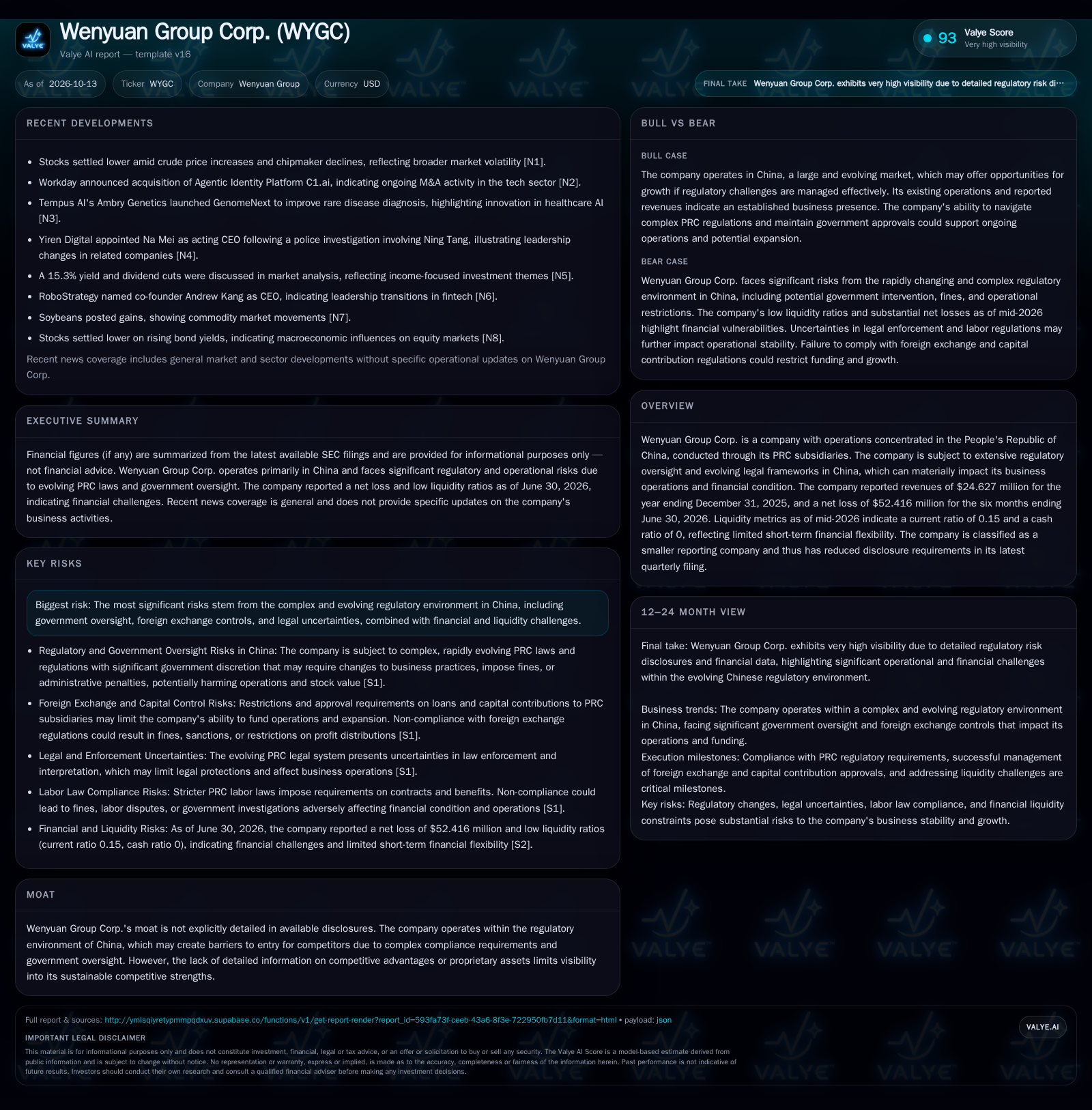
Wenyuan Group Corp., operating through PRC subsidiaries, posted $24.6M in 2025 revenue but faces a $52.4M net loss and severe liquidity pressure as of mid-2026. Navigating China’s stringent, shifting regulatory environment and capital controls is essential for survival, but the company’s low cash and high current liabilities leave little margin for error. Sustained operations will depend on regulatory compliance, restructuring or external funding, and adaptability in an intensely competitive market [S1] [S2].
Wenyuan Group Corp. stands at a precarious juncture: its $24.6 million in 2025 revenue signals an established presence in China’s cultural and health product market, but its $52.4 million net loss and near-zero liquidity as of mid-2026 raise the specter of operational instability. With only five employees and no intellectual property, Wenyuan is exposed to fierce competition and the full weight of China’s regulatory and capital controls. Its ability to survive and grow hinges on navigating these constraints, securing capital under adverse conditions, and demonstrating that its business model can be adapted to China’s shifting commercial landscape.
Liquidity Crisis and Regulatory Exposure Define the Immediate Landscape
As of June 30, 2026, Wenyuan Group Corp. reported cash and cash equivalents of $841 thousand versus $183.8 million in current liabilities—a current ratio of just 0.15 and a cash ratio of 0 [S2]. The company also posted a net loss of $52.4 million for the six-month period ending June 30, 2026, despite generating $24.6 million in revenue for the full year 2025 [S2].
Wenyuan’s operations are conducted entirely through PRC subsidiaries and are subject to evolving Chinese regulatory frameworks, including foreign exchange controls and labor law compliance obligations [S1]. Any misstep in these areas could result in fines, penalties, or forced business modifications, amplifying existing financial vulnerabilities.
Beyond the immediate liquidity crunch, the company’s exposure to regulatory shifts extends to potential changes in tax policies and import-export restrictions that could affect cost structures and pricing flexibility. Given the evolving nature of China’s regulatory environment, Wenyuan must maintain agile compliance mechanisms to anticipate and adapt to policy changes that may not only increase operational costs but also restrict access to certain raw materials or distribution channels. Failure to proactively manage these risks could exacerbate cash flow challenges and further constrain operational resilience.
Cost Structure, Funding Needs, and the Challenge of Achieving Operating Leverage
Wenyuan derives its primary revenue from the sale of cultural and health products in China, a sector characterized by intense price competition, low switching costs, and limited differentiation absent proprietary offerings. The company reported no intellectual property assets as of December 2025 and only five employees as of May 2026, suggesting a lean cost base but also limited internal capacity to scale or innovate [S1].
The business appears to operate on thin gross margins, with fixed costs likely dominated by regulatory compliance, labor, and necessary investments in sales channels and platform development. Given the net loss and negative cash conversion, Wenyuan is not currently achieving operating leverage. To fund business continuity or growth, the company may need to raise additional equity or debt. However, further equity issuances would dilute existing shareholders, and debt may impose restrictive covenants or be unavailable on favorable terms given the company’s current balance sheet [S1].
The company’s capital structure is thus precarious: absent a rapid improvement in working capital management, margin structure, or access to external capital, Wenyuan faces a heightened risk of operational disruption or insolvency.
The absence of intellectual property and a minimal workforce suggest limited capacity for product innovation or brand development, which are critical levers for improving margins in a commoditized market. Without proprietary products or scalable sales infrastructure, Wenyuan’s cost structure is likely dominated by variable expenses tied directly to sales volume, limiting the potential for meaningful operating leverage. Incremental improvements in working capital management—such as optimizing inventory turnover or extending payables—could provide temporary relief but are unlikely to offset fundamental margin pressures without strategic shifts or capital infusion.
Survival in a Fragmented, Compliance-Intensive Market
Wenyuan operates in China’s cultural and health product market—a highly fragmented and competitive sector dominated by larger chains and established brands offering wider product assortments and superior after-sales service [S1]. Without intellectual property or clear product differentiation, Wenyuan’s ability to capture or retain market share is likely limited. The company’s small workforce further inhibits its ability to scale, innovate, or deliver consistent customer experience.
Regulatory complexity itself can act as a partial barrier to entry, but it also raises the stakes for compliance missteps and imposes ongoing costs. Larger, better-capitalized peers may be better positioned to absorb these fixed overheads and invest in compliance infrastructure. Substitution risk is high: consumers can readily switch between brands in this category, and regulatory actions could rapidly shift the competitive landscape.
Regulatory Compliance and Strategic Funding Unlock a Turnaround
If Wenyuan successfully navigates Chinese regulatory requirements—maintaining all necessary licenses, adhering to labor and foreign exchange controls, and avoiding fines—while securing new funding, it could stabilize operations and invest in growth initiatives. Additional capital could be used to enhance sales channels, expand product offerings, or build a more robust compliance and reporting infrastructure.
Confirmation of this scenario would require evidence of a completed capital raise (equity or debt) on non-punitive terms, sustained regulatory approval, and perhaps a shift to positive operating cash flow or a reduction in net losses. Early signs could include new partnerships, expanded distribution, or product innovation efforts. Falsification would occur if the company fails to secure funding, faces regulatory penalties, or continues to post widening losses.
Financial Strain Persists Amid Ongoing Regulatory Burden
The most plausible outcome is continued financial pressure: Wenyuan may struggle to raise external capital on favorable terms, forcing it to operate in a constrained mode. Margins remain thin, with limited resources to invest in compliance, talent, or product development. Regulatory compliance absorbs increasing effort and cost, while competition from larger players intensifies.
Falsifying evidence would include a material improvement in working capital, successful cost containment, or a strategic alliance that materially changes the company’s scale or economics.
Liquidity Exhaustion or Regulatory Sanctions Trigger a Crisis
Regulatory penalties or loss of operating licenses—whether due to labor law violations, foreign exchange missteps, or non-compliance with evolving PRC mandates—could accelerate a downward spiral.
Confirmation would come from public disclosures of default, auditor going-concern warnings, regulatory fines, or management commentary on business interruptions. Falsification would require clear evidence of a successful capital infusion, regulatory clearance, or a dramatic turnaround in cash flow and operating results.
Factors That Will Determine Wenyuan Group’s Trajectory in the Next Year
Announcement and terms of any capital raising transaction (equity, convertible, or debt), including resulting dilution or covenants.
Sustained regulatory compliance: evidence of renewed licenses, absence of fines, or explicit regulatory approvals in public filings.
Gross margin trends and cost structure detail (if disclosed) to assess the potential for operating leverage.
Expansion of the workforce or addition of key management personnel with sector expertise.
Development or acquisition of intellectual property, proprietary products, or exclusive distribution agreements.
Any public disclosure of new partnerships, expanded sales channels, or entry into higher-margin subsectors.
Resolution of outstanding legal, labor, or foreign exchange compliance issues as detailed in future filings.
Disclaimer: This is research-only, informational analysis and not investment advice. It may include AI-generated interpretation and general industry context. Always verify important details using primary sources.

Comments