
Birdie Win Corporation: Unbiased Financial Literacy in Hong Kong—Promise, Pressure, and the Path to Viability
The company’s ability to scale beyond its founder-led phase—and to convert independence into recurring revenue—will determine whether its differentiated approach can translate into sustainable growth.
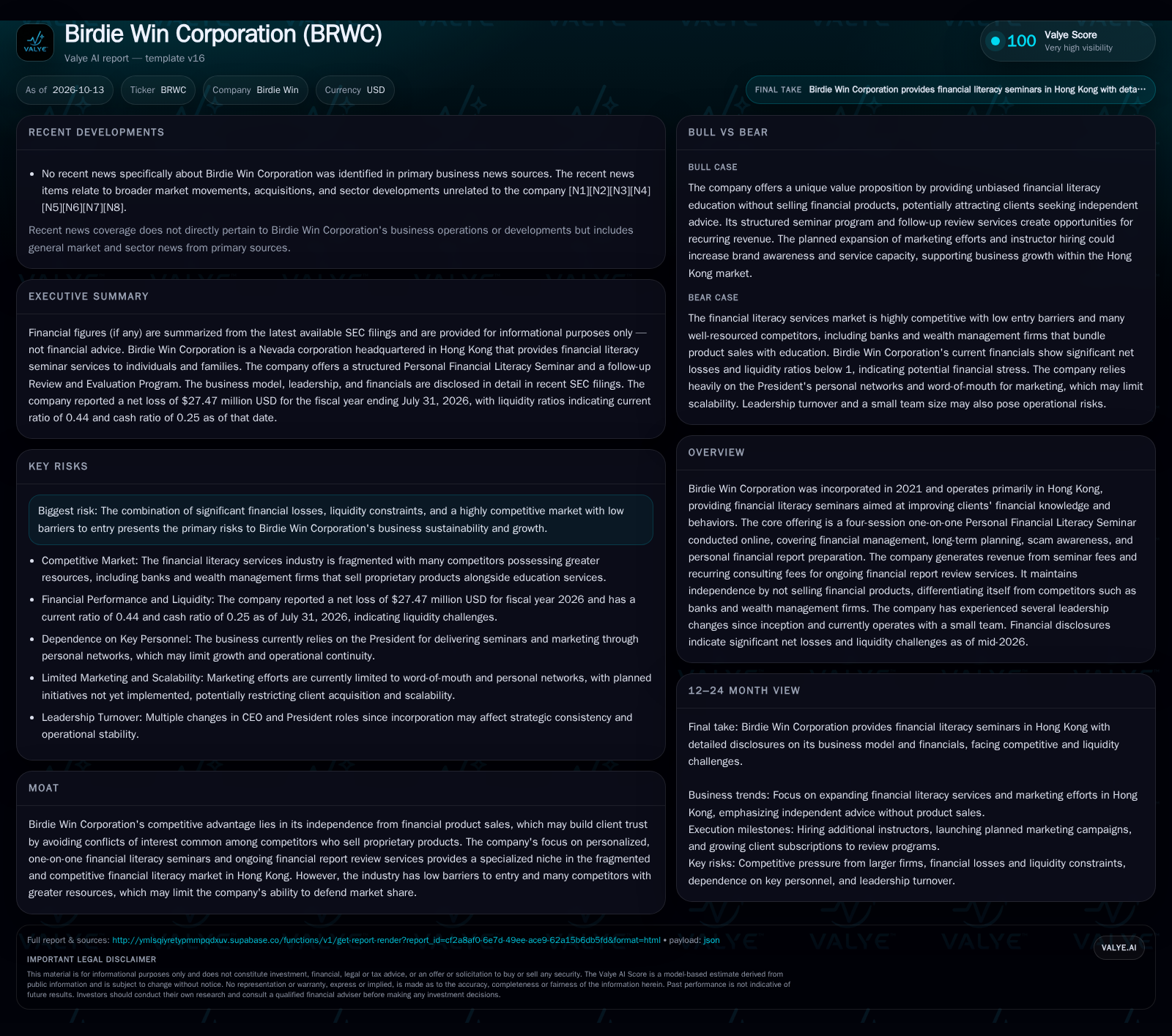
Birdie Win Corp delivers independent, fee-based financial literacy seminars in Hong Kong, emphasizing unbiased advice by eschewing product sales. Despite this value proposition, the company confronts significant net losses, low liquidity ratios, and heavy dependence on its President for both client delivery and marketing. Future prospects hinge on scaling operations, broadening marketing, and demonstrating that its conflict-free approach can capture a defensible client base amid intense competition from larger financial institutions. [S1]
Birdie Win Corporation has positioned itself as an independent provider of financial literacy seminars in Hong Kong, targeting individuals and families wary of the conflicts of interest that plague traditional banks and wealth managers. Its promise of unbiased advice—unencumbered by product sales—addresses a real market concern. However, Birdie Win is at a crossroads: it faces severe liquidity pressures, ongoing net losses, and the operational limits of a founder-led model. Whether the company can scale, professionalize, and carve out a defensible niche will be the test of its ultimate viability in a crowded, low-barrier market. [S1]
Acute Liquidity Strain and Operational Constraints Define Birdie Win’s Present
Birdie Win Corporation reported a net loss of $27.47 million for the fiscal year ending July 31, 2026, with cash and cash equivalents of $5.82 million and a current ratio of just 0.44. The company reported cash and liquidity metrics for the period; these figures do not by themselves establish operating runway, investment capacity, financial flexibility, or financing capacity. As of April 2026, the company had 6.72 million shares outstanding, but has experienced multiple leadership changes since inception, adding a layer of strategic uncertainty. These facts suggest that Birdie Win is operating under significant financial and organizational pressure, with both sustainability and execution risk in focus. [S1]
In markets like Hong Kong, where consumer trust and brand reputation are critical, financial instability can undermine client confidence and impede long-term relationship building. Furthermore, the founder-led nature of operations amplifies execution risk, as key-person dependency may delay decision-making or reduce operational flexibility. Without a clear path to stabilizing liquidity or diversifying leadership responsibilities, the company’s runway for experimentation and scaling remains precariously short.
How the Seminar-Driven Model Generates Revenue—And Where the Economic Leverage Lies
Birdie Win’s business model revolves around a flat $5,000 fee per client for a four-session, one-on-one Personal Financial Literacy Seminar, delivered online. This is complemented by recurring consulting fees from clients who subscribe to ongoing financial report review services. The economics are straightforward: high-ticket, high-touch, low-volume engagements, with a possible annuity stream from ongoing subscriptions. However, fixed costs are likely dominated by personnel—currently concentrated in the President—while variable costs per additional client may be low if delivery can be standardized.
Operating leverage is constrained at present: with all seminars delivered by the founder, scaling is bottlenecked by individual capacity. The plan to hire additional instructors could unlock more scalable economics, but would also add upfront fixed costs before revenue ramps. The model’s defensibility may ultimately depend on converting initial seminar clients into recurring subscribers, which, if successful, could provide a higher-margin, more predictable revenue base.
The seminar-driven model’s revenue generation is inherently tied to the perceived value and differentiation of the educational content, which must justify the premium fee. If the content is commoditized or perceived as substitutable by free or lower-cost alternatives, client acquisition and retention may falter. Additionally, the transition from one-time seminar fees to recurring subscription revenue is critical for improving margins and smoothing revenue volatility. This transition requires not only effective client engagement strategies but also scalable service delivery infrastructure. The upfront investment in additional instructors and marketing may pressure margins in the short term, but successful execution could unlock operating leverage and reduce reliance on the founder’s time.
Independence as Differentiator—But Can Birdie Win Outcompete Banks and Wealth Managers?
Birdie Win’s stated competitive advantage is its independence: it does not sell insurance or investment products, aiming to assure clients of unbiased advice. This stands in contrast to banks, wealth managers, and insurance brokers, who often bundle financial literacy with product sales and may face inherent conflicts of interest. However, these larger players possess substantial resources, broad distribution, and existing client networks, allowing them to subsidize education as a loss leader and cross-sell products.
The industry is characterized by low barriers to entry and fragmentation, making it difficult for any single player to defend share absent strong brand equity, proprietary content, or network effects. Birdie Win’s reliance on word-of-mouth and the President’s personal network for marketing, at least to date, limits its reach and could weaken its competitive position as larger institutions ramp up their own educational offerings—often at lower or no direct cost to clients. The question is whether independence, in itself, is a sufficiently valued differentiator to overcome these structural disadvantages.
Birdie Win’s independence can be a double-edged sword: while it may attract clients wary of conflicts of interest, it also limits the company’s ability to monetize through product sales, which traditionally subsidize educational offerings in the financial services industry. Larger competitors can leverage cross-selling opportunities and economies of scale to offer education at low or no direct cost, raising the bar for Birdie Win to prove value purely through advisory quality. Moreover, the lack of proprietary content or technology platforms may hinder differentiation and client stickiness. To build defensible market share, Birdie Win must deepen client trust and demonstrate measurable impact, which requires robust client feedback mechanisms and outcome tracking.
If Independence Drives Demand: What a Flywheel of Trust and Recurring Revenue Could Look Like
In the bullish scenario, consumer skepticism toward traditional financial institutions intensifies, making unbiased, product-free advice highly sought after. Birdie Win successfully recruits and trains additional instructors, enabling it to serve more clients without diluting quality. The planned marketing campaigns—webinars, white papers, social media—gain traction, expanding brand awareness beyond the founder’s network.
A growing proportion of seminar clients convert to the recurring review program, creating a base of predictable, higher-margin subscription revenue. As the company demonstrates client outcomes and satisfaction, word-of-mouth accelerates, creating a virtuous cycle of referrals. Evidence confirming this scenario would include rapid client growth, successful hiring and onboarding of new instructors, and a measurable uptick in recurring consulting revenue. Falsification would come from stagnant client numbers despite marketing spend or inability to retain clients post-seminar.
Founder-Led Growth Encounters Structural Hurdles
The most plausible near-term outcome is that Birdie Win achieves modest growth through incremental gains in client acquisition, primarily via existing networks and targeted marketing pilots. The company may begin hiring instructors and investing in marketing, but progress is likely to be gradual given capital constraints and competitive pressure. Conversion rates from seminars to recurring services remain uncertain, and the pace of new client acquisition may not be sufficient to offset high fixed costs and accumulated losses.
Evidence supporting this scenario would be slow but steady increases in both seminar and subscription clients, coupled with measured growth in operating expenses. Falsification would be a sharp acceleration in either client wins or recurring revenue, or, conversely, a further deterioration in liquidity forcing retrenchment or strategic review.
Liquidity Crunch and Competitive Squeeze Threaten Business Continuity
Competitors—especially banks and wealth managers—intensify their educational outreach, bundling free or subsidized seminars with their own products and leveraging established client bases. Birdie Win struggles to acquire new clients beyond the founder’s immediate network, and the low conversion rate to recurring services results in insufficient revenue to cover fixed costs.
Leadership turnover or loss of key personnel could exacerbate operational fragility. Confirmation of this scenario would include declining cash balances, stagnant or shrinking client numbers, and heightened accounts payable or other signs of financial distress. Falsification would require evidence of new funding, a turnaround in client acquisition, or successful cost restructuring.
Milestones That Will Determine Birdie Win’s Ability to Scale and Survive
The pace and success of hiring additional seminar instructors—if disclosed—would be a concrete sign of scalability beyond the founder-led model.
Growth in paid seminar clients and conversion rates to the recurring review program would clarify whether the business can generate predictable, high-margin revenue streams.
Implementation and measured results of planned marketing campaigns (webinars, social media, outreach) would help test whether the company can build brand awareness outside the President’s personal network.
Any new external financing or capital raises would provide a buffer against further losses and enable marketing or hiring investments.
Churn rates for recurring consulting clients—if disclosed—would reveal the stickiness and value perception of ongoing services.
Evidence of client satisfaction, testimonials, or measurable improvements in client financial outcomes could help validate the value proposition and support word-of-mouth growth.
Leadership stability and evidence of operational continuity will matter, given recent turnover and reliance on a small team.
Disclaimer: This is research-only, informational analysis and not investment advice. It may include AI-generated interpretation and general industry context. Always verify important details using primary sources.

Comments