
EON Resources: Permian Focus, Operational Setbacks, and the Pressures of reported liquidity position
EON Resources Inc. operates in the prolific Permian Basin with full control over its acreage and recent expansion via acquisition and joint development agreements.
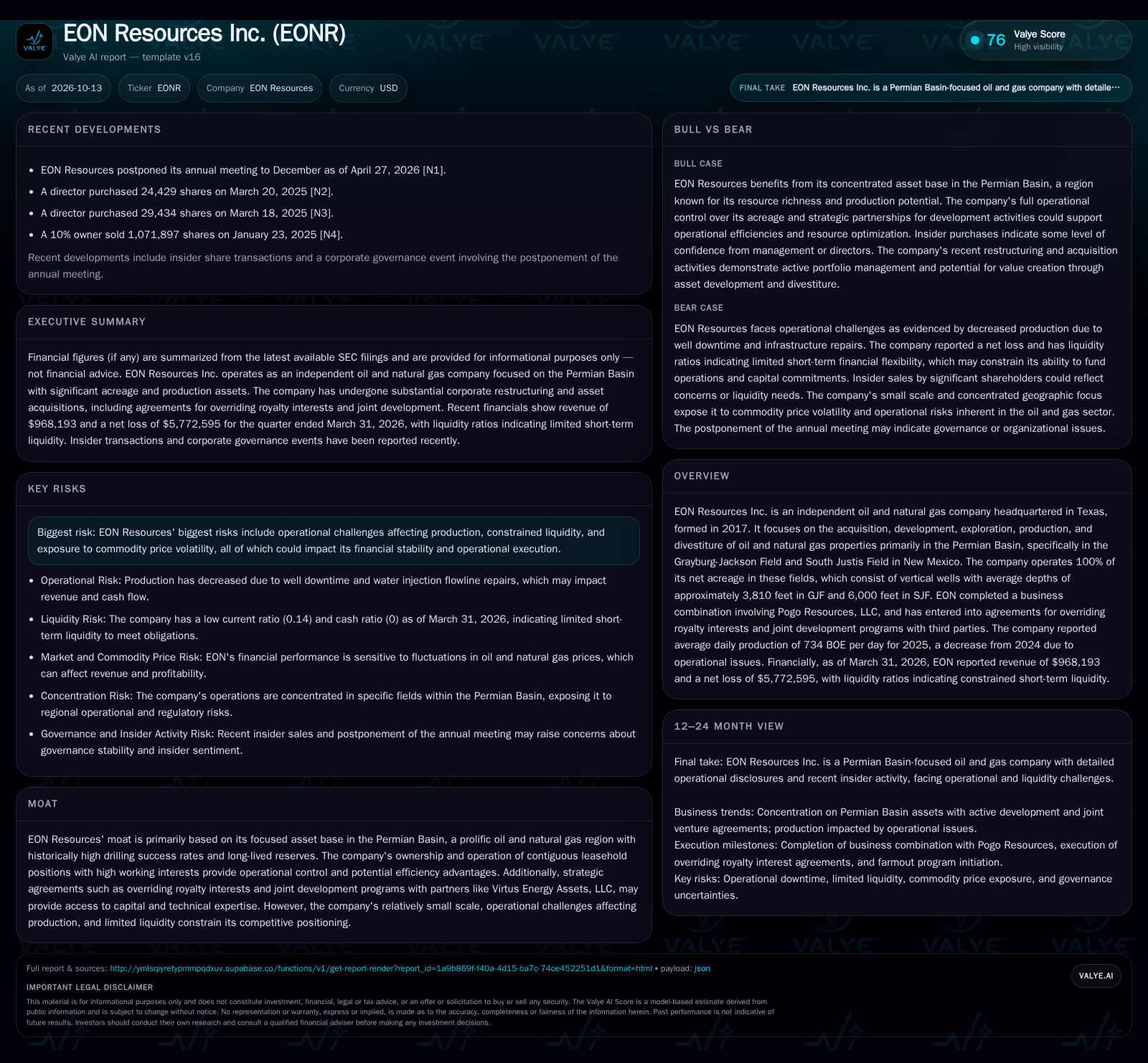
With insider trading activity and a postponed annual meeting highlighting governance uncertainty, the company's ability to stabilize production and secure funding will determine whether it can capitalize on its strategic asset base or face further financial distress. [S1] [S2] [N1] [N2] [N3] [N4]
EON Resources Inc. is emblematic of the small-cap energy operator with concentrated upside and acute risk. Despite controlling substantial and contiguous acreage in the Permian Basin—one of the most productive oil and gas regions in North America—the company’s declining production, sizable net losses, and extremely low liquidity ratios as of March 2026 cast a long shadow over its operational and financial trajectory. Recent transactions and governance events further complicate the outlook, leaving the company at a crossroads: can EON stabilize operations and secure the capital needed to leverage its asset base, or will its balance sheet constraints and execution setbacks undermine its potential?
Operational Decline and Liquidity Strain Define EON’s Present
EON Resources operates approximately 13,700 net acres in the Grayburg-Jackson Field and 5,400 net acres in the South Justis Field, holding nearly full working interest and operational control in both. However, average daily production declined from 798 BOE/day in 2024 to 734 BOE/day in 2025, attributed primarily to well downtime and water injection flowline repairs. The company reported cash and liquidity metrics for the period; these figures do not by themselves establish operating runway, investment capacity, financial flexibility, or financing capacity. Recent insider share purchases and a significant sale, plus the postponement of the annual meeting, add to a sense of instability in corporate governance and potentially in management confidence. [S1] [S2] [N1] [N2] [N3] [N4]
How the Permian Asset Base Could Drive Value—If Funding and Reliability Are Restored
EON’s business model is classic for a small-cap E&P: acquire, develop, and operate oil and natural gas properties, extracting value through production and, where possible, divestiture of mature or non-core assets. Full operational control over contiguous acreage in the Permian theoretically allows for economies of scale in drilling, development, and field operations, as well as flexibility in capital allocation. Vertical well development at moderate depths in both GJF and SJF suggests lower capital intensity than unconventional shale, but also potentially lower per-well productivity and higher base decline rates.
Revenue is a direct function of production volumes and realized commodity prices, but both are under pressure: output has declined, and the company’s ability to invest in new drilling or remedial work is constrained by a near-absence of cash. Fixed costs (overhead, lease operating expenses) may not scale down as quickly as revenue, exacerbating negative operating leverage. Recent agreements with Virtus Energy Assets, involving overriding royalty interests and joint development, suggest attempts to bring in external capital and technical support, but royalty structures typically reduce net revenue interest and could further compress margins if production does not rebound.
In the absence of a significant external capital injection, EON’s ability to fund drilling, maintenance, and even basic operations is severely restricted. This amplifies the risk of a negative feedback loop: declining production reduces cash flow, which limits the ability to fund field work, leading to further declines. The business is inherently capital-intensive and vulnerable to working capital shocks.
Asset Concentration: Strength in Control, Weakness in Scale and Flexibility
EON’s 100% working interest and operatorship in its Permian Basin acreage provide a level of control that many small operators lack, potentially enabling more efficient development planning and faster response to field issues. The Permian itself remains a highly attractive region, with low geological risk and extensive existing infrastructure. However, EON’s small absolute scale and geographic concentration make it vulnerable to field-level disruptions, regulatory changes, and commodity price swings.
Compared to larger, better-capitalized Permian operators, EON likely faces higher per-unit costs, less negotiating leverage with service providers, and limited access to capital markets. Its recent move to partner with Virtus Energy Assets may help offset some of these disadvantages by sharing risk and tapping into external expertise, but also dilutes upside through royalty structures and shared project economics. Substitution risk is moderate: while oil and gas from the Permian are broadly fungible, EON’s particular asset portfolio is not easily replicable unless acquired outright, but its small scale limits any systemic advantage.
In summary, EON’s position is one of operational control but strategic fragility, with its moat—if any—resting on the quality and contiguity of its acreage rather than any cost or technology advantage.
Turnaround Hinges on Field Reliability and New Capital
A favorable scenario for EON requires a rapid stabilization of field operations—reducing unplanned downtime and restoring water injection infrastructure—to halt or reverse production declines. If the joint development programs with Virtus Energy Assets can deliver meaningful external capital and technical expertise, EON could fund necessary workovers or new drilling, increasing output and improving cash flow. An uptick in oil and gas prices would further magnify the impact, as even modest volume gains would have a leveraged effect on revenue and EBITDA given the company’s fixed cost base.
To confirm this scenario, investors would look for sequential increases in production volumes, evidence of successful well remediation or drilling, and explicit disclosure of new funding or JV capital inflows. Improved liquidity metrics, a return to positive operating cash flow, and sustained insider buying would also be confirming signals. If, instead, production remains flat or declines further and no new capital is raised, this scenario would be quickly falsified.
Stagnation and Survival: Managing Decline While Seeking Strategic Alternatives
The most plausible near-term outcome is that EON muddles through a period of operational and financial stress. The company may focus on preserving cash, deferring discretionary capital spending, and seeking asset-level partnerships or farmouts to fund any new activity.
Absent a large and rapid recovery in production or commodity prices, EON likely continues to report net losses and may face periodic covenant or payment stress. Management may pursue non-core asset sales or further royalty/farmout deals to raise cash, but these would likely come at the expense of future upside. Confirmation of this scenario would include continued low or declining production, limited new drilling activity, and flat or deteriorating liquidity metrics. Evidence of asset sales or further equity dilution would further support the base case.
Liquidity Crisis and Operational Attrition as the Vicious Cycle Deepens
If operational disruptions persist—whether due to equipment failures, regulatory issues, or lack of maintenance—production could fall below fixed cost breakeven, accelerating cash burn.
Without access to new capital (debt, equity, or JV funding), the company may be forced to curtail production, sell core assets at distressed prices, or enter restructuring. Governance issues—such as the postponed annual meeting and significant insider sales—could signal or trigger further instability. Confirmation would come from further declines in production, negative working capital trends, disclosure of missed or delayed payments, or announcements of asset sales under duress.
Crucial Evidence to Test Whether EON Can Reverse Its Slide or Succumb to Constraints
Sequential quarter-over-quarter production volumes: any sustained recovery or further decline will be critical in assessing operational momentum.
Disclosure of new funding, JV capital contributions, or asset sales: confirmation of external capital inflow would be a pivotal catalyst.
Updates on field repairs, downtime incidents, and water injection infrastructure status: operational reliability is central to the turnaround thesis.
Liquidity metrics—especially cash and current ratio trends: continued deterioration or sudden improvement would have immediate implications.
Insider transaction activity was reported in the cited source; this activity does not by itself establish insider confidence.
Board and governance actions, including the timing and outcomes of the postponed annual meeting, to gauge organizational stability.
Commodity price realizations and hedging disclosures, if available, as a key external swing factor for near-term cash flow.
Explicit disclosure of covenant compliance, payment delays, or restructuring discussions—if these begin to emerge, they would strongly support the downside scenario.
Disclaimer: This is research-only, informational analysis and not investment advice. It may include AI-generated interpretation and general industry context. Always verify important details using primary sources.

Comments