
Art’s Way Manufacturing: Niche Focus, Modular Expansion, and the Challenge of Margins in Specialized Ag Equipment
Art’s Way Manufacturing’s dual-segment model—agricultural machinery and modular research buildings—anchors it in specialized, defensible markets. Yet, persistent margin pressure, fluctuating backlogs, and customer concentration highlight the tension between product innovation and the economic realities of niche scale.
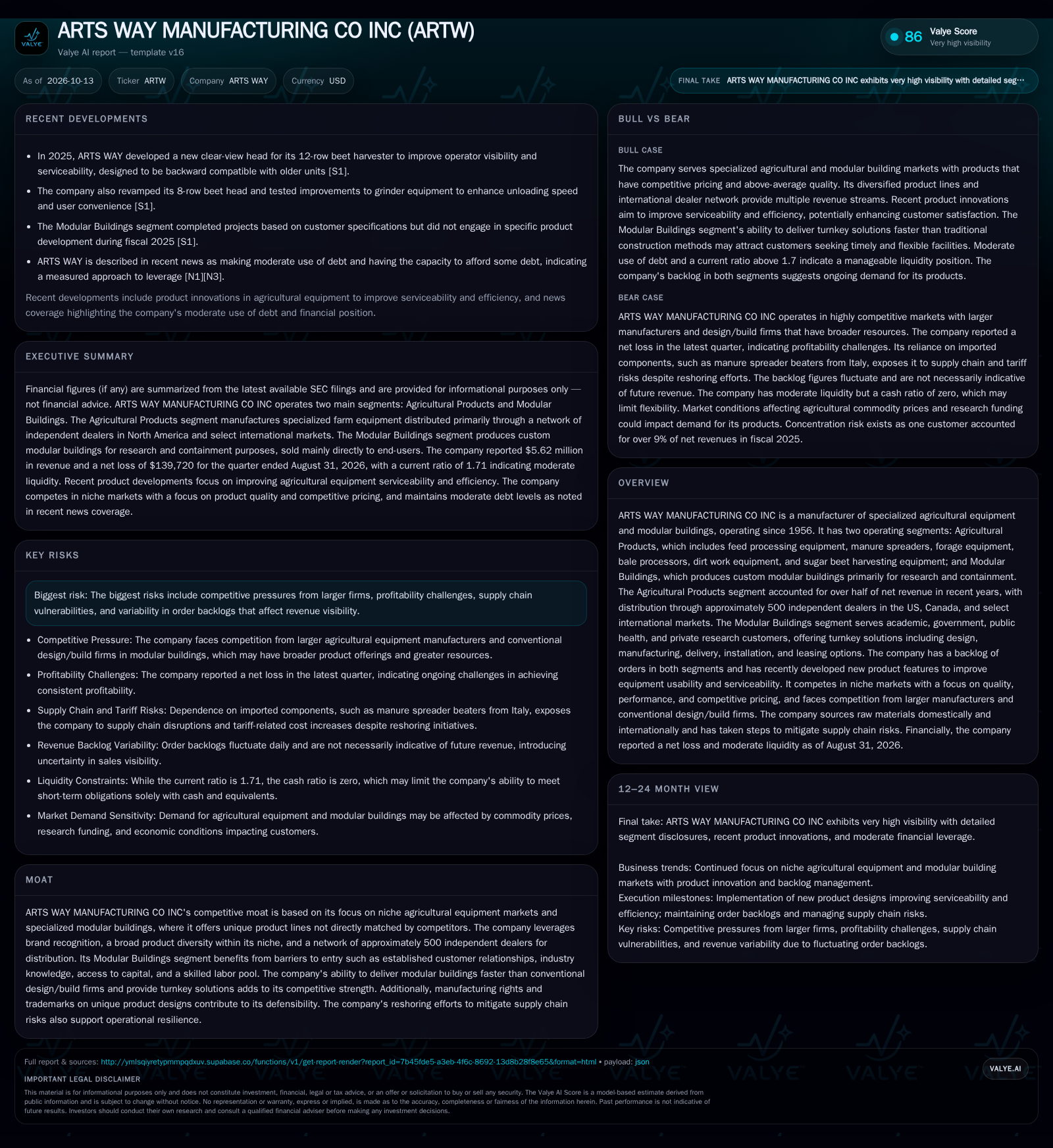
Art’s Way Manufacturing operates in two specialized segments—agricultural equipment and modular research buildings—leveraging product diversity, dealer networks, and recent innovations to drive value. While its backlog and moderate debt use suggest operational resilience, margin pressure, customer concentration, and exposure to supply chain risks underscore the limits of niche scale and the need for continued execution on product and commercial fronts. Recent product improvements and reshoring efforts may help, but sustained profitability remains the central challenge. [S1] [S2] [N1] [N3]
Art’s Way Manufacturing stands at the intersection of specialized agricultural equipment and modular science building solutions, leveraging decades of niche expertise and a broad dealer network to reach customers in North America and beyond. Recent product innovations and efforts to mitigate supply chain risk reflect a company striving to sustain relevance and growth in two distinct, defensible markets. Yet, as its latest net loss and customer concentration reveal, Art’s Way’s scale and margin structure continue to pose challenges—raising the stakes for execution, backlog conversion, and the realization of its product-led strategy.
Recent Backlogs, Product Developments, and the Profitability Challenge
As of early 2026, Art’s Way reported a $3.2 million backlog in Agricultural Products and a $4.9 million backlog in Modular Buildings, reflecting ongoing demand across both segments. The company launched a new clear-view head for its 12-row beet harvester and made improvements to other equipment lines, aiming to enhance usability and operational efficiency. Despite these efforts, Art’s Way recorded a net loss of $139,720 for the quarter ended August 31, 2026, with basic and diluted EPS at -$0.03. One customer represented over 9% of consolidated net revenues in fiscal 2025, underscoring a tangible concentration risk. [S1] [S2]
How Product Mix, Dealer Reach, and Cost Structure Shape Returns
Art’s Way’s business model is anchored in two distinct but complementary segments: specialized agricultural machinery (55.5% of FY25 revenue) and modular buildings for research and animal containment (44.5%). The agricultural segment’s economics are driven by relatively high-mix, lower-volume sales through a network of about 500 independent dealers, creating broad geographic reach but limited scale economies. Pricing power is constrained by competition with larger manufacturers and the capital sensitivity of end customers, which ties order volume to broader farm economics and commodity cycles.
The Modular Buildings segment operates on a project basis, with contracts typically direct to end-users in academic, government, and research markets. This business can offer higher ticket sizes and, in theory, greater margin potential due to customization, speed, and the value of turnkey delivery. However, the project nature introduces lumpiness and limits recurring revenue. Both segments face significant variable costs tied to raw materials and labor, while fixed costs include manufacturing overhead and R&D. Product development and reshoring efforts, such as the move to domestically source manure spreader beaters, may reduce supply chain risk but can raise near-term costs.
Operating leverage is modest: incremental volume may not meaningfully dilute fixed costs given the company’s niche scale, and profitability is highly sensitive to project margins and the timing of backlog conversion. Moderate debt usage adds some potential financial flexibility but does not fundamentally alter the need for sustained gross margin improvement.
Defending a Niche: Advantages and Counterforces in Specialized Equipment and Modular Construction
Art’s Way positions itself as a specialist in agricultural equipment, emphasizing quality, serviceability, and competitive pricing rather than competing head-to-head with full-line OEMs. Its dealer network provides access to a fragmented customer base, while manufacturing rights and trademarks on unique designs add some product defensibility. The Modular Buildings segment’s value proposition centers on speed, flexibility, and turnkey service, competing against conventional design/build firms and new modular entrants.
Barriers to entry in both segments include established customer relationships, technical know-how, and the ability to deliver specialized solutions. However, the company faces counterforces: larger competitors have greater resources, broader product lines, and can exert pricing pressure. In Modular Buildings, the market is also exposed to cyclical research funding and public sector budgets, while agricultural equipment demand is tied to volatile commodity cycles. Supply chain exposure—especially to imported components—remains a vulnerability, though reshoring initiatives have begun to address this.
Switching costs for end customers are moderate: while relationships and service matter, alternative suppliers are available, especially for less differentiated equipment. The ability to innovate and maintain a reputation for above-average quality is critical to sustaining share.
When Innovation and Backlog Conversion Translate to Profitable Growth
The most favorable scenario for Art’s Way is one in which recent product upgrades—such as the clear-view beet harvester head and improved grinder equipment—drive incremental demand, lifting sales through the dealer network and enabling some price premium on differentiated features. If Modular Buildings projects can be delivered on time and on budget, this segment could secure additional contracts with research and academic institutions, leveraging its speed and customization advantage.
Operationally, if reshoring efforts reduce supply chain disruptions and input volatility, gross margins could improve.
Evidence supporting this scenario would include a return to positive net income over multiple quarters, stable or rising gross margins, continued backlog growth, and customer wins attributable to new product features or rapid modular delivery. Disclosure of increased recurring contracts or multi-year relationships in Modular Buildings would further confirm durable demand.
Specialization Sustains Revenue, but Margin Volatility Persists
The most plausible outcome is that Art’s Way continues to carve out a niche in both agricultural equipment and modular buildings, with revenue supported by its dealer network, product updates, and a modestly growing international presence. Backlog levels remain healthy but fluctuate, and the company experiences periodic swings in profitability depending on project mix, input costs, and the timing of larger orders.
Margins remain under pressure from competition, supply chain costs, and the company’s limited scale, resulting in intermittent quarters of net loss interspersed with breakeven or slightly profitable periods. Customer concentration remains a risk, but no single loss is catastrophic. The company retains reported liquidity position, using debt sparingly and focusing on incremental product improvement to defend share.
Confirmation of this scenario would include stable revenue with low-to-mid single-digit growth, continued backlog presence in both segments, and gross margin trends that fluctuate within a narrow band. Periodic net losses would be offset by occasional profitable quarters, with no major changes in customer or geographic concentration.
Margin Compression, Order Volatility, and the Limits of Niche Scale
A negative scenario would see Art’s Way’s niche advantages eroded by intensifying competition, input cost inflation, or a downturn in agricultural and research capital spending. If new product introductions fail to generate incremental demand or pricing power, and if backlogs decline or are delayed in conversion, revenue and margin pressure could intensify.
Supply chain disruptions—particularly if reshoring does not fully offset risks—could raise costs or delay deliveries, leading to project overruns and customer dissatisfaction. Loss of a major customer, given the current concentration, would exacerbate revenue volatility.
Indicators supporting this outcome would include declining or persistently low backlogs, negative gross margins, rising debt, and shrinking cash balances. News of project cancellations, customer defections, or significant supply chain disruptions would also validate downside risks.
Milestones That Will Shape Art’s Way’s Niche Strategy and Margin Trajectory
Quarterly backlog trends for both Agricultural Products and Modular Buildings, with attention to conversion rates and margin on completed projects.
Gross margin progression by segment, especially following product launches or supply chain changes—if disclosed.
Frequency and size of repeat Modular Buildings contracts or the emergence of multi-year agreements, which could signal durable demand.
Customer concentration metrics—specifically, whether any single customer continues to account for 9% or more of annual revenue.
Impact of reshoring initiatives on input costs and supply chain reliability, as evidenced by reduced delays or cost overruns.
Net income and operating cash flow trends across consecutive quarters, testing for sustained profitability.
International sales growth and dealer network expansion, particularly in new geographies or through strategic partnerships.
Disclosures regarding debt usage, covenant compliance, or changes in working capital financing that could affect liquidity.
Disclaimer: This is research-only, informational analysis and not investment advice. It may include AI-generated interpretation and general industry context. Always verify important details using primary sources.

Comments