
ANVI Global Holdings: Ambitions in Diversification Face Acute Liquidity and Execution Hurdles
With no operating assets, minimal liquidity, and significant liabilities, ANVI Global Holdings aspires to build a diversified portfolio in high-growth sectors across emerging markets. The company's future now hinges on capital access and its ability to execute acquisitions before financial constraints force strategic compromise.
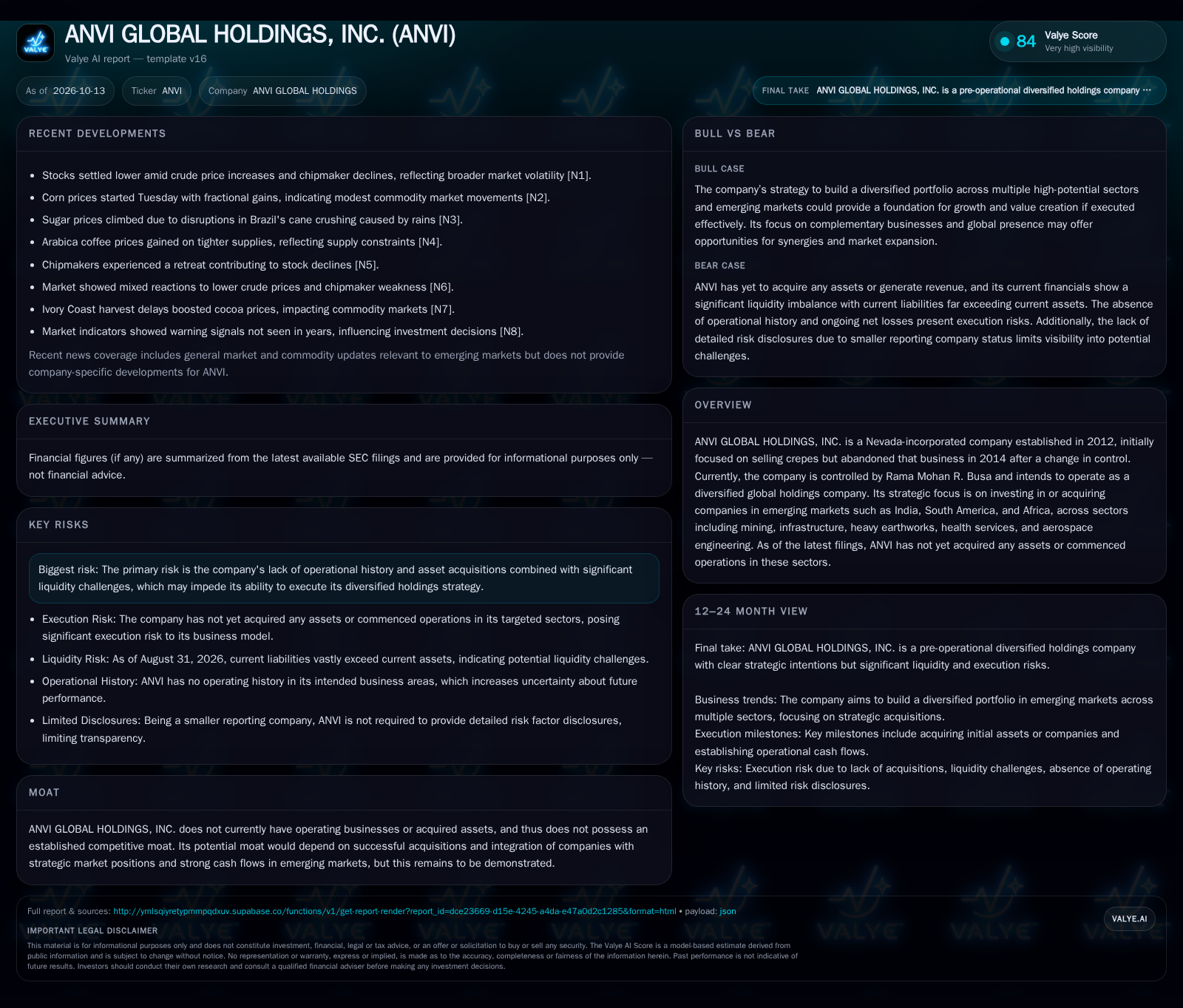
ANVI Global Holdings, Inc. has not yet acquired any assets or generated revenue, but aims to build a diversified portfolio in mining, infrastructure, health, and aerospace across emerging markets. Execution will require raising capital and closing acquisitions before existing resources are exhausted. The company’s thesis remains theoretical until it demonstrates asset acquisition and operational cash flow generation. [S2]
ANVI Global Holdings, Inc. is at a strategic crossroads: with no operating businesses or acquired assets, the company’s vision of building a diversified holdings platform in emerging markets remains aspirational. Its acute liquidity imbalance—current liabilities dwarfing assets—raises immediate questions about its ability to execute on ambitious acquisition plans. Until ANVI secures capital and demonstrates tangible progress, its future as a viable holdings company is highly uncertain.
Liquidity Deficit and Absence of Operating Assets Define Immediate Reality
As of August 31, 2026, ANVI Global Holdings holds current assets of just $4,375 against current liabilities of $2,475,981, resulting in both a current and cash ratio of zero. The company reported a quarterly net loss of $57,846 and has not generated any revenue or acquired operating assets in its stated focus areas of mining, infrastructure, health services, or aerospace engineering. The company’s cash position and lack of operations highlight a critical liquidity imbalance and underscore the urgency of raising capital or securing an acquisition to avoid further financial deterioration. [S2]
The absence of operating assets coupled with a severe liquidity deficit places ANVI in a precarious position where its strategic options are highly constrained. Without immediate capital infusion, the company risks insolvency or forced asset sales at distressed valuations. Moreover, the lack of operational scale means fixed overhead costs, while currently low, cannot be meaningfully reduced, creating a persistent cash burn. This dynamic underscores the critical importance of timing in capital raises and acquisitions; delays increase the likelihood of value erosion and diminish bargaining power with potential sellers or investors.
How the Holdings Model Could Create Value—If Capital and Deals Materialize
The classic diversified holdings model relies on acquiring controlling or significant stakes in cash-generating companies, ideally with complementary sector or geographic exposure to smooth cyclical risks and enable operational synergies. Earnings and value are built via dividend flows, asset appreciation, and strategic realignment or sale of portfolio companies. In theory, targeting high-growth sectors in emerging markets—such as mining, infrastructure, and health—could provide access to outsized returns, especially where capital markets are less efficient and valuations lower.
However, these sectors are capital-intensive, often require deep local expertise, and involve long cycle times before returns are realized. Without revenue or assets, ANVI is entirely dependent on raising external capital, likely on dilutive terms or via debt if available, to fund initial acquisitions. Once an acquisition is made, the economics will hinge on the acquired company’s cash flow profile, integration costs, and the ability to leverage operational scale. Until then, fixed costs are minimal but so are any sources of income, and the burn rate—though not high in absolute terms—quickly compounds when there is no offsetting cash inflow.
The success of a diversified holdings model in emerging markets depends heavily on the ability to navigate local regulatory environments, political risks, and currency volatility, which can materially impact asset valuations and cash flow stability. Additionally, the heterogeneity of sectors targeted—mining, infrastructure, health, aerospace—requires differentiated operational expertise and risk management approaches. If ANVI cannot build or access this expertise, integration risks and execution failures may erode anticipated synergies and returns. Furthermore, the capital-intensive nature of these sectors means that even after acquisition, significant additional investment may be required before positive cash flows materialize, extending the timeline to profitability.
Potential Positioning: No Moat Yet, and Facing Crowded, Sophisticated Fields
ANVI currently lacks any operating businesses, assets, or market share, and therefore has no established competitive moat. In the holdings company arena, competition ranges from large, established conglomerates to nimble regional investment funds and private equity players—many of whom possess deep sector knowledge, established deal networks, and ready access to financing. In mining and infrastructure, for example, global conglomerates and local champions dominate deal flow and have entrenched relationships with regulators and suppliers. Health services and aerospace are similarly competitive, with high barriers to entry, regulatory scrutiny, and the need for specialized technical expertise.
The only plausible future moat for ANVI would arise from acquiring uniquely positioned, cash-generative businesses that can be integrated to create cross-portfolio synergies, or from identifying and executing deals overlooked by larger players—both scenarios requiring capital, local insight, and operational prowess that are not currently evident.
In the absence of a competitive moat, ANVI’s ability to differentiate itself hinges on its deal sourcing capabilities and post-acquisition value creation. Given the crowded landscape, merely bidding on assets is unlikely to yield favorable terms or attractive returns. Instead, ANVI would need to leverage unique insights, proprietary networks, or operational enhancements to outcompete entrenched players. This is particularly challenging without a track record or demonstrated sector expertise. Moreover, the company’s relatively small size and lack of scale may limit its negotiating leverage and ability to absorb integration costs, potentially resulting in suboptimal acquisitions or failure to realize expected portfolio benefits.
Catalyst Chain: Rapid Capital Raise and Transformative Acquisition Launch the Platform
The most favorable scenario for ANVI would involve quickly securing a significant capital injection—via equity, debt, or a strategic partner—enabling the company to close its first acquisition in a high-growth, cash-flow positive sector. This initial deal would serve as a proof point for the business model and could unlock credibility with additional investors and acquisition targets. If ANVI demonstrates the ability to identify undervalued assets, integrate them efficiently, and generate positive cash flow, the company could begin to build a virtuous cycle of deal flow, operational leverage, and valuation uplift.
Evidence that would confirm this scenario includes the public announcement of a sizable capital raise, closing of a first acquisition with disclosed terms, and subsequent reporting of operating revenues and positive cash flow from acquired assets. If these milestones are not achieved within the next 12-18 months, the upside scenario becomes increasingly implausible.
Prolonged Pre-Operational State and Incremental Steps Toward Viability
The most plausible near-term outcome is that ANVI remains in a pre-operational holding pattern, seeking but struggling to raise sufficient capital or to secure an acquisition on attractive terms. The company may pursue incremental fundraising—such as small private placements or convertible notes—to cover ongoing administrative costs and extend its runway. Progress could be limited to non-binding memoranda of understanding or letters of intent in target sectors, with no material revenue or asset base established in the next year.
Confirmation of this scenario would come from continued reporting of minimal assets and persistent net losses, with only modest changes in the balance sheet or news of preliminary (but not closed) deal negotiations. A falsification would require evidence of a closed, substantive acquisition or a transformative capital raise.
Acute Cash Constraints Force Strategic Retreat or Restructuring
Should ANVI fail to secure capital or an initial acquisition, its acute liquidity imbalance could quickly become existential. With liabilities exceeding assets by over $2.47 million and no incoming cash flows, creditors could press for payment, and the company might be forced to reduce operations to a bare minimum or seek restructuring, creditor negotiation, or even bankruptcy protection.
Signs confirming the downside would include default notices, legal actions from creditors, or filings indicating intent to wind down, liquidate, or enter restructuring. If the company manages to extend its liabilities or secure bridge financing, this scenario might be delayed but not fundamentally averted unless a substantive change in the business trajectory occurs.
Milestones That Will Determine Whether ANVI’s Holdings Ambition Becomes Reality
Announcement of a substantial capital raise or strategic investment—terms, size, and investor profile would clarify viability.
Closing and public disclosure of the first acquisition, including sector, size, and expected cash flow contribution.
Shift in balance sheet composition—specifically, a meaningful increase in current assets or reduction in current liabilities.
First reported operating revenue and positive cash flow from acquired or invested companies.
Disclosures regarding the structure and terms of any acquisition or investment—price, financing, and integration plans.
Evidence of sector-specific expertise or local partnership arrangements in target geographies, if disclosed.
Changes in management or board composition that could signal added operational or investment expertise.
Any creditor actions, restructuring announcements, or going concern warnings that would indicate mounting financial distress.
Disclaimer: This is research-only, informational analysis and not investment advice. It may include AI-generated interpretation and general industry context. Always verify important details using primary sources.

Comments