
OKMIN RESOURCES, INC.:, Acquisition Gambit, and the Uncertainty of Commodity Exposure
OKMIN RESOURCES, INC.
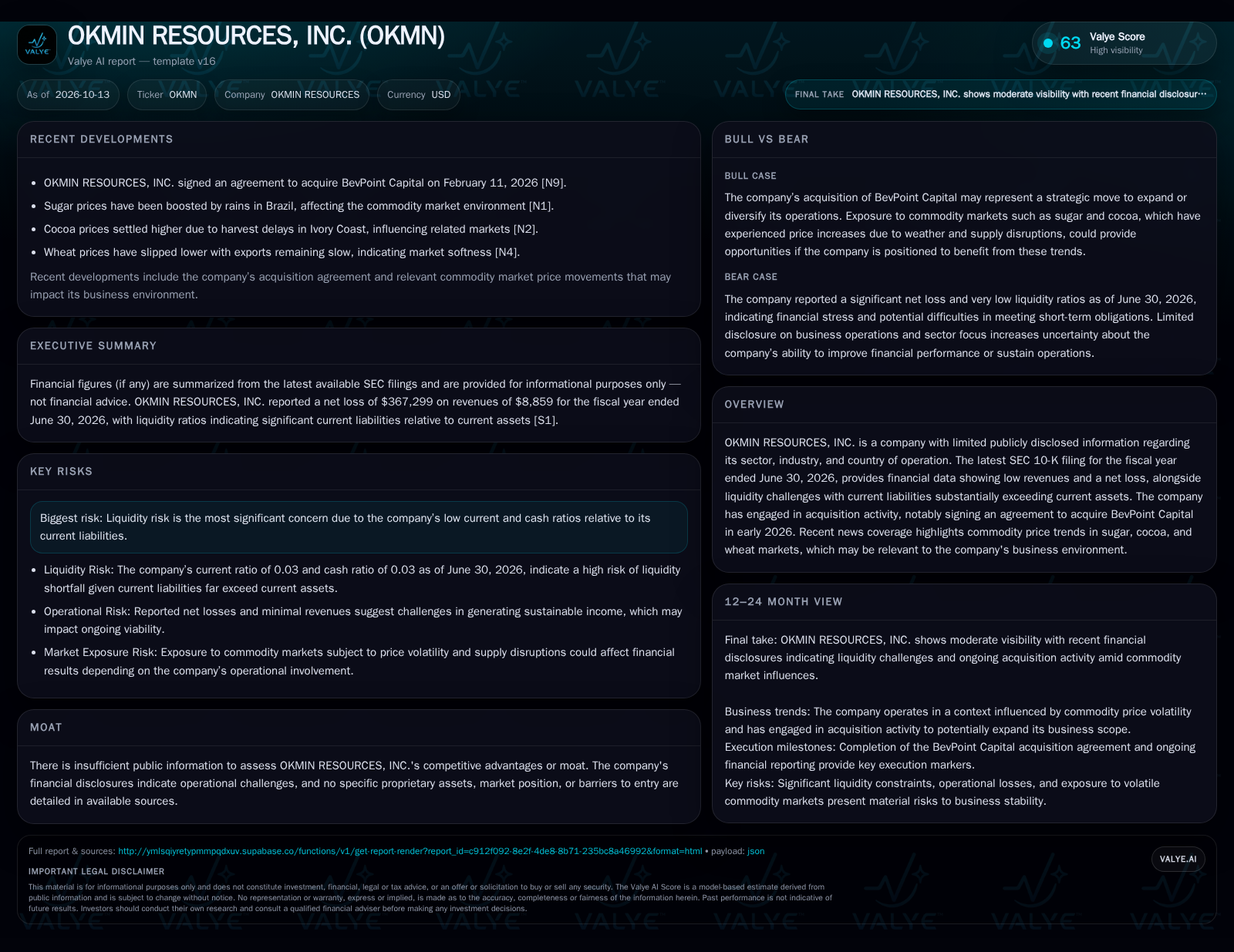
OKMIN RESOURCES, INC. reported a net loss of $367,299 on revenues of just $8,859 for the fiscal year ended June 30, 2026, with current liabilities vastly exceeding current assets and cash. In February 2026, OKMIN signed an agreement to acquire BevPoint Capital, suggesting a pivot or expansion. The company’s exposure to volatile commodity markets adds uncertainty to its outlook. Execution on the BevPoint Capital acquisition and improvement in liquidity are crucial near-term milestones. [S1]
OKMIN RESOURCES, INC. presents a portrait of financial distress, reporting minimal revenues and a significant net loss for the fiscal year ended June 30, 2026. Amid this precarious backdrop, OKMIN’s agreement to acquire BevPoint Capital in early 2026 signals a potential bid for transformation or survival. The company’s relevance to agricultural commodity markets, which have experienced recent price volatility, could introduce both upside and further risk—yet fundamental questions about its business model and operational capacity remain unanswered. [S1]
Liquidity Crisis and Strategic Acquisition Define the Immediate Landscape
The most material facts for OKMIN RESOURCES, INC. are its reported net loss of $367,299 on revenues of just $8,859 for the fiscal year ended June 30, 2026, and its acute liquidity constraints, with cash and current assets totaling only $22,243 against current liabilities of $730,676. The company reported cash and liquidity metrics for the period; these figures do not by themselves establish operating runway, investment capacity, financial flexibility, or financing capacity. In February 2026, OKMIN signed an agreement to acquire BevPoint Capital, marking a notable corporate action that may signal a shift or expansion in strategic direction. These developments collectively set the context for a company in financial distress, seeking a possible reset or diversification through acquisition, while remaining exposed to commodity market dynamics. [S1]
Beyond the immediate liquidity crisis, the strategic rationale behind OKMIN's acquisition of BevPoint Capital warrants deeper analysis. Acquisitions in distressed contexts often aim to either acquire undervalued assets or pivot into higher-growth segments. However, the success of such a maneuver depends on the target's operational health, integration feasibility, and potential synergies. If BevPoint Capital operates in a complementary commodity or service niche, it could provide OKMIN with enhanced market access or diversified revenue streams. Conversely, if the acquisition is primarily a financial engineering move without operational substance, it may exacerbate existing financial stress by adding integration costs and management distraction.
Revenue Model Unclear Amid Minimal Sales and Capital Shortfall
OKMIN’s latest financials reflect an inability to generate meaningful revenue, with just $8,859 reported for the fiscal year. If OKMIN’s future model is tied to commodity trading, production, or related services, earnings would likely hinge on price/volume dynamics and market volatility. However, without disclosure of core activities, it is equally plausible that the company acts as a holding entity or is seeking to pivot toward new business lines via acquisition. The economics of any post-acquisition model will depend heavily on BevPoint Capital’s underlying business, which remains undisclosed. In any scenario, the company’s current financial position severely limits its ability to survive adverse shocks or execute on new opportunities without urgent external funding.
The opaque revenue model complicates assessment of OKMIN's intrinsic value and growth prospects. If the company’s future depends on commodity trading, its profitability will be highly sensitive to inventory turnover rates, hedging strategies, and counterparty credit risk. Commodity trading margins can be thin and require substantial scale and risk management sophistication to be sustainable. Alternatively, if OKMIN is transitioning toward a service-oriented or value-added business via the acquisition, the economics would shift toward recurring revenue and margin stability but require investment in capabilities and client acquisition. The absence of disclosure on cost structure, gross margin, or segment contribution leaves critical gaps in evaluating operational leverage and break-even thresholds.
Competitive Standing Obscured by Lack of Disclosure and Resource Constraints
With no clear disclosure on sector, product, or customer base, OKMIN’s competitive position is indeterminate. If the company is involved in agricultural commodities, it faces formidable competition from established trading houses, processors, and financial intermediaries, all of which benefit from scale, reputation, and access to working capital. In such markets, cost efficiency, supply chain integration, and risk management capabilities are critical. Alternatively, if OKMIN seeks to reposition through the BevPoint Capital acquisition, the competitive landscape will be defined by the nature of the acquired business. In either scenario, the key disadvantage is the company’s depleted liquidity, which impairs its ability to compete for deals, procure inventory, or weather market volatility. Without proprietary assets, entrenched customer relationships, or demonstrated operational excellence, barriers to entry are low, and the risk of displacement or irrelevance is high.
From a competitive standpoint, liquidity constraints severely limit OKMIN’s ability to capitalize on market opportunities or respond to competitive pressures. In commodity markets, access to working capital is often a key determinant of negotiating power and transaction volume. Established competitors with deeper pockets can offer better payment terms, secure preferential supplier agreements, and invest in technology for price discovery and risk mitigation. Without such resources, OKMIN risks being marginalized to lower-margin or higher-risk segments. Additionally, a lack of transparency around customer concentration or supplier relationships raises concerns about revenue stability and bargaining leverage, which are vital in fragmented and volatile commodity sectors.
Turnaround Hinge: Successful Acquisition and Commodity Tailwinds
The most favorable scenario for OKMIN involves the successful completion and integration of BevPoint Capital, coupled with a business model that capitalizes on positive commodity price movements. If BevPoint brings operational assets, cash flow, or strategic relationships, it could provide a foundation for stabilizing the company’s finances. A surge in commodity prices—such as those recently observed in sugar and cocoa—could further bolster results if the combined entity is positioned to benefit from these trends. Confirmation of this scenario would require disclosure of BevPoint Capital’s business, evidence of post-acquisition revenue growth, and a marked improvement in liquidity and profitability. Falsification would occur if the acquisition fails to close, brings no incremental assets or earnings, or if commodity markets turn against the company’s interests.
Operational Stasis and Ongoing Financial Strain
The most plausible near-term outcome is that OKMIN continues to operate at a minimal revenue base, struggling with persistent net losses and severe liquidity constraints. The BevPoint Capital acquisition may proceed but fail to materially alter the company’s financial trajectory, either due to limited operational synergies or the acquired entity’s own challenges. Without a dramatic shift in business fundamentals or a significant capital infusion, the company would likely remain at risk of default, asset sales, or restructuring. Confirmation of the base scenario would be continued low sales, negative cash flow, and a lack of substantive improvement in balance sheet metrics post-acquisition. Falsification would require evidence of rapid revenue scaling, successful cost containment, or new sources of funding that materially improve near-term viability.
Liquidity Exhaustion and Escalating Solvency Risk
The most adverse outcome is a scenario in which OKMIN is unable to close the BevPoint acquisition, secure new funding, or generate meaningful revenue, leading to exhaustion of remaining cash and inability to meet liabilities as they come due. In this scenario, creditors may pursue claims, and the company could face forced liquidation or bankruptcy. This risk is amplified by exposure to commodity markets, which could deliver further downside if prices decline or supply disruptions negatively impact operations. Confirmation would be further deterioration in liquidity ratios, missed payments, or formal default events. Falsification would require evidence of a completed acquisition that brings significant assets or income, or a successful capital raise that alleviates immediate solvency concerns.
Milestones That Will Determine OKMIN’s Path Forward
Completion and public disclosure of the BevPoint Capital acquisition, including the nature of the acquired business and its financials.
Disclosure of any new capital raised, debt restructuring, or other measures to address the acute shortfall in liquidity.
Quarterly revenue and cash flow trends post-acquisition (if disclosed), to assess whether the underlying business is improving.
Updates on exposure to and impact from commodity price movements—sugar, cocoa, wheat, or other relevant markets.
Any mention of customer contracts, backlog, or recurring revenue sources that would indicate improved revenue visibility (if disclosed).
Board or management commentary on strategic priorities, risk management, or turnaround plans.
Disclaimer: This is research-only, informational analysis and not investment advice. It may include AI-generated interpretation and general industry context. Always verify important details using primary sources.

Comments