
ESG Inc.: Liquidity Crunch, Operating Losses, and the Commodity Price Crossroads
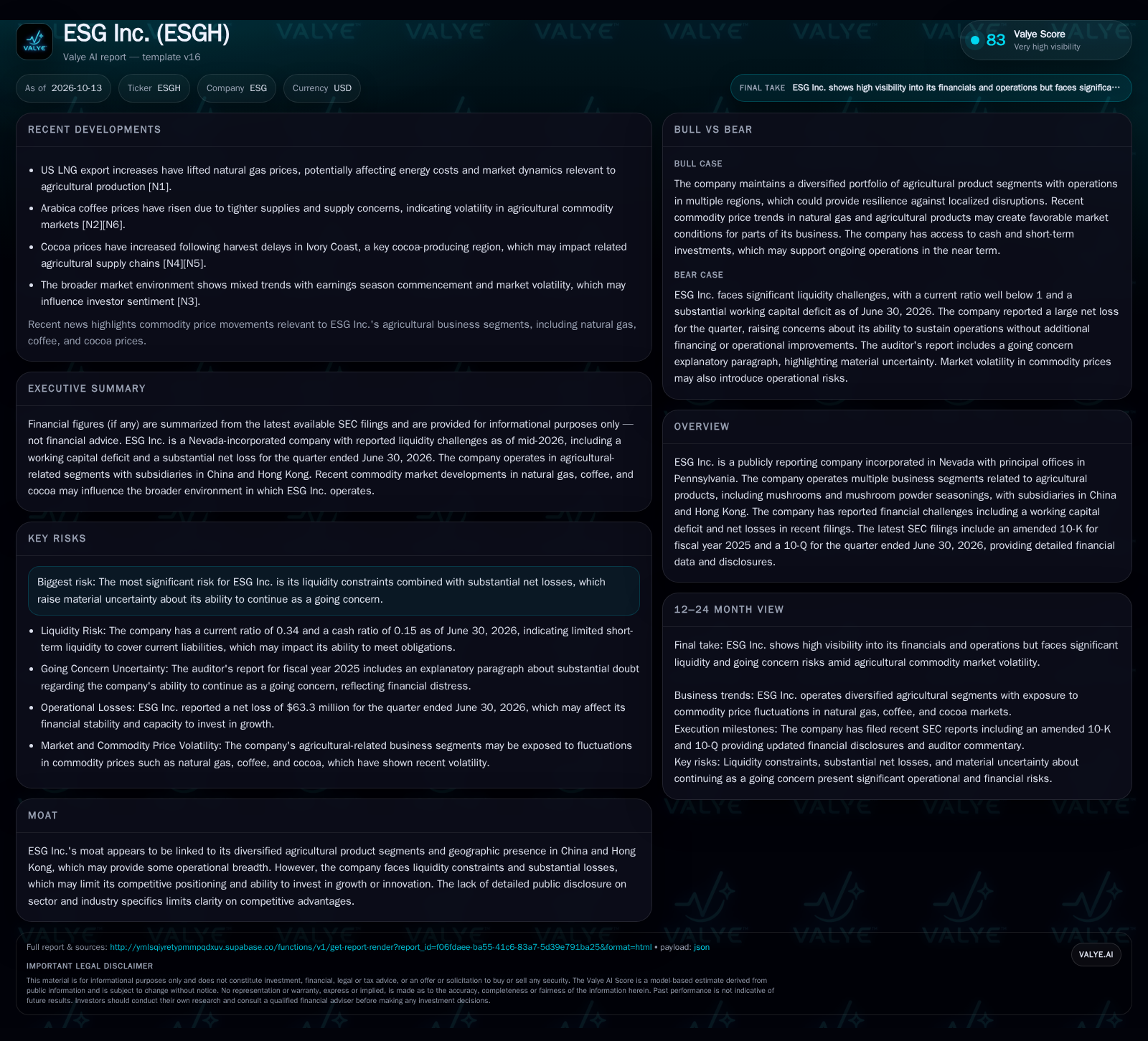
ESG Inc. operates a multi-segment agricultural business spanning China and Hong Kong, but faces acute liquidity shortfalls and sustained net losses. With a going concern warning and exposure to volatile commodity markets, the company’s future hinges on its ability to restructure, secure new capital, or rapidly improve operational economics.
An auditor’s going concern warning underscores material uncertainty, while commodity price volatility may amplify operational risks or opportunities depending on market direction [S1] [S2].
ESG Inc. straddles the agricultural supply chain with operations in China and Hong Kong, focusing on mushrooms and mushroom-derived products. Despite its geographic and product diversity, the company’s fundamentals are under severe pressure. With a working capital deficit, large net losses, and an auditor-flagged going concern risk, ESG’s ability to continue as an independent entity is in doubt. The company’s fate now depends on its capacity to stabilize operations, capitalize on commodity price movements, or secure outside funding in a volatile environment [S1] [S2].
Acute Liquidity and Operating Losses Define Current Reality
As of June 30, 2026, ESG Inc. reported cash and cash equivalents of $42.98 million and current assets of $190.7 million, set against current liabilities of $564.9 million, producing a current ratio of just 0.34 and a cash ratio of 0.15 [S2]. The company reported cash and liquidity metrics for the period; these figures do not by themselves establish operating runway, investment capacity, financial flexibility, or financing capacity. The reported net loss of $63.3 million for the quarter reflects ongoing operational inefficiency or revenue shortfall, which compounds the liquidity challenge [S2].
The presence of an auditor’s explanatory paragraph regarding substantial doubt about ESG’s ability to continue as a going concern further underscores the gravity of the situation [S1]. These facts collectively place the company's survival and strategic flexibility in question, making near-term financing or operational restructuring critical to avoid insolvency.
Agricultural Product Margins, Cash Burn, and the Search for Scale
ESG Inc.’s core business revolves around agricultural products, specifically mushrooms and mushroom powder seasonings, which are typically characterized by moderate gross margins and significant sensitivity to input costs and commodity price volatility. The company’s segment structure—spanning subsidiaries in China and Hong Kong—suggests a mix of upstream production and downstream processing or distribution. However, absent explicit disclosure of unit economics, it is plausible that fixed costs (facilities, labor, logistics) are high relative to the low-margin nature of bulk agricultural products.
With quarterly revenue of just $918,000 and a net loss exceeding $63 million, the company is burning cash at an unsustainable rate [S2]. This suggests either significant overhead, underutilized capacity, or ongoing restructuring costs. Unless ESG can quickly scale revenues, improve gross margin mix (such as by shifting toward higher-value processed products), or aggressively cut costs, the existing capital base is likely insufficient to achieve breakeven.
Given the working capital deficit, ESG may struggle to access supplier credit or negotiate favorable terms, further eroding margin and increasing reliance on external financing. The company’s ability to restructure or pivot to higher-margin segments may be constrained by reported liquidity position and competitive pressure from larger, better-capitalized agricultural players.
Diversification Offers Breadth, But Competitive Edge Remains Unproven
ESG Inc.'s operations across China and Hong Kong provide some geographic and product diversification, which can help buffer localized shocks such as crop failures, regulatory changes, or supply chain disruptions. However, the agricultural sector is intensely competitive, with commodity producers and processors often competing on scale, cost structure, and logistics efficiency rather than product differentiation.
While mushrooms and specialty seasonings may offer niche opportunities, barriers to entry are generally low, and price competition can be fierce in both domestic and export markets. Without evidence of proprietary technology, exclusive supply contracts, or a recognized brand, ESG’s competitive position may be vulnerable. Larger agribusinesses and integrated food processors could outcompete ESG on cost and distribution, while emerging substitutes (such as plant-based protein alternatives) may further pressure demand for traditional agricultural products.
The company’s ability to capture value may depend on vertical integration, branding, or successful movement up the value chain—none of which are clearly established in current disclosures.
Turnaround Hinges on Margin Expansion and Commodity Tailwinds
A favorable outcome for ESG Inc. would require a combination of external and internal catalysts: stabilization or decline in key input costs, successful renegotiation of supplier and customer terms, and a sharp improvement in operating leverage through higher-margin product mix or volume growth. If commodity price trends (e.g., rising prices for mushrooms or related agricultural inputs) swing in ESG’s favor, the company could see improved gross margins without corresponding increases in costs.
Operationally, a rapid cost restructuring—such as shuttering underperforming segments or automating production—could stem cash burn. Access to new equity or debt capital would buy time for restructuring or investment in higher-value offerings. Evidence that would confirm this scenario includes a significant sequential reduction in net losses, stabilization or improvement in the current ratio, and revenue growth outpacing cost increases over multiple quarters.
If ESG announces new customer contracts, strategic partnerships, or asset sales that materially improve liquidity, it would further support the plausibility of a turnaround. Conversely, continued negative cash flow and deteriorating liquidity would falsify this scenario.
Prolonged Restructuring, Uncertain Survival, and the Search for a Lifeline
The most plausible trajectory for ESG Inc. is a period of ongoing financial distress marked by efforts to restructure operations, cut costs, and seek new funding. Given the magnitude of the working capital deficit and recurring net losses, the company may be forced to sell non-core assets, renegotiate debt, or pursue dilutive equity raises. Margins are likely to remain thin absent a major shift in product mix or market conditions.
ESG’s survival over the next 12–24 months will likely depend on its ability to slow cash burn while searching for strategic alternatives—such as joint ventures, partial divestitures, or acquisition by a better-capitalized peer. Confirming evidence would include stabilization of quarterly losses, improved liquidity metrics, and announcements of new funding or major restructuring plans. If losses deepen and liquidity worsens, the risk of insolvency or forced liquidation increases.
Liquidity Exhaustion Could Drive Forced Asset Sales or Insolvency
In the adverse scenario, ESG Inc. fails to secure additional financing or meaningfully reduce its cash burn, leading to an acceleration of liquidity exhaustion. Suppliers may tighten terms or demand cash in advance, exacerbating working capital strain, while customers may hesitate to enter into longer-term agreements with a financially distressed partner.
As cash reserves dwindle, ESG may be compelled to sell core assets at distressed valuations, exit key markets, or seek bankruptcy protection. If commodity prices move against the company—raising input costs or depressing end-product prices—margin compression could accelerate losses. Evidence confirming this scenario would include a further decline in the current ratio, missed payments or covenant breaches (if disclosed), and a lack of progress on restructuring or capital raising initiatives.
Should the company announce asset sales, layoffs, or restructuring charges without a clear path to profitability, it would further signal distress. The ultimate risk is that ESG ceases to operate as a going concern, resulting in little or no recovery for equity holders.
Milestones That Will Determine ESG Inc.'s Fate in the Next 12–24 Months
Net loss and cash flow from operations trends—sequential narrowing of losses or positive operating cash flow would signal operational turnaround.
Announcements of new financing (debt or equity) or successful asset sales that materially improve the liquidity position.
Disclosure of major restructuring plans, cost-reduction programs, or divestitures that could lower the fixed-cost base.
Revenue growth or margin expansion in core agricultural product segments—if disclosed, this would indicate improving business economics.
Any new customer contracts, strategic partnerships, or geographic expansions that could aid revenue diversification and reduce concentration risk.
Commodity price movements for mushrooms, agricultural inputs, and relevant energy costs, as these could materially affect segment profitability.
Auditor’s commentary in future filings—removal or persistence of the going concern warning will be a key signal of financial health.
Disclaimer: This is research-only, informational analysis and not investment advice. It may include AI-generated interpretation and general industry context. Always verify important details using primary sources.

Comments