
Visium Technologies: Proprietary AI Platforms Meet Severe Financial Headwinds in the Quest for Commercialization
Despite building a portfolio of AI-driven cybersecurity and analytics solutions, Visium Technologies remains pre-revenue, highly illiquid, and dependent on affiliate funding. Its future hinges on converting technical assets into paying customers before financial constraints force strategic choices.
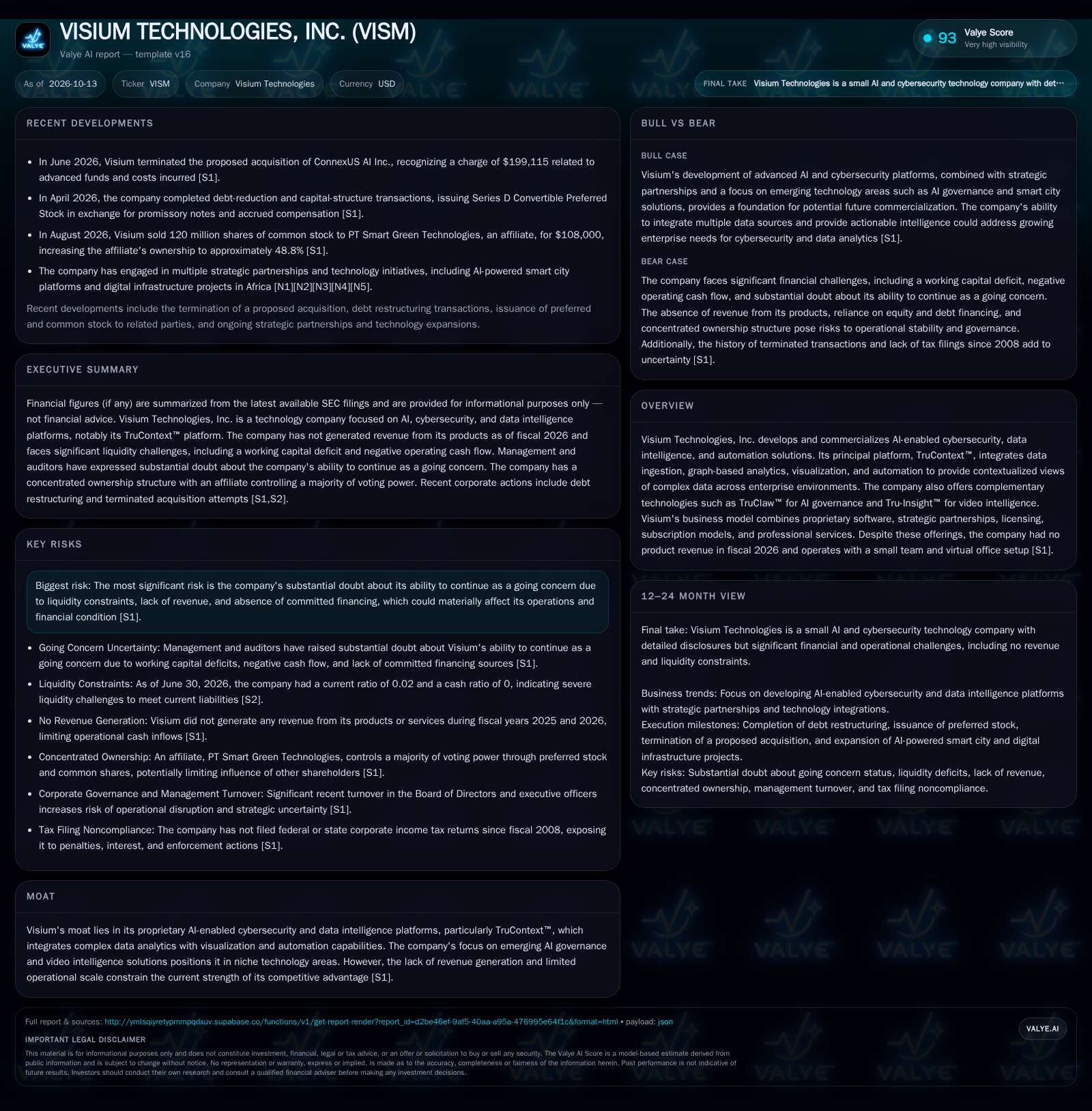
Visium Technologies has developed proprietary AI-enabled cybersecurity and analytics platforms but has not generated any product revenue as of fiscal 2026. The company’s business model depends on commercializing its software platforms and services, but execution risk is acute given its financial state and history of unconsummated transactions. Affiliate control and governance issues further complicate the outlook. Success now depends on rapid conversion of technical assets into revenue-generating contracts before financial strain necessitates drastic restructuring or asset sales. [S1] [S2]
Recent debt restructuring and affiliate share sales have bought time, yet the company’s tiny operational footprint, unresolved tax filings, and history of unclosed deals highlight the acute execution risk. The next chapter will be defined not by technical vision, but by the company’s ability to rapidly commercialize its assets or secure a lifeline before financial pressures force drastic restructuring.
Zero Revenue, Extreme Cash Deficit, and Affiliate Control Define the Current State
As of June 30, 2026, Visium Technologies had not generated any revenue from its principal software platforms—including TruContext™, TruClaw™, Tru-Insight™, or ELI™. The company reported only $8,247 in cash and equivalents, against current liabilities of $1.98 million, yielding a current ratio of 0.02 and a cash ratio of 0, which together signal acute liquidity distress [S1] [S2]. The company’s net income of $856,102 for the year was driven exclusively by a non-cash gain on debt extinguishment, not by operational performance. PT Smart Green Technologies, an affiliate, now holds nearly 49% of the common stock and controls a majority of voting power through preferred shares, centralizing decision-making. Management and auditors have formally raised substantial doubt about the company’s ability to continue as a going concern due to persistent working capital deficits, negative cash flow, tax noncompliance, and reliance on uncommitted external funding [S1] [S2].
How Visium Could Make Money: Platform Licensing, Subscriptions, and Services—If Commercialization Occurs
Visium’s intended business model centers on proprietary AI-enabled platforms for cybersecurity, data intelligence, and automation—primarily TruContext™. The company aims for a mix of software licensing, recurring SaaS-style subscriptions, professional services, and strategic integrations. If successful, such a model could yield high gross margins typical of software, with incremental costs largely tied to cloud infrastructure, customer support, and ongoing R&D.
However, with no revenue to date, the company has yet to test its pricing power, customer acquisition costs, or the stickiness of its platform. The small team (two full-time employees) and virtual office setup keep fixed operating costs low, but the lack of scale precludes operating leverage. Capital needs remain acute: negative cash flow and a $1.95 million working capital deficit mean that any ramp in commercialization would require upfront investment in sales, support, and possibly cloud infrastructure. Without outside funding or rapid customer wins, Visium’s financial structure is not currently viable for sustained standalone operations [S1] [S2].
A critical factor in Visium's potential monetization lies in the scalability of its AI platforms. Given the capital-intensive nature of building and maintaining sophisticated AI cybersecurity solutions, the company must achieve a delicate balance between investing in ongoing R&D and managing operational expenses. Should Visium secure initial customers, the marginal cost of onboarding additional clients could decline significantly, leveraging cloud infrastructure efficiencies and automation. However, this scaling advantage is contingent on the platforms' ability to integrate seamlessly with diverse enterprise IT environments and demonstrate measurable improvements in security outcomes, which are prerequisites for justifying subscription fees and service contracts.
Another important consideration is the competitive pricing environment in AI-driven cybersecurity and analytics. Enterprises often demand flexible pricing models, including usage-based fees or tiered subscriptions, which could pressure Visium to refine its revenue streams. Moreover, the sales cycle in this sector tends to be lengthy and complex, involving multiple stakeholders and compliance assessments. Without a seasoned sales force or established channel partnerships, Visium faces heightened challenges in converting technical capabilities into recurring revenue. Success would require not only technical validation but also robust customer engagement strategies and clear demonstration of return on investment.
Positioned in Crowded AI Cybersecurity, but Lacks Scale, Revenue, and Market Proof
Visium targets high-growth but highly competitive segments: AI-driven cybersecurity, data intelligence, and automation. The TruContext™ platform’s ability to ingest, analyze, and visualize complex data is directionally aligned with enterprise demand for advanced threat detection, forensic analysis, and AI governance. However, the company faces entrenched competition from well-capitalized cybersecurity vendors, established analytics platforms, and emerging AI-native startups.
Without commercial traction, Visium’s platform differentiation—integrated graph analytics, AI-driven automation, and data fusion—remains theoretical. The company’s small scale, lack of customer references, and limited resources for go-to-market initiatives are significant disadvantages. Switching costs in enterprise cybersecurity can be high if a platform is deeply embedded, but absent deployments, Visium cannot yet claim meaningful customer lock-in, pricing power, or network effects. Its governance and AI safety focus (TruClaw™) may offer an entry point into emerging compliance-driven niches, but execution risk remains high.
Rapid Monetization of AI Platforms Could Unlock Operational Breathing Room
A favorable outcome would see Visium converting its R&D investment into signed contracts for TruContext™ or related platforms—potentially through pilot projects with enterprise or government customers, or via white-label partnerships with larger integrators. Initial wins could validate the platform, generate reference accounts, and enable the company to raise additional funding on better terms.
Confirmation would come from: (1) public disclosure of customer contracts or paid pilots; (2) recognized product revenue; (3) evidence of recurring SaaS billings or licensing income; and (4) partnership announcements with meaningful commercial terms. Falsification would be continued absence of revenue, staff attrition, or asset sales under distress. If the company demonstrates even modest commercial traction, its high-margin software model could quickly improve the cash profile and make it a more attractive acquisition target or partner.
Ongoing Financial Strain Forces Tactical Choices Absent Revenue Breakthrough
The most plausible near-term outcome is continued financial stress. Without near-term revenue, Visium will likely be forced to pursue further dilutive equity sales, asset divestitures, or strategic alternatives such as a merger or sale of intellectual property. Affiliate support may provide interim funding, but the lack of external capital and unresolved tax compliance issues constrain options.
Base-case confirmation would include ongoing cash burn, further working capital deficits, and continued pre-revenue status. Falsification of this scenario would require clear evidence of revenue generation, new customer wins, or non-dilutive funding. If no commercial inflection point is reached, the company may face delisting, creditor negotiations, or asset liquidation.
Liquidity Exhaustion Triggers Forced Restructuring or Asset Fire Sale
If Visium fails to secure revenue or external funding in the near term, its liquidity position may deteriorate to the point of technical insolvency. In this scenario, the company could be forced into bankruptcy, a distressed asset sale, or involuntary dissolution. The absence of tax compliance since 2008 could accelerate enforcement actions, compounding the risk.
Evidence for this scenario would include: (1) missed payroll or vendor payments; (2) legal actions from creditors or tax authorities; (3) resignation of remaining staff or directors; and (4) public disclosure of bankruptcy or receivership proceedings. The value of Visium’s platforms in a liquidation would likely be a fraction of invested R&D, realized only if a buyer emerges for the underlying technology or IP.
Milestones That Will Determine Whether Visium’s Technology Translates to Survival
Any public disclosure of paid customer contracts, pilots, or licensing deals for TruContext™ or related platforms would be the clearest signal of commercialization progress.
Quarterly product revenue—if disclosed—would help test whether the company is moving beyond pre-revenue status.
Updates on affiliate funding, bridge loans, or equity infusions will indicate the company’s near-term ability to meet obligations and sustain operations.
Resolution or public update on multi-year tax noncompliance would clarify the risk of enforcement actions and penalties.
Changes in board composition, executive turnover, or new strategic partnerships could signal a shift in operational direction or pending transactions.
Disclosure of any asset sales, IP licensing, or M&A activity would signal either strategic progress or distressed restructuring.
Evidence of customer adoption, such as published case studies or reference deployments, would validate product-market fit and help support future funding or sales.
Meaningful new product launches or integration announcements with established technology partners could broaden the addressable market and accelerate adoption.
Disclaimer: This is research-only, informational analysis and not investment advice. It may include AI-generated interpretation and general industry context. Always verify important details using primary sources.

Comments