
Aehr Test Systems Accelerates on AI Semiconductor Demand Despite Customer Concentration Risks
Advanced test and burn-in equipment provider Aehr Test Systems reports strong backlog growth driven by AI market expansion, while facing operational risks from customer concentration and supply chain.
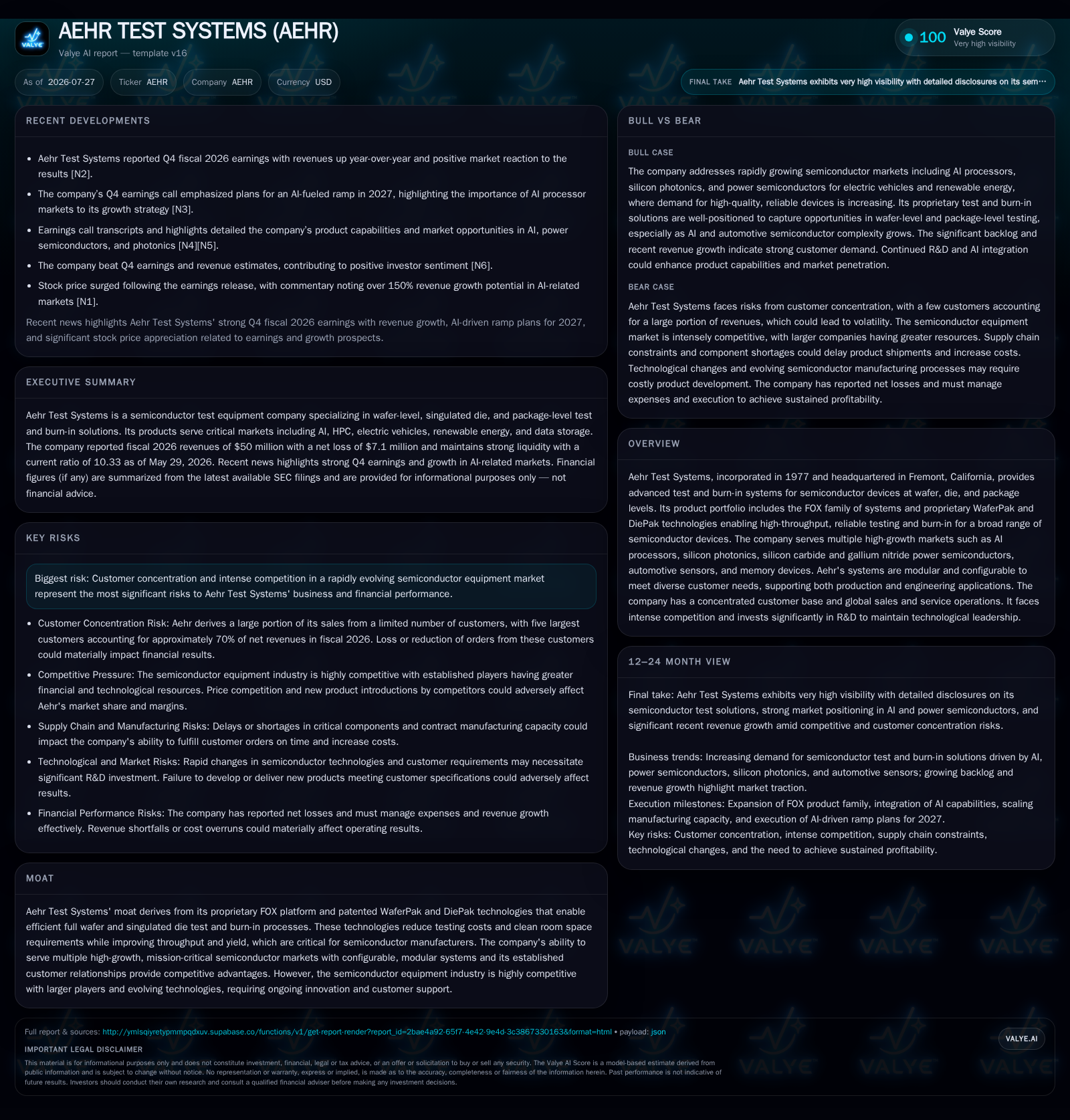
Aehr Test Systems, a Fremont-based semiconductor test and burn-in equipment provider, reported a dramatic increase in its backlog to $80.6 million at fiscal 2026 year-end, up from $15.2 million the prior year, fueled by surging demand for test solutions in AI and high-performance computing segments. The company’s proprietary FOX platform and wafer-level burn-in technologies uniquely position it to serve expanding markets including silicon carbide, GaN power devices, automotive sensors, and advanced memory semiconductors. However, a highly concentrated customer base—five customers accounted for nearly 70% of sales—poses a material risk amid the cyclical and complex nature of capital equipment sales. Aehr continues to invest heavily in R&D and expand manufacturing capacity to support growth but must manage supply chain headwinds and order timing uncertainty inherent in high-value system sales.
Recent Operating Update Highlights
In its Q4 fiscal 2026 filing ending May 29, 2026, Aehr Test Systems disclosed an exceptional increase in its order backlog to $80.6 million compared with only $15.2 million one year prior [S4][S6]. This backlog represents confirmed purchase orders scheduled for shipment within the subsequent 12 months, underscoring strong near-term demand. The jump primarily reflects accelerated orders from semiconductor manufacturers producing AI processors and related high-performance computing (HPC) devices [S1]. Management highlighted that growing AI workloads have rapidly increased the need for reliability screening at both wafer- and package-level testing stages due to the complexity and die-to-die interdependency unique to these advanced chips [S1]. A large portion of the backlog comes from relatively small-volume but high-dollar-value system orders typical in this capital equipment sector [S7][S8].
Business Model: High-Value Capital Equipment With Embedded Technology Differentiation
Aehr operates principally as a developer and manufacturer of advanced test systems used by semiconductor wafer fabs, contract test labs, and device manufacturers during production validation phases. The company's revenue is principally derived from selling capital equipment—its FOX family—that performs wafer-level contact testing combined with burn-in processes designed to stress devices under thermal cycling to identify early-life failures [S25]. This hardware-centric model is augmented by service contracts including installation, repair support, application engineering assistance, spare parts provision, and customer training worldwide [S5].
The FOX systems leverage proprietary WaferPak aligners/contactors enabling full-wafer simultaneous testing up to 300mm wafers which increase throughput versus sequential die testing methods [S25]. Complementary Fox DiePak carriers allow singulated die or modules of up to 1,024 devices per DiePak to be tested in parallel on the FOX-NP or FOX-XP systems [S25]. The recent addition of high-power FOX-XP systems combined with acquired Sonoma package-level burn-in technology offers an expanded capability set covering both wafer-level testing/burn-in plus post-packaging reliability screening vital for AI accelerators and GPUs [S25].
Revenue recognition depends on satisfying customer specifications—especially for non-standard products—and timing can be volatile since purchase orders often allow cancellation or rescheduling without penalty [S7][S8]. Thus quarterly results can fluctuate materially based on shipment timing.
Industry Structure and Competitive Position
The semiconductor test and burn-in equipment segment is dominated by companies selling highly configurable capital equipment tailored to evolving semiconductor device architectures. Key competitors include industry leaders like Teradyne and Advantest who provide broad test solutions integrated across multiple manufacturing stages. Aehr differentiates itself through patented FOX WaferPak contactor technology that reduces cleanroom space requirements while improving throughput and yield enhancement via full-wafer simultaneous testing capabilities—a critical efficiency gain when testing costly multi-die wafers such as those used in silicon carbide power semiconductors or stacked DRAM through-silicon vias (TSVs).
The company’s modular platforms enable customers to configure features according to specific device types ranging from photonics for AI applications to automotive sensor ICs requiring high reliability standards [S25]. This flexibility is important as semiconductor manufacturers adopt new materials (e.g., gallium nitride) and increasingly integrate complex sensors into mobile devices or E-mobility systems [S25]. Nevertheless, Aehr operates in an intensely competitive environment where competitors may offer lower-cost alternatives or newer technical capabilities requiring sustained R&D investment just to maintain parity [S10].
Growth Drivers
Multiple structural drivers underpin Aehr's growth trajectory:
- AI and HPC Semiconductor Expansion: The surge in AI workload volumes mandates greater test coverage given complex die stacks with interconnected memory requiring comprehensive wafer-level reliability verification [S1][S20].
- Emergence of New Semiconductor Materials: Growth in silicon carbide (SiC) and gallium nitride (GaN) power semiconductors entails specialized high-power burn-in capabilities that Aehr targets with its FOX-XP platform coupled with Sonoma package test systems [S25].
- Automotive Sensor Proliferation: Increasing embedding of optical sensors (LIDAR/RADAR) in vehicles for ADAS functions drives demand for mission-critical IC qualification which requires batch burn-in screening at volume production scale [S20].
- Rising Use of Wafer-Level Burn-In: To reduce latent failures in stacked DRAM or other multi-chip modules common in AI servers, cost-effective full-wafer burn-in improves yield economics significantly compared with sequential die testing approaches.
- Modular Configurability: Customer demand for adaptable platforms capable of serving various device types alongside automation enhancements allows penetration into broader customer verticals including memory producers and contract assembly-test providers.
Risks / Watchpoints
Aehr faces notable risks centered around customer concentration—its top five customers accounted for approximately 70% of net sales in fiscal 2026—with three alone representing more than half the revenue base [S7][S8]. This concentration amplifies exposure to any downturns or strategic shifts by these major purchasers.
Furthermore, the semiconductor capital equipment purchasing cycle is characterized by long lead times combined with possible cancellations or rescheduling at short notice without penalty. Given that each system sale can represent millions in revenue but comes irregularly in timing, reported backlogs are not always reliable predictors for net revenue realization if delays or order modifications occur [S8][S7]
Supply chain constraints remain relevant: reliance on global suppliers exposes Aehr to risks from geopolitical trade frictions or component shortages that could hamper delivery schedules or increase input costs compromising competitiveness [S24][S23]. Although management has engaged with key subcontractors extensively—including qualifying direct shipments of Sonoma systems recently—ongoing global economic uncertainties around tariffs pose potential margin pressure scenarios.
Competitive pressure also constitutes a watchpoint. Larger rivals with greater scale may introduce new products capturing market share if Aehr cannot keep pace technologically or cost-wise;there is observed pricing competition particularly on less advanced products impacting margins [S10]
Finally, field failure rates of installed systems or delays meeting exacting customer qualification specs can lead to deferred revenue recognition or costly warranty claims that negatively affect operating profit metrics.
What To Watch Next
Key execution milestones include the ability to convert the elevated backlog into shipped revenue while maintaining high on-time delivery rates amidst supply chain challenges [N1][N3]. Monitoring accelerated adoption trends of the FOX-XP high-power systems aligned with AI/HPC processor segments will be important.
Additionally, tracking the diversification of the customer base away from concentration risk will signal durability against demand fluctuations. Product innovation pace measured by new product introductions or automation upgrades will also indicate competitive positioning.[S6]
Investor focus should include quarterly reports noting shipment scheduling dynamics near quarter ends given historical volatility patterns,[S8] plus updates on supplier stability amid macroeconomic trade policy shifts.[S24]
Financial Profile Discussion
Aehr maintains a strong liquidity position with cash and equivalents exceeding $116 million as of May 29, 2026, supported by minimal current liabilities of approximately $18 million, resulting in a robust current ratio above 10x [F1]. The company reports zero debt outstanding, reflecting a conservatively funded balance sheet that provides financial flexibility for continued manufacturing capacity scale-up and sustained technology development critical in this fast-evolving industry segment [F1][S10].
Despite operating losses related to ongoing R&D investments targeting next-generation semiconductor applications, Aehr's substantial cash reserves buffer execution risks related to supply chain disruptions or order timing variability common within capital equipment sales models [S6]
This analysis is grounded solely on publicly available filings as cited without extrapolation beyond disclosed facts; it does not constitute investment advice but rather a focused industry positioning review rooted in documented evidence.
Disclaimer: This is research-only, informational analysis and not investment advice. It may include AI-generated interpretation and general industry context. Always verify important details using primary sources.

Comments