
Axe Compute’s Dual Strategy: GPU Infrastructure Meets Digital Asset Treasury—Potential and Tensions in Capital-Intensive AI Compute
Axe Compute Inc. is rapidly transforming from an asset-light AI compute platform to a capital-intensive owner-operator of GPU clusters, while uniquely tying its business model to the Aethir network’s ATH token. This hybrid strategy opens new revenue streams and risks, as the company balances infrastructure scale, customer concentration, digital asset exposure, and uncertain regulatory and technology cycles.
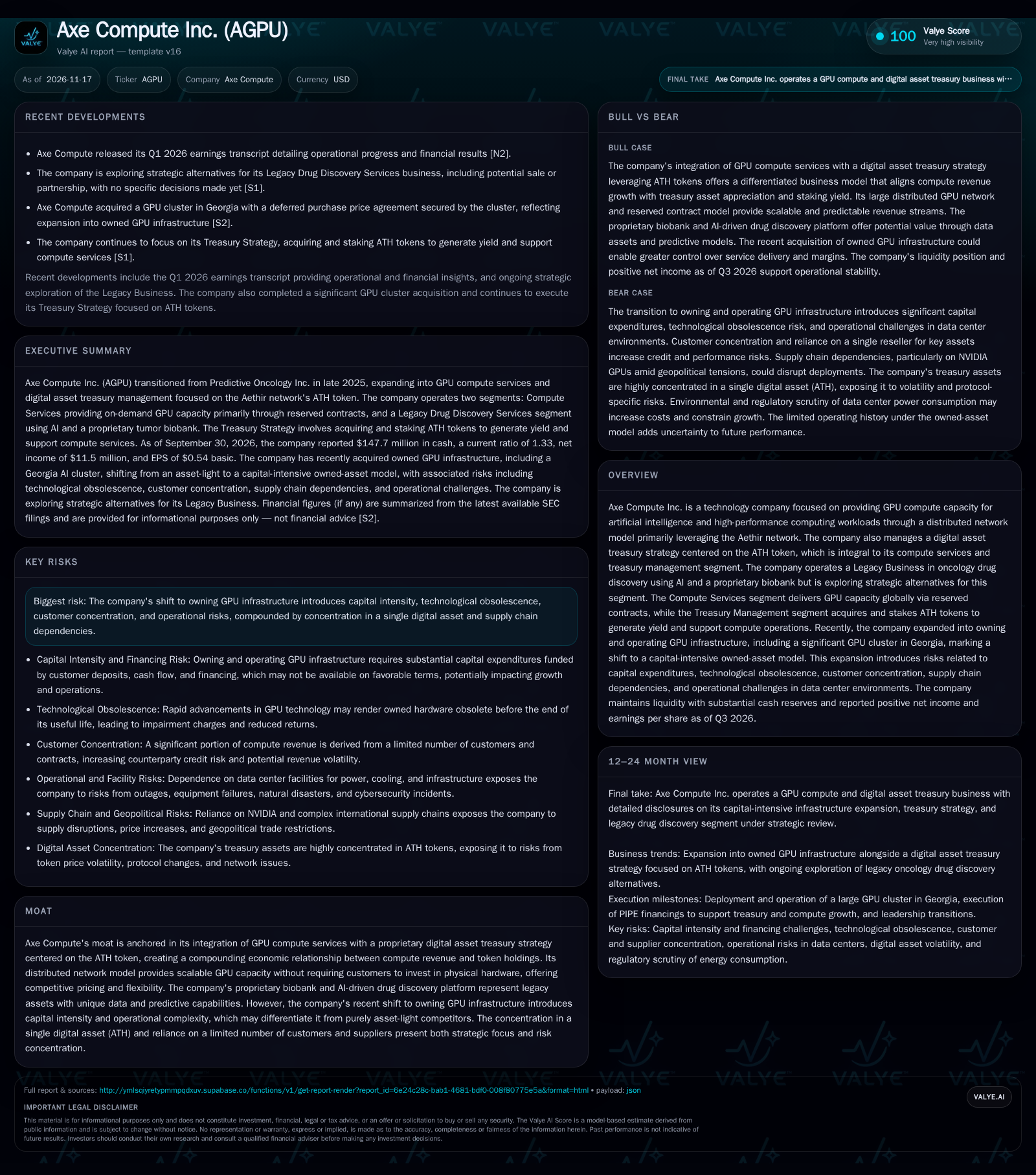
Axe Compute is navigating a high-stakes pivot from providing distributed GPU compute services via the Aethir network to owning physical GPU infrastructure, financed through PIPE deals and underpinned by a digital asset treasury based on ATH tokens. The next phase will test whether Axe can sustainably scale its hybrid compute-and-token model amid evolving technology, customer, and regulatory challenges. [S1] [S2]
Axe Compute Inc. stands at the intersection of two volatile but high-potential frontiers: AI-driven GPU infrastructure and digital asset treasury management. Having rebranded from Predictive Oncology and aggressively expanded into owning physical GPU clusters, Axe Compute is now a dual-strategy business—offering on-demand, contract-based GPU capacity while holding and staking billions in ATH tokens on the Aethir network. This unique structure could align compute revenue growth with digital asset appreciation, but it also exposes the company to intensified capital requirements, technology risk, customer concentration, and the unpredictable dynamics of digital assets. The coming quarters will reveal whether Axe Compute’s hybrid approach can deliver durable returns—or if the inherent risks will outweigh the rewards.
Recent Expansion into GPU Ownership Reshapes Axe Compute’s Risk and Return Profile
Axe Compute Inc. has recently transitioned from an asset-light, distributed GPU compute service model to an owner-operator of physical GPU infrastructure. The acquisition of a GPU cluster in Georgia under a deferred purchase price agreement marks a significant step into capital-intensive operations, with the asset subject to monthly installment payments and refinancing needs. The company’s financial results for Q3 2026 reflect positive net income of $11.5 million and basic EPS of $0.54, but assets remain highly concentrated in ATH tokens, valued at $54.6 million at year-end 2025. Revenue from Compute Services is largely driven by reserved GPU contracts, but is concentrated among a limited number of customers, with the Georgia cluster’s revenue dependent on a single reseller. [S1] [S2]
How Axe Compute’s Hybrid Model Could Scale—And Where the Economics May Break
Axe Compute’s business model now marries two distinct economic engines: contract-based GPU compute revenue and digital asset yield from ATH token staking. Compute Services revenue is primarily generated through prepaid, reserved GPU capacity contracts (12–36 months), providing a degree of revenue visibility and the potential for high utilization rates. Pricing is positioned to be competitive with hyperscale cloud providers, which could drive volume but may also compress margins if capital and operational costs outpace price realization.
The shift to owning and operating hardware introduces high fixed costs and capital expenditure requirements. Unlike the asset-light, network-leveraged model, ownership means Axe must manage the full lifecycle of GPU assets—acquisition, deployment, maintenance, and eventual obsolescence or impairment. The economics here are highly sensitive to utilization rates: underutilized hardware directly erodes returns, while over-optimistic useful life estimates risk costly write-downs. Customer deposits and contract prepayments partially offset capital needs, but the company remains exposed to financing risk if upfront demand falters.
The Treasury Management segment is a novel feature—staking ATH tokens to earn yield and support compute operations. This creates a compounding effect if token value appreciates and staking yields persist, potentially subsidizing compute costs and enhancing returns. However, this structure also introduces volatility, as both operational funding and balance sheet strength become correlated with ATH market and protocol dynamics. Should ATH decline or the staking mechanism change, Axe’s treasury and compute economics could be impaired.
Overall, the model’s success relies on maintaining high GPU utilization, securing favorable contract terms, managing the pace of hardware reinvestment, and realizing consistent staking yield from ATH tokens. Capital intensity, digital asset volatility, and contract concentration represent the primary economic friction points.
Competitive Pressures: Scale, Supply Chains, and the Limits of Differentiation
Axe Compute operates in a fiercely competitive and rapidly evolving AI infrastructure market, facing direct and indirect competition from hyperscale cloud providers, specialized GPU infrastructure startups, and decentralized compute networks. The company’s asset-light origins offered flexibility and rapid scaling, but the move to owned infrastructure places it in direct competition with large, capital-rich incumbents capable of leveraging economies of scale, global data center footprints, and deep supplier relationships.
Axe’s differentiation lies in its integration with the Aethir network and use of the ATH token, which may appeal to customers seeking decentralized, on-demand access and financial participation in tokenized compute ecosystems. However, this advantage may be offset by customer hesitancy around digital asset exposure, regulatory uncertainty, and the lack of a proven track record under this hybrid model.
Supply chain dependency—especially on NVIDIA for GPU hardware—remains a structural vulnerability. Geopolitical tensions and supplier prioritization can delay deployments or inflate input costs, while regulatory scrutiny over data center energy use may limit expansion or require costly compliance investments. Customer concentration further weakens Axe’s bargaining power relative to larger peers with more diversified revenue streams.
Legacy assets in AI-driven drug discovery and a proprietary tumor biobank offer unique intellectual property and possible monetization avenues, but these are not core differentiators in the compute market and remain under strategic review.
If the Compute-Token Flywheel Spins Up: Pathways to Superior Returns
In the most favorable scenario, Axe Compute achieves high utilization across its owned GPU clusters, locking in multi-year reserved contracts with a diversified set of enterprise customers. The value of ATH tokens appreciates, and staking yields remain robust, allowing the Treasury Management segment to subsidize infrastructure expansion and support competitive pricing without eroding margins.
Operational execution would be validated by consistently high hardware utilization rates, expansion into new clusters funded by both customer prepayments and treasury yield, and minimal impairment charges despite rapid hardware cycles. Customer concentration would diminish as new contracts are secured, and the risk of underutilization or counterparty default would decline.
Evidence confirming this scenario would include sequential growth in compute revenue from a growing and diversified customer base, stable or rising ATH token values and staking yields, and disclosure of successful refinancing or prepayment structures that reduce capital costs. Minimal asset write-downs and positive operating leverage as fixed costs are spread over greater volume would reinforce the thesis.
Falsification would come from persistent underutilization, a sharp drop in ATH value or staking yield, or loss of key customers without rapid replacement.
Hybrid Model Delivers Mixed Results Amid Cyclical and Operational Frictions
The most plausible outcome is that Axe Compute sustains moderate growth in compute revenue, with utilization rates varying by cluster and customer segment. The company continues to rely on a handful of large contracts, with some success in expanding its customer base, but remains exposed to customer churn and delayed deployments. ATH token value and staking yields fluctuate, providing some treasury support but also introducing volatility to reported results.
Capital expenditure and operating costs rise as the company expands its owned infrastructure footprint, partially offset by customer deposits and stable contract prepayments. Occasional impairment charges on hardware may occur due to rapid technology cycles, but these are manageable within overall cash flow. Supply chain and power cost volatility intermittently impact margins and deployment schedules.
The legacy drug discovery business remains a non-core asset, with management exploring but not yet executing a sale or partnership. The overall business demonstrates positive net income, but with more cyclical swings in profitability and cash flow tied to digital asset markets and major contract renewals.
Confirmation would come from steady, if lumpy, revenue growth, periodic volatility in treasury asset values, and stable but not expanding customer concentration metrics. Falsification would be indicated by a marked increase in impairment charges, persistent negative operating cash flow, or a sudden loss of key contracts without replacement.
What If Capital Intensity, Customer Churn, or ATH Volatility Overwhelm the Model?
In a negative scenario, Axe Compute faces a confluence of adverse events: key customers or the Georgia cluster reseller reduce or terminate contracts, leading to underutilized GPU assets and revenue shortfalls. The ATH token experiences a sharp decline in value or a protocol disruption, eroding the company’s treasury and undermining the economics of compute services subsidized by staking yield.
The company struggles to refinance or service deferred purchase agreements on hardware, resulting in forced asset sales, impairment charges, or increased financial leverage at unfavorable terms. Supply chain disruptions—such as a shortage of NVIDIA GPUs or power outages—delay new deployments and further depress utilization. Regulatory changes increase the cost of data center power or limit expansion in key markets.
Confirmation of this scenario would include rising impairment charges, negative operating cash flow, a rapid deterioration in cash and equivalents, loss of major customers without replacement, and a sharp drop in the value or liquidity of ATH tokens. Inability to meet installment or refinancing obligations would raise solvency concerns, particularly if access to new financing dries up.
Milestones That Will Determine Axe Compute’s Hybrid Compute-Treasury Trajectory
Quarterly GPU utilization rates by cluster and segment—if disclosed—are critical to assess the efficiency and profitability of owned infrastructure.
Customer concentration metrics: The percentage of compute revenue from the top one or three customers, and any disclosure of new contract wins or losses, will illuminate counterparty risk.
ATH token market value, staking yield, and realized treasury income—reported quarterly—will directly impact both funding capacity and balance sheet strength.
Impairment charges or write-downs on GPU hardware, and updated useful life estimates, will reveal the pace and cost of technological obsolescence.
Refinancing terms or debt service coverage for the Georgia cluster and any future owned hardware acquisitions will indicate potential financial flexibility and risk.
Disclosure of power cost trends, energy availability, or regulatory developments affecting data center operations will affect both margin outlook and expansion capacity.
Progress on strategic alternatives for the Legacy Drug Discovery Services segment—sale, partnership, or wind-down—could release capital or clarify focus.
Any material changes in supply chain access, especially relating to NVIDIA GPU procurement or geopolitical restrictions, would alter deployment timelines and cost structure.
Disclaimer: This is research-only, informational analysis and not investment advice. It may include AI-generated interpretation and general industry context. Always verify important details using primary sources.

Comments