
GSR V Acquisition Corp.: Post-IPO Blank-Check Structure, Capital Resources, and the Countdown to a Business Combination
GSR V Acquisition Corp. is a recently listed SPAC that has not begun operating activities beyond capital formation and trust-account management. With substantial IPO proceeds and high liquidity metrics, the company’s next phase hinges entirely on sourcing and executing a suitable business combination—where target selection, deal quality, and market timing will define value creation or destruction.
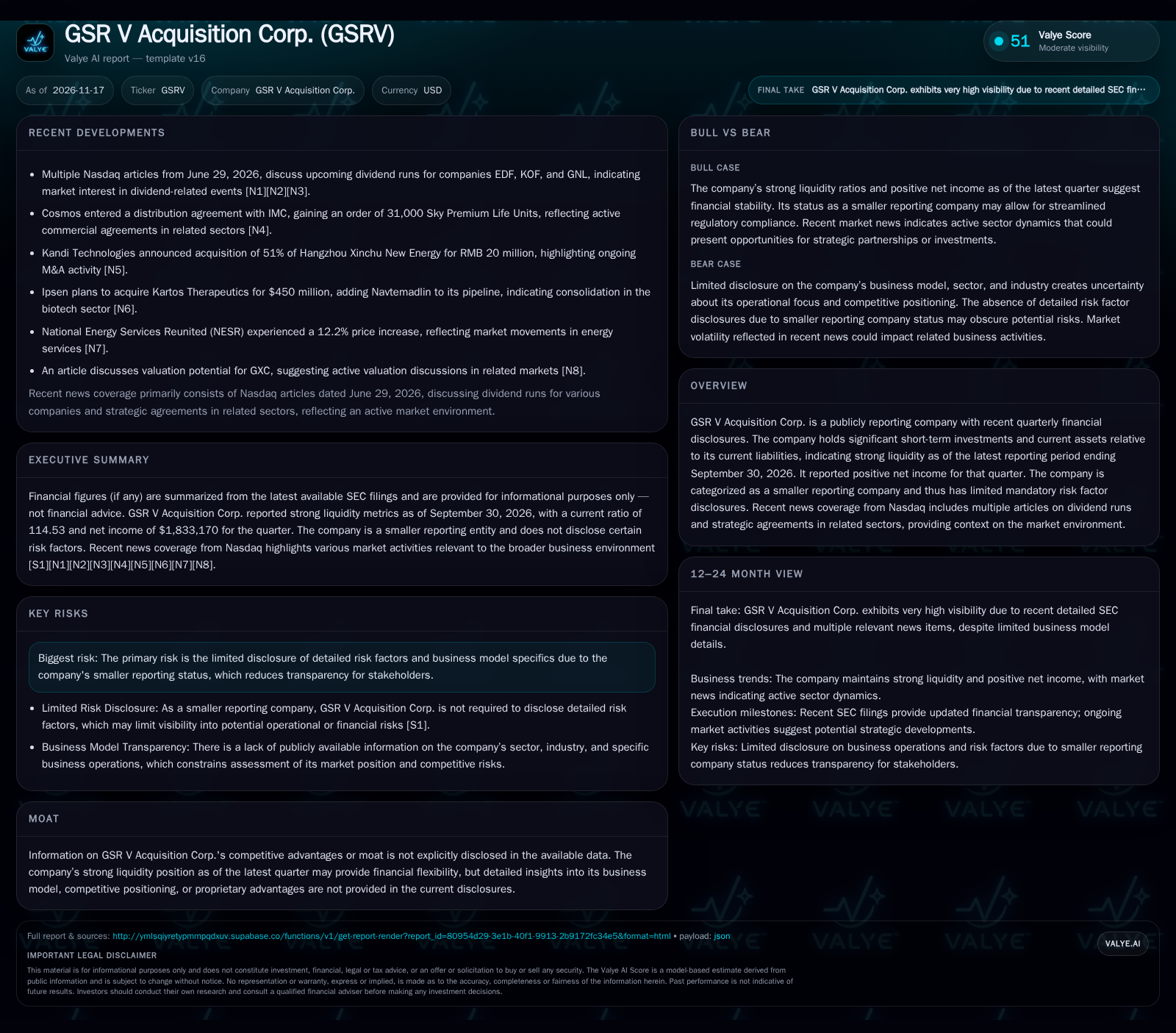
GSR V Acquisition Corp. is a blank check company that raised $230 million in its May 2026 IPO and has not yet completed a business combination.Its reported current ratio and net income are byproducts of trust-account interest, not operating activities. The company’s value proposition and risk profile will shift dramatically upon target announcement and deal execution, with current financial strength offering flexibility but not guaranteeing success or downside protection. [S1]
GSR V Acquisition Corp. exemplifies the high-stakes, high-uncertainty model of the post-IPO special purpose acquisition company (SPAC). Having raised $230 million in May 2026 and still pre-combination as of September 30, its only business activity to date is managing the IPO proceeds in a trust account. The company's financials show high liquidity and positive net income, but these are artifacts of its capital structure and interest income, not of underlying commercial operations. The entire thesis pivots on the company's ability to identify, negotiate, and close a business combination before capital redemption or SPAC sunset—making the next deal announcement the defining moment for investors and stakeholders. [S1]
IPO Proceeds, Trust Account, and the Pre-Combination Phase
GSR V Acquisition Corp. is a blank check company, incorporated in July 2025 and listed via a $230 million IPO in May 2026. As of September 30, 2026, it had not commenced any business operations or generated operating revenue. All reported net income—$1.83 million for the quarter—derives from interest income on IPO and private placement proceeds held in a trust account. Its balance sheet is highly liquid, with $1,474,561 in current assets and minimal current liabilities of $12,875, resulting in a current ratio of 114.53 and a cash ratio of 78.35. The company is classified as a smaller reporting company, exempting it from certain detailed risk disclosures. These facts underscore that the company's current state is purely preparatory, with no operational track record and no revenue-generating assets beyond its cash and short-term investments. [S1]
SPAC Economics: How Value Is (or Isn’t) Created Before and After a Deal
In the current phase, GSR V’s economics are entirely financial: it earns non-operating interest on trust-account assets, offset by minimal overhead. The core business model is to identify and merge with, or acquire, one or more operating businesses (the 'business combination'), typically within 18-24 months of IPO. Until a deal is closed, there is no operating leverage, revenue, or cost structure to analyze. The company’s capital is largely locked in the trust account, with withdrawals restricted to permitted expenses or redemptions.
Upon closing a business combination, the economics shift dramatically. The merged entity inherits the acquired company’s revenue model, cost base, and capital needs. If GSR V secures a high-quality, scalable target at a reasonable valuation, the combined company could benefit from public-market access, acquisition currency, and potential operating leverage. Conversely, overpaying for a weak or unproven target could destroy shareholder value. The SPAC structure also creates a ticking clock: failure to complete a deal by the deadline typically results in liquidation and return of trust funds to public shareholders, leaving only sponsors and deal advisors exposed to sunk costs.
SPAC Market Dynamics: Competition for Targets and Sponsor Differentiation
GSR V operates in an intensely competitive SPAC market, where dozens of blank check companies vie for a finite pool of attractive targets. The primary competitors are other SPACs of similar size and mandate, along with private equity and strategic buyers. Differentiation can come from sponsor reputation, sector expertise, deal-sourcing networks, and willingness to offer favorable terms or post-close support.
However, GSR V’s public filings do not disclose sponsor pedigree, sector focus, or target criteria—information that could materially affect its ability to outcompete peers for premium assets. In the absence of a clear value proposition or proprietary sourcing advantage, the company may be forced to pursue less competitive, potentially lower-quality targets. The risk of adverse selection is heightened by the time-limited nature of the SPAC structure, especially as deadlines approach and the market for high-quality targets becomes more crowded or expensive.
Value Creation If GSR V Secures a High-Quality, Scalable Target
The most favorable outcome for GSR V is the successful identification and acquisition of a high-growth, scalable business at a reasonable valuation. This would allow for the rapid deployment of trust capital into commercial operations with significant upside potential. Public listing could provide the target with capital for expansion, brand visibility, and access to additional strategic partners or follow-on financing.
Confirmation of this scenario would require timely announcement of a business combination with credible financials, strong growth prospects, and clear strategic rationale. Further evidence would include positive market reaction, low redemption rates, and institutional investor support for the deal. Falsification would come from delays, red-flagged targets, or high redemption rates that undermine post-merger capitalization.
What Likely Happens: A Standard SPAC Deal with Execution and Market Risks
The most plausible path is that GSR V will announce a business combination within the typical SPAC window, targeting an operating company seeking public-market access. The deal is likely to be in a competitive sector, with average or modest growth prospects, and may face significant redemptions depending on prevailing market sentiment and deal quality.
This scenario would be confirmed by the filing of a merger agreement, proxy materials outlining the target’s business and financials, and subsequent shareholder vote. Key variables will include redemption rates, PIPE (private investment in public equity) participation, and whether the combined entity meets ongoing listing and business performance requirements. Falsification would be triggered by prolonged delays, failure to secure a credible target, or an inability to close a deal before the SPAC’s deadline.
Adverse Outcomes: Failure to Close a Deal or Value Destruction on Merger
The primary downside is that GSR V fails to identify or close a business combination before the statutory deadline, forcing liquidation and return of trust funds to public holders—resulting in loss of sponsor capital and opportunity cost. A secondary risk is the acquisition of a poor-quality or overvalued target, leading to post-merger value destruction, high redemption rates, and potential delisting due to failure to meet minimum listing standards.
Warning signs would include repeated deadline extensions, lack of credible deal announcements, or market skepticism reflected in high redemptions and low post-merger trading volume. Falsification of the downside scenario would require timely completion of a deal with sustained post-close investor support and operational traction.
Milestones That Will Determine GSR V’s Real Value Proposition
Announcement of a definitive business combination agreement, including target financials, sector, and strategic rationale.
Shareholder redemption rate at the time of merger approval—a low redemption rate would indicate investor confidence; a high rate would signal skepticism or poor target fit.
PIPE financing participation and terms, if disclosed, which would demonstrate institutional support and help backstop redemptions.
Timeliness of deal execution relative to SPAC deadline; multiple extensions could signal difficulty sourcing quality targets.
Post-merger trading performance and ability to meet ongoing listing requirements.
Disclosure of sponsor background, sector focus, or proprietary sourcing advantages, if made available, would help test the thesis.
Material changes in trust-account value or unusual withdrawals, which could indicate off-cycle expenses or deal structuring.
Disclaimer: This is research-only, informational analysis and not investment advice. It may include AI-generated interpretation and general industry context. Always verify important details using primary sources.

Comments