
Collective Acquisition Corp. II: SPAC Readiness, Execution Risk, and the Road to a Business Combination
Collective Acquisition Corp.
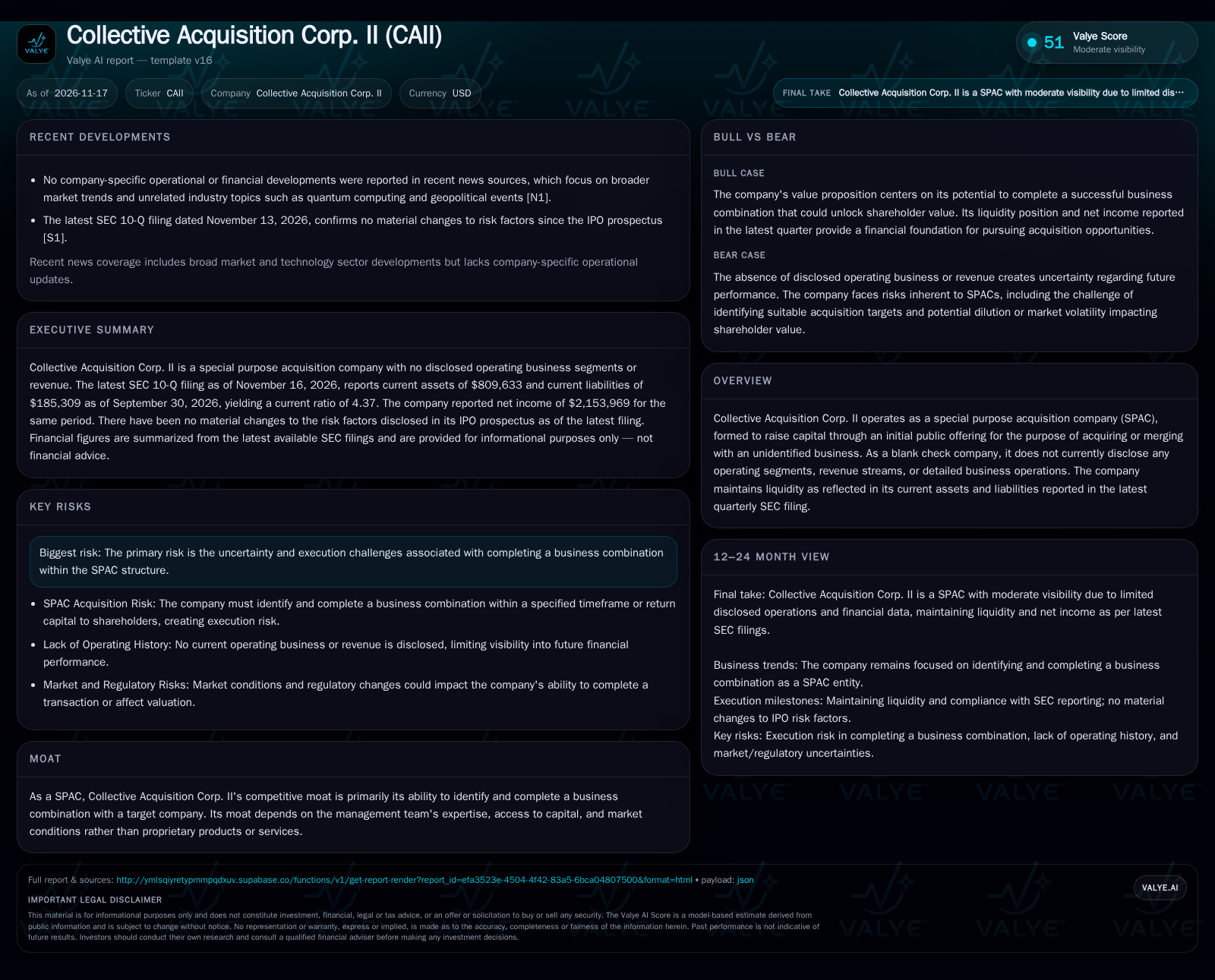
Collective Acquisition Corp. II maintains reported liquidity position (current ratio 4.37) and net income from trust interest, but with no operating business, its future hinges on executing a successful acquisition before the SPAC window closes. The company’s prospects depend on the management team’s ability to source, negotiate, and close a value-accretive deal in a competitive and time-sensitive SPAC market environment. [S1]
Collective Acquisition Corp. II sits at the classic SPAC crossroads: flush with liquidity, benefiting from interest income, but with no operating business or disclosed revenue streams. Its net income for the latest quarter is entirely the result of interest earned on trust assets, highlighting the pre-combination phase in which the company currently operates. The core challenge now is the identification and execution of a business combination before its SPAC window closes—a process fraught with competitive, regulatory, and market risks that will determine whether the company’s cash will ultimately be put to productive use or returned to shareholders. [S1]
Liquidity and Net Income Signal a Classic Pre-Combination SPAC Profile
As of September 30, 2026, Collective Acquisition Corp. II reported current assets of $809,633 and current liabilities of $185,309, resulting in a current ratio of 4.37. This reported current ratio is typical for a SPAC in its pre-combination phase, designed to preserve liquidity for a potential transaction. Notably, the company reported net income of $2,153,969 for the quarter, which is attributable to interest income on marketable securities held in its trust account rather than from any operating activities. There is no disclosed revenue or operating business as of the latest filing, underscoring the company’s status as a blank check entity with all future value dependent on the successful execution of a business combination. [S1]
How SPACs Like CAII Create (or Lose) Value: Funding, Income Streams, and Dilution Dynamics
The economics of Collective Acquisition Corp. II are fundamentally tied to the SPAC model. Initial capital is raised from public investors in exchange for units (typically shares and warrants), with the proceeds placed in a trust account. Until a business combination is completed, the only source of income is interest earned on the trust assets. Operating expenses—primarily legal, compliance, and diligence costs—are paid from a smaller pool of working capital outside the trust.
There is no recurring revenue or operating margin until a target is acquired. The company’s net income is not sustainable or indicative of future performance, as it is entirely dependent on prevailing interest rates and the size of the trust. Once a merger is completed, the economics shift dramatically: the combined entity may have operating revenues and costs, but the transaction often triggers significant dilution for public shareholders via redemptions and the exercise of sponsor warrants. The capital structure post-combination is sensitive to redemption rates, PIPE financing terms (if any), and the valuation at which the deal is struck.
Capital needs are modest until a deal is executed, but after a merger, the entity may require additional funding for growth, integration, or working capital, depending on the target’s profile. Operating leverage and margin potential are entirely a function of the post-merger business, which is currently unidentified.
SPAC Success Hinges on Management’s Sourcing Edge and Market Timing
Collective Acquisition Corp. II’s competitive position is defined not by products or services but by its ability to source and close an attractive deal ahead of other SPACs. The market is crowded, with dozens of blank check companies competing for a finite pool of viable targets, especially after a multi-year SPAC boom that has left many companies chasing similar acquisition candidates.
Advantages may stem from the management team’s network, deal-making experience, and sector focus—though these are not disclosed in detail in the current filings. Counterforces include rising regulatory scrutiny, increased shareholder redemptions, and target companies’ growing leverage in deal negotiations. The threat of substitutes is high: private equity, direct listings, and traditional IPOs all compete for the same targets.
Ultimately, any competitive edge is transient unless converted into a completed transaction that creates value for public shareholders. Without a transaction, the company offers no moat and will simply liquidate, returning capital.
A Well-Executed Acquisition Could Unlock Shareholder Value—If the Right Target Emerges
The favorable outcome for Collective Acquisition Corp. II involves the identification and completion of a business combination with a high-quality target, ideally in a sector with secular growth or differentiated economics. If the management team leverages its network to secure an attractive business at a reasonable valuation and manages to minimize public shareholder redemptions, the merged entity may benefit from immediate market interest and post-combination momentum.
Confirmation of this scenario would come from a definitive merger announcement with a credible, growth-oriented business, limited shareholder redemptions at the vote, and the ability to raise PIPE or follow-on capital on favorable terms. Falsification would include failure to announce a deal before the deadline, or a transaction with a distressed or low-growth target that fails to garner investor support.
Most Likely Outcome: Execution Pressure Builds as Completion Window Narrows
The most plausible path is that Collective Acquisition Corp. II continues its search for a target, incurring ongoing administrative and due diligence costs while generating modest interest income. As the SPAC’s completion window narrows, pressure mounts to announce a deal. This dynamic often leads to challenging negotiations, and the risk is that the company may be forced to accept a less attractive transaction or face high redemption rates, eroding the capital base available for the merger.
Evidence supporting this scenario would include continued absence of a deal announcement, increased disclosures around target sectors or diligence activities, and rising administrative expenses relative to interest income. Conversely, a sudden definitive agreement with clear market enthusiasm would suggest the company has escaped the typical end-of-window scramble.
Failure to Execute a Business Combination Triggers Liquidation and Capital Return
The primary risk facing Collective Acquisition Corp. II is the failure to identify and consummate a business combination within the allotted timeframe. In this scenario, the SPAC would be forced to liquidate, returning trust capital to shareholders minus any allowable expenses. This outcome is value-neutral for most public shareholders, but can destroy value for sponsors and warrant holders, and may result in opportunity cost for investors who had capital locked up during the SPAC’s life.
Confirmation of this downside would be a lack of material deal progress as deadlines approach, or regulatory, market, or shareholder obstacles preventing completion of a proposed transaction. High redemption rates or inability to secure PIPE funding in a proposed deal are further red flags.
What Could Move the Needle for Collective Acquisition Corp. II’s SPAC Trajectory
Announcement of a definitive business combination agreement, including target sector, valuation, and structure.
Shareholder redemption rates at the time of merger vote, if disclosed, as a proxy for investor confidence.
PIPE (private investment in public equity) financing commitments or alternative capital sources to backstop redemptions.
Changes in regulatory environment or SEC guidance impacting SPAC merger mechanics.
Disclosure of management’s sector focus or acquisition criteria, if provided in future filings.
Administrative expenses as a percentage of remaining interest income, which may signal urgency or cost discipline.
Market sentiment toward SPAC transactions and de-SPACed companies in the relevant period.
Disclaimer: This is research-only, informational analysis and not investment advice. It may include AI-generated interpretation and general industry context. Always verify important details using primary sources.

Comments