
Scienture Holdings: Commercial Pipeline Execution Meets Financial Strain in Specialty Pharma
Scienture Holdings is pursuing growth through the commercialization of Arbli and REZENOPY, targeting hypertension and opioid overdose markets, while balancing patent-driven differentiation against persistent operating losses and tight liquidity. The company’s trajectory will hinge on its ability to translate recent product launches and distribution gains into sustainable revenue amid ongoing capital needs and execution risk.
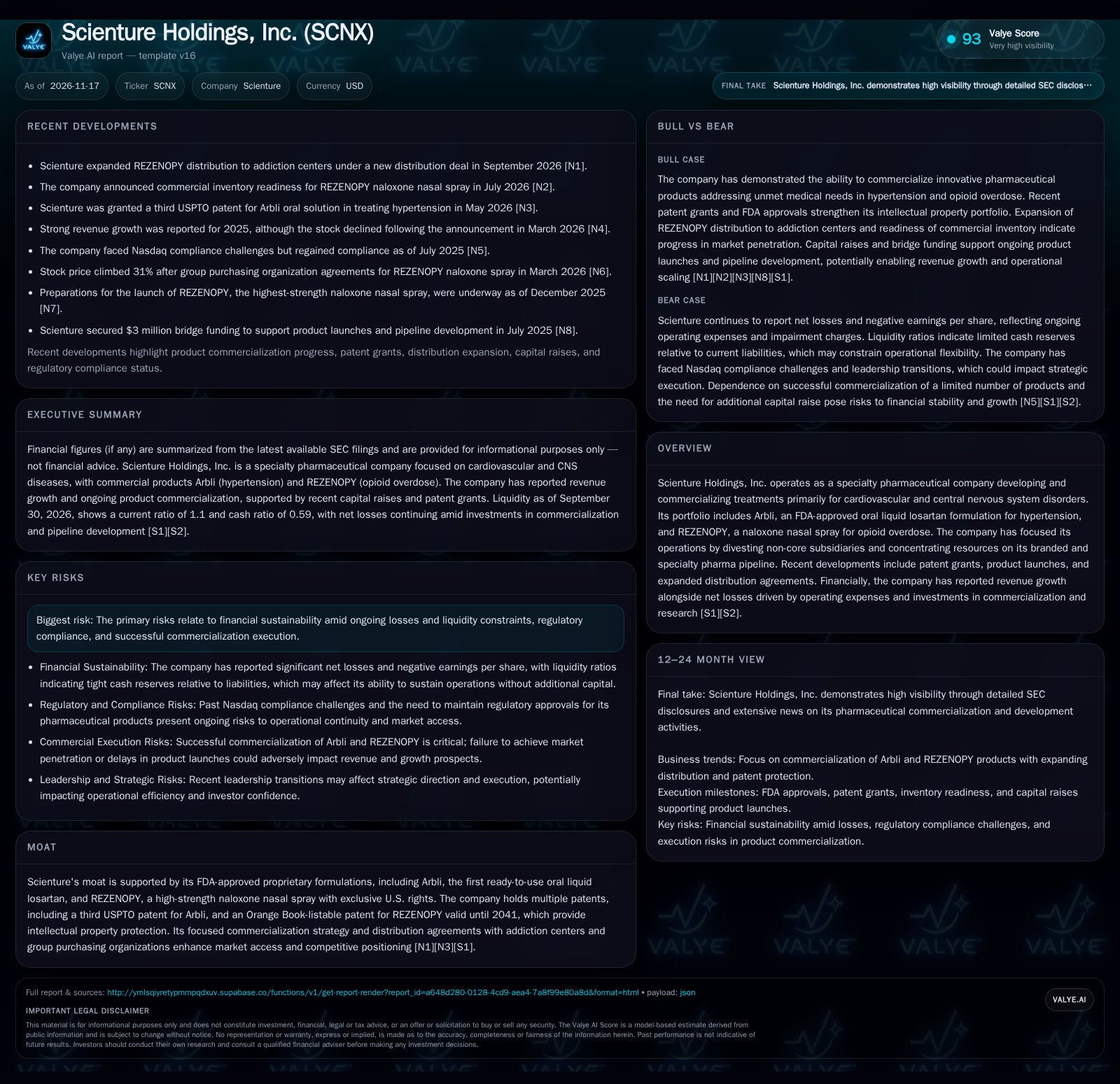
Scienture Holdings is focused on commercializing FDA-approved therapies for hypertension and opioid overdose, with recent distribution expansion and patent grants. The company’s near-term performance will depend on converting its specialty pharma launches and patent protection into meaningful market share and operating leverage, all while managing capital constraints and regulatory compliance [S1] [S2] [N1] [N2] [N3].
Scienture Holdings, Inc. stands at a pivotal point in its evolution as a specialty pharmaceutical company. With the commercial launches of Arbli for hypertension and REZENOPY for opioid overdose, the company is transitioning from development to market-facing operations, leveraging its patent portfolio for competitive differentiation. However, persistent operating losses, modest early revenue from product sales, and tight liquidity underscore the precariousness of this transition. The central question is whether Scienture can achieve sufficient commercial traction and scale to offset ongoing costs, or if capital constraints and execution risks will force another strategic pivot or financing round in the coming year [S1] [S2] [N1] [N2].
Recent Product Launches and Financial Pressure Shape Scienture’s Immediate Outlook
The most material recent facts for Scienture Holdings are the commercial launches and distribution gains for its two lead products: Arbli, an FDA-approved oral liquid losartan for hypertension, and REZENOPY, a high-strength naloxone nasal spray for opioid overdose. In September 2026, REZENOPY expanded distribution to addiction centers under a new agreement, following commercial inventory readiness in July 2026 [N1] [N2]. The company also secured a third USPTO patent for Arbli in May 2026, reinforcing its intellectual property position [N3].
Despite these advances, the company reported revenue of $1.25 million and a net loss of $6.0 million for the first nine months of 2026. The company reported cash and liquidity metrics for the period; these figures do not by themselves establish operating runway, investment capacity, financial flexibility, or financing capacity. [S2] These facts highlight a critical tension: while Scienture is making progress on commercialization and IP protection, the pace of revenue growth has not matched operating expenses, raising questions about the sufficiency of its capital base and the speed of market adoption.
How Commercialization and Pipeline Investment Drive Scienture’s Cost Structure
Scienture’s business model is typical of specialty pharma: significant upfront investment in product development, regulatory approval, and initial commercialization, followed by a period in which scale and recurring sales are needed to achieve profitability. Revenue comes from the sale of proprietary pharmaceutical products, with pricing power and gross margins heavily influenced by patent protection, product differentiation, and reimbursement dynamics.
For Arbli and REZENOPY, revenue growth will depend on physician adoption, formulary access, and penetration into target markets such as hypertension clinics and addiction centers. The company’s recent patent grants could enable premium pricing and market exclusivity, but actual realized margins will be shaped by manufacturing costs, distribution agreements, and potential rebates or discounts required to drive uptake.
Operating leverage is possible as commercial volumes grow—fixed costs related to R&D and regulatory compliance could be spread over a larger revenue base. However, with only $1.25 million in revenue against $6.0 million in net losses for the first nine months of 2026, the current scale is insufficient to cover operating expenses [S2]. The company’s capital needs remain acute: it has relied on equity offerings and bridge funding to finance product launches and pipeline development, suggesting ongoing dilution risk if commercial traction does not accelerate [N8] [S1].
Intellectual Property and Niche Focus Provide a Moat—But Only If Market Penetration Follows
Scienture’s competitive position is anchored in its intellectual property portfolio. The company holds multiple patents for Arbli—including a third USPTO patent granted in 2026—and an Orange Book-listable patent for REZENOPY valid until 2041 [N3] [S1]. This IP could provide several years of market exclusivity, especially valuable in the generic-prone cardiovascular and CNS drug spaces.
However, the moat is not absolute. In hypertension, losartan is a well-established molecule with multiple generic competitors; Scienture’s advantage rests on its ready-to-use oral liquid formulation, which may appeal to patient subgroups (e.g., pediatric, geriatric, or those with swallowing difficulties) underserved by standard tablets. In opioid overdose reversal, the high-strength naloxone nasal spray (REZENOPY) targets a market with entrenched branded and generic alternatives. Success will depend on demonstrating clinical or logistical advantages and securing placement in hospital, EMS, and community settings.
Distribution agreements with addiction centers and group purchasing organizations expand access, but the true test will be sustained volume growth and formulary wins. Without recurring customer adoption, the IP moat risks being underutilized.
Rapid Uptake of REZENOPY and Arbli Could Unlock Operating Leverage and Fund Pipeline Growth
A favorable scenario for Scienture would see REZENOPY and Arbli gain rapid traction in their target markets, driven by effective distribution partnerships, robust formulary access, and growing clinical acceptance. For REZENOPY, expanded adoption by addiction centers, EMS, and public health agencies could translate into recurring institutional orders, leveraging its high-strength profile and exclusive U.S. rights. For Arbli, differentiated positioning as the first oral liquid losartan could open doors in specialty clinics and pediatric or geriatric care settings.
This scenario would be confirmed by a sharp increase in quarterly revenue, a reduction in net losses or a move toward break-even, and announcements of additional distribution or formulary agreements. Evidence of repeat orders, broader coverage by payers, and pipeline progress funded by internal cash flow would further support the bull case. If these dynamics play out, Scienture could achieve operating leverage, improve its negotiating position for future partnerships, and reduce reliance on dilutive external capital.
Incremental Market Penetration Amid Ongoing Losses and Capital Needs
The most probable near-term outcome for Scienture is one of steady but modest revenue growth from Arbli and REZENOPY, with commercial progress offset by continued operating losses. While distribution agreements and patent protection provide a foundation, market penetration may prove gradual, as physician awareness, payer reimbursement, and institutional adoption often take time to build in specialty pharma.
This scenario would be confirmed by slow but sequential revenue increases, persistent (but narrowing) net losses, and periodic capital raises to extend runway. The company may need to demonstrate durable demand through repeat orders, while also advancing pipeline assets to diversify beyond its two lead products. A useful metric would be the proportion of revenue from recurring institutional contracts versus one-time sales, if disclosed. If Scienture can maintain regulatory compliance and avoid major execution missteps, it could gradually improve its financial position, but the risk of dilution and heightened sensitivity to any commercial setbacks would remain.
Liquidity Constraints and Slow Commercial Ramp Force Strategic Retrenchment
In a negative scenario, market uptake for REZENOPY and Arbli falls short of expectations, either due to entrenched competition, slower-than-anticipated adoption by target institutions, or reimbursement headwinds. With revenue growth insufficient to offset operating expenses, cash burn accelerates and the company is forced to seek additional financing under unfavorable terms—or faces the prospect of asset sales or pipeline delays.
This outcome would be confirmed by flat or declining sales, widening net losses, or disclosures of urgent capital needs. A slip back into Nasdaq compliance issues or further leadership turnover could also signal operational stress. If the company is unable to secure bridge funding or strategic partnerships, it may be forced to curtail R&D or commercialization efforts, undermining the value of its patent portfolio and diminishing investor confidence.
Milestones That Will Clarify Scienture’s Ability to Scale and Sustain Operations
Quarterly revenue growth from Arbli and REZENOPY, with a focus on sequential acceleration and the mix of institutional versus retail sales (if disclosed).
Gross margin trends as a signal of pricing power and manufacturing efficiency as product volumes increase.
Rate of repeat orders from addiction centers, hospitals, and group purchasing organizations, which would indicate sustainable product demand.
Disclosure of new or expanded formulary placements, particularly for REZENOPY in public health and EMS settings.
Updates on pipeline progress, including clinical milestones, regulatory submissions, or out-licensing deals that could diversify revenue sources.
Details of future capital raises, bridge funding, or strategic partnerships, and their terms relative to dilution and balance-sheet impact.
Regulatory compliance status, including ongoing Nasdaq listing requirements and any new FDA or patent developments.
Leadership stability and strategic hires, given recent turnover and the need for experienced commercial execution.
Disclaimer: This is research-only, informational analysis and not investment advice. It may include AI-generated interpretation and general industry context. Always verify important details using primary sources.

Comments